Addressing the Widening Generation Gap in Digital Society
Source:The Hindu ↗
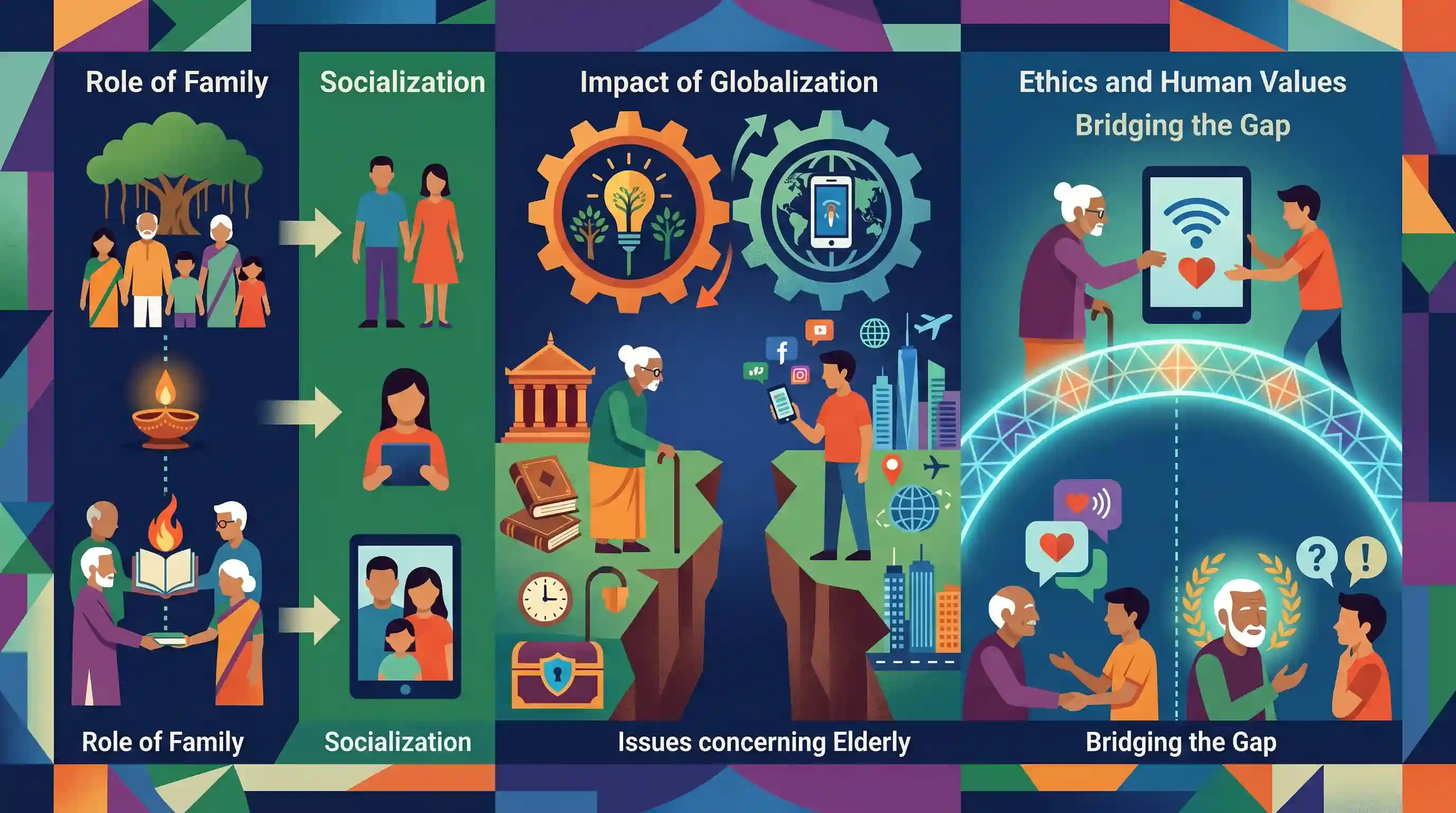
Why It Matters
This topic is fundamentally important for GS-1 (Indian Society) and GS-4 (Role of family/society in inculcating values). It explores the sociological and ethical implications of technological and cultural shifts on family structures, making it highly relevant for questions on globalization, the elderly, and cultural assimilation.
Summary
The article highlights the growing generation gap fueled by rapid technological advancements, globalization, and shifting societal norms. It examines the ideological and cultural dissonance between the traditional values held by older generations and the modern, digital-first worldview of the youth. The shift from joint to nuclear families further exacerbates this divide, impacting the socialization of children and the social security of the elderly. To bridge the gap, the piece advocates for mutual empathy, open communication, digital inclusion for the aged, and an appreciation of experiential wisdom among the youth.
Key Points
- The generation gap has widened significantly in recent times, primarily driven by rapid technological advancements and internet expansion.
- The transition from traditional joint families to nuclear family structures has reduced intergenerational interactions, fundamentally altering the socialization process.
- Older generations often face challenges in adapting to the digital age, whereas the youth, shaped by a digital-first worldview, may lack a strong connection to traditional cultural values.
- Fostering empathy, active listening, and open intergenerational dialogue is essential to bridge this growing disconnect.
- Harmonizing the experiential wisdom of the elderly with the innovative, modern mindset of the younger generation is vital for building a cohesive and resilient society.
Prelims Trap
Globalization has completely replaced the joint family system with nuclear families across India.
UPSC exploits extreme words like 'completely'. India actually exhibits a 'modified joint family' system where members live in nuclear setups but maintain strong functional ties.
Static Concepts Connected
What are the key socio-economic implications of India's ageing population?
- Care Economy: Surging demand for geriatric healthcare, specialized housing, and social security pensions amidst traditional family breakdowns.
- Feminization of Ageing: Women generally outlive men, leading to a higher proportion of vulnerable, financially dependent elderly widows.
- Rising Dependency Ratio: A future shrinking working-age demographic will increasingly bear the financial burden of supporting the elderly.
How has globalization impacted the traditional Indian family structure?
- Structural Shift: Urban migration for modern employment fragments traditional joint households into smaller, urban nuclear units.
- Rise of Individualism: Western cultural influence prioritizes personal autonomy, privacy, and consumerism over collective family obligations.
- Modified Joint Family: Despite physical separation, families retain deep functional ties through digital communication, remittances, and ritual gatherings.
Cross-Topic Patterns
Digital Governance vs. Elderly Exclusion
The push for e-governance and Aadhaar-based DBT inadvertently marginalizes digitally illiterate seniors, bridging GS1 (Society) with GS2 (Governance/Vulnerable Groups).
Ethics of Digital Socialization
Digital devices replacing primary socialization (e.g., grandparent storytelling) ties directly into GS4: the role of family in inculcating foundational human values.

Expect a GS1 Mains question linking India's transition to an ageing society (~20% by 2050) with the crisis in the care economy.
Linked PYQs · 5
Linked PYQs · 5
- 2023MainsGS1
Child cuddling is now being replaced by mobile phones. Discuss its impact on the socialization of children.
- 2020MainsGS4
‘The current internet expansion has instilled a different set of cultural values which are often in conflict with traditional values.’ Discuss.
- 2014MainsGS1
The life cycle of a joint family depends on economic factors rather than social values. Discuss.
- 2013MainsGS1
Critically examine the effect of globalization on the aged population in India.
- 2016MainsGS4
Our attitudes towards life, work, other people and society are generally shaped unconsciously by the family and the social surroundings in which we grow up. Some of these unconsciously acquired attitudes and values are often undesirable in the citizens of a modern democratic and egalitarian society. How can such undesirable attitudes be changed and socio-ethical values considered necessary in public services be cultivated in the aspiring and serving civil servants ?
