Infrastructure Failures Highlight Maintenance Deficits in Bridges
Source:Indian Express ↗
Why It Matters
Recurring bridge collapses directly impact GS3 (Infrastructure and Disaster Management) and GS2 (Accountability in Governance). It highlights the critical gap between rapid infrastructure creation and the maintenance of aging assets, a key challenge in India's developmental trajectory.
Summary
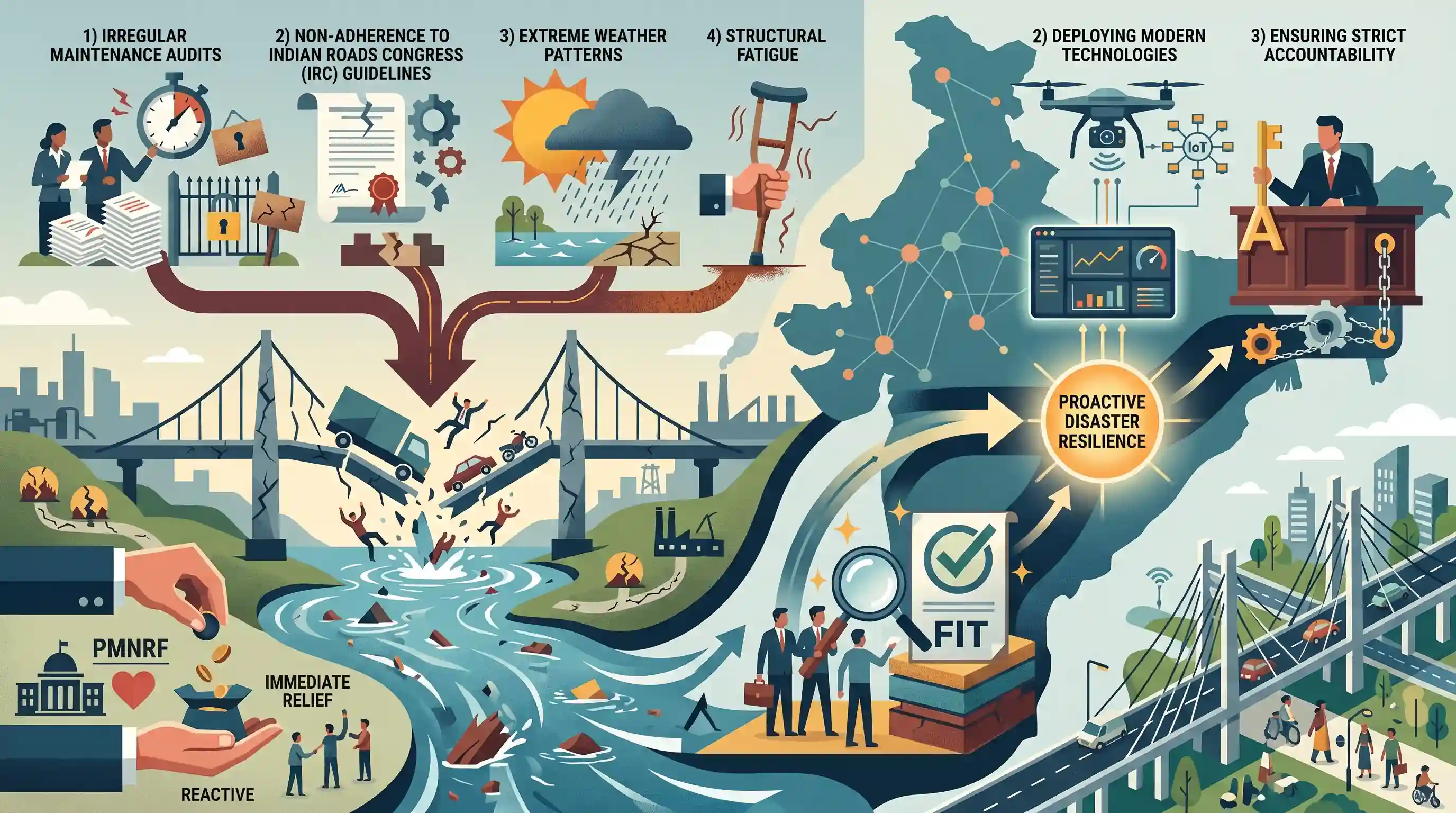
The collapse of a 43-year-old bridge over the Mahisagar river in Gujarat, resulting in 11 fatalities, underscores critical flaws in India's infrastructure management. Along with recent collapses in Pune and Ahmedabad, these tragedies point to a systemic failure in monitoring aging infrastructure. Contributing factors include irregular maintenance audits, non-adherence to Indian Roads Congress (IRC) guidelines, extreme weather patterns, and structural fatigue. While the government provided immediate relief through the PMNRF, the recurring nature of these incidents demands a shift from reactive compensation to proactive disaster resilience. This involves comprehensive safety audits, deploying modern technologies like IoT sensors and drones for real-time monitoring, and ensuring strict accountability in public works execution.
Key Points
- A 43-year-old bridge over the Mahisagar river collapsed in Gambhira, Gujarat, claiming 11 lives, highlighting the vulnerability of aging public infrastructure in India.
- Ex gratia compensation of Rs 2 lakh for the deceased and Rs 50,000 for the injured was announced from the Prime Minister's National Relief Fund (PMNRF).
- Two other significant bridge-related incidents occurred recently: the collapse of the Kundamala suspension bridge over the Indrayani river in Pune and a gantry collapse on the bullet train corridor in Ahmedabad.
- Key factors contributing to such failures include aging infrastructure, lack of regular maintenance/auditing, non-compliance with structural standards, extreme weather, and vehicle overloading.
- The incidents emphasize the urgent need for comprehensive national infrastructure audits, adoption of modern monitoring technologies like drones and sensors, and stricter enforcement of structural safety regulations.
Important Terms
Indian Roads Congress (IRC)

A premier technical body of highway engineers established in 1934 to set standardized codes and guidelines for the design, construction, and maintenance of roads and bridges in India.
UPSC context
GS Paper 3: Infrastructure; essential for questions on road safety, engineering standards, and the Jayakar Committee recommendations.
Prime Minister's National Relief Fund (PMNRF)
A trust fund established in 1948, chaired by the Prime Minister, and funded entirely by voluntary public donations to provide immediate relief for disaster victims and major accidents.
UPSC context
GS Paper 2: Governance/Disaster Management; tests knowledge of executive-led relief mechanisms and its non-statutory nature.
Disaster Resilient Infrastructure (DRI)
Infrastructure designed and managed to withstand, respond to, and recover rapidly from natural or man-made disasters, ensuring the continuity of essential services and reducing economic loss.
UPSC context
GS Paper 3: Disaster Management; vital for discussing the shift from reactive relief to proactive structural mitigation.
Coalition for Disaster Resilient Infrastructure (CDRI)
An Indian-led global partnership launched in 2019 to promote the resilience of new and existing infrastructure systems to climate and disaster risks.
UPSC context
GS Paper 2 & 3: International Relations/Environment; key for India’s global leadership in climate action and disaster risk reduction.
National Disaster Management Authority (NDMA)
The apex statutory body in India, chaired by the Prime Minister, responsible for laying down policies, plans, and guidelines for disaster management to ensure a timely and effective response.
UPSC context
GS Paper 3: Disaster Management; the primary body for implementing the Disaster Management Act, 2005.
Safety Audit
A systematic, evidence-based process of inspecting and evaluating infrastructure to identify potential structural hazards and ensure compliance with safety standards and maintenance protocols.
UPSC context
GS Paper 3: Infrastructure/Governance; tests understanding of administrative accountability and preventive maintenance in public works.
Prelims Trap
"PMNRF receives an annual budgetary allocation from the Consolidated Fund of India and is audited by the CAG."
PMNRF operates entirely on voluntary public contributions with zero parliamentary budgetary allocation. Furthermore, it is audited by an independent chartered accountant, not the CAG.
Static Concepts Connected
What are the key geographical characteristics of the Mahi River?
- Origin: It originates in the western Vindhya Range, just south of Sardarpur in Madhya Pradesh.
- Tropic of Cancer: It is uniquely the only river in India that cuts across the Tropic of Cancer twice.
- Discharge: It flows through Madhya Pradesh, Rajasthan, and Gujarat before emptying into the Gulf of Khambhat in the Arabian Sea.
How does the PMNRF differ from the National Disaster Response Fund (NDRF)?
- Statutory backing: NDRF is a statutory fund established under the Disaster Management Act, 2005. PMNRF was established by Jawaharlal Nehru and has no statutory backing.
- Funding source: NDRF is funded by a disaster management cess and budgetary allocations. PMNRF relies solely on voluntary public contributions.
- Audit mechanism: NDRF is audited by the Comptroller and Auditor General (CAG) of India. PMNRF is audited by an independent auditor.
Cross-Topic Patterns
Sendai Framework + Climate Resilience
Extreme weather accelerates structural fatigue in aging public infrastructure, making Sendai Framework Priority 3 (investing in disaster resilience) a vital link between climate change and urban governance.
Tech-enabled Governance & Accountability
Shifting from reactive compensation to predictive maintenance utilizing IoT sensors, drones, and GIS ties directly into GS-2 themes of e-governance applications and administrative accountability.

Expect a multi-statement Prelims question comparing PMNRF/PM-CARES/NDRF funding sources, or a map question on the Mahi River.
Linked PYQs · 3
Linked PYQs · 3
- 2023MainsGS3
Dam failures are always catastrophic, especially on the downstream side, resulting in a colossal loss of life and property. Analyze the various causes of dam failures. Give two examples of large dam failures.
- 2024MainsGS3
What is disaster resilience? How is it determined? Describe various elements of a resilience framework. Also mention the global targets of Sendai Framework for Disaster Risk Reduction (2015–2030).
- 2025MainsGS2
"In contemporary development models, decision-making and problem-solving responsibilities are not located close to the source of information and execution defeating the objectives of development." Critically evaluate.
