BRICS Youth Ministers Meeting: Visakhapatnam Declaration Adopted
Source:kashmir-horizon ↗
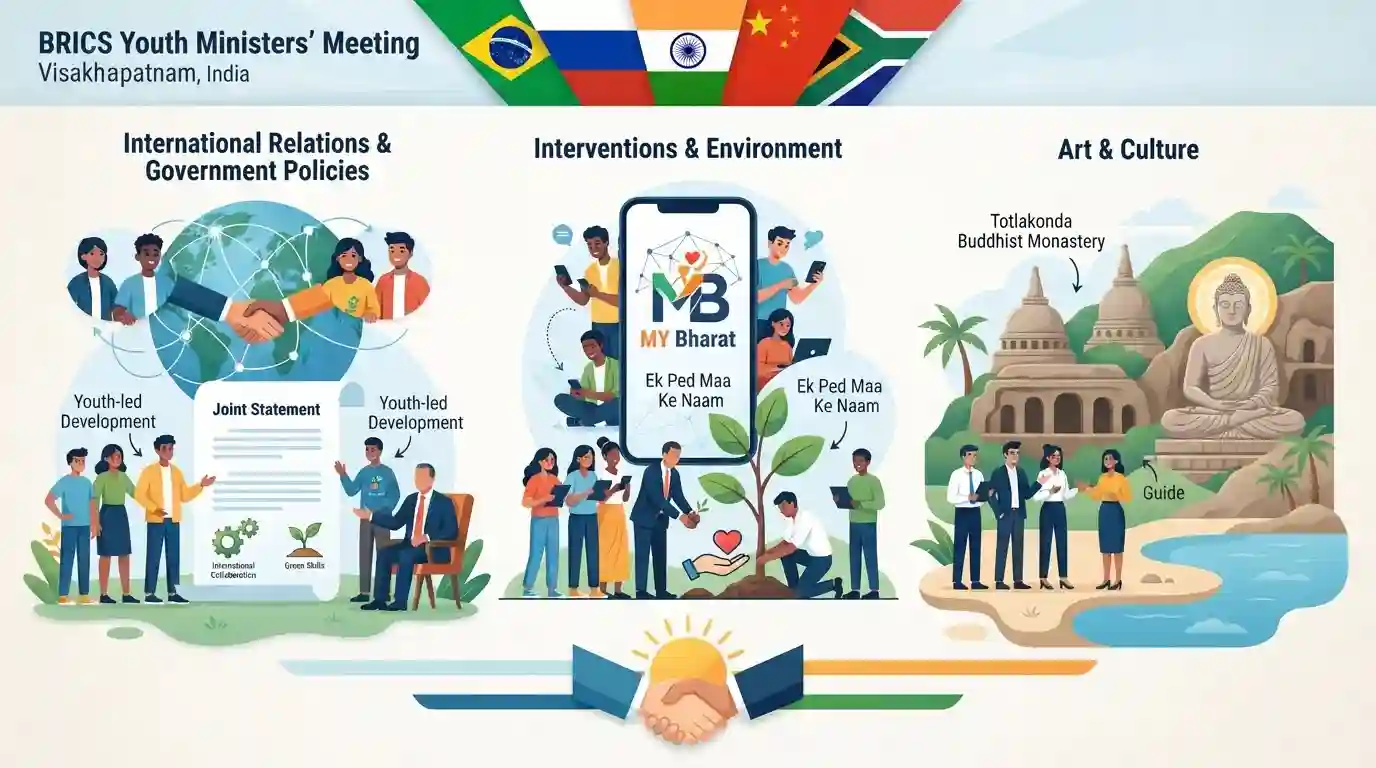
Why It Matters
BRICS summits and their specific declarations are frequently tested in APPSC Prelims as key International Relations topics. Furthermore, the mention of the Totlakonda Buddhist Monastery integrates critical regional Art & Culture knowledge specific to Andhra Pradesh, while schemes like MY Bharat and 'Ek Ped Maa Ke Naam' demonstrate significant national policy interventions.
Summary
The BRICS Youth Ministers' Meeting concluded in Visakhapatnam, adopting a Joint Statement centered on youth-led development, international collaboration, and green skills. Chaired by Union Minister Dr. Mansukh Mandaviya, the summit highlighted the MY Bharat platform's success in mobilizing youth and promoted environmental awareness through the 'Ek Ped Maa Ke Naam' plantation drive. Delegates also explored Andhra Pradesh's cultural heritage with a visit to the historic Totlakonda Buddhist Monastery.
Key Points
- A Joint Statement focusing on youth empowerment, education, and sports was adopted at the BRICS Youth Ministers' Meeting in Visakhapatnam.
- The MY Bharat platform was showcased for successfully registering over 25 million youths to drive youth-led development in India.
- Delegates participated in the 'Ek Ped Maa Ke Naam' plantation campaign, reinforcing the importance of youth in environmental sustainability and climate action.
- The visit to the ancient Totlakonda Buddhist Monastery highlighted the rich Buddhist cultural heritage of Andhra Pradesh.
Important Terms
Totlakonda Buddhist Monastery

An ancient Buddhist site near Visakhapatnam, Andhra Pradesh, active between 200 BC and 200 AD. The coastal hilltop complex features historic stupas, viharas, and rock-cut cisterns reflecting rich maritime heritage.
UPSC context
APPSC State History & GS Paper 1 (Art and Culture). Highlights regional ancient history, Buddhist architecture, and maritime cultural heritage.
MY Bharat
Mera Yuva Bharat (MY Bharat) is a national platform established by the Ministry of Youth Affairs and Sports. It empowers youth through opportunities for volunteering, experiential learning, and civic engagement.
UPSC context
GS Paper 2 (Government Policies). Evaluates mechanisms for harnessing India's demographic dividend and youth empowerment through digital governance platforms.
Ek Ped Maa Ke Naam
A nationwide environmental campaign launched in 2024. It encourages citizens to plant tree saplings in honor of their mothers, combining mass ecological conservation with deeply rooted cultural values.
UPSC context
GS Paper 3 (Environment). Tests knowledge of participatory afforestation strategies, climate action, and community-led ecological restoration initiatives.
BRICS Youth Council
A dedicated coordinating body within the BRICS framework. It facilitates cross-border youth cooperation, policy dialogue, and collaborative initiatives in education, entrepreneurship, and sustainable development.
UPSC context
GS Paper 2 (International Forums). Relevant for understanding soft power diplomacy, people-to-people ties, and youth-centric international governance.
BRICS
An intergovernmental organization of major emerging economies (originally Brazil, Russia, India, China, South Africa) coordinating strategic cooperation on global economic governance, sustainable development, and a multipolar world order.
UPSC context
GS Paper 2 (International Relations). Crucial for evaluating global multipolarity, the influence of emerging economies, and India's strategic foreign policy.
Prelims Trap
"Thotlakonda monastery was established by the Ikshvakus and was historically isolated from maritime trade networks."
Thotlakonda flourished mainly during the Satavahana era (2nd c. BCE - 3rd c. CE). Hoards of Roman silver coins found there prove its active role in ancient maritime foreign trade.
Static Concepts Connected
What are the key historical and architectural features of the Thotlakonda Buddhist site?
- Etymology & Location: Situated near Visakhapatnam, its name translates to "hill of rock-cut cisterns" in Telugu, referring to the water reservoirs hewn directly into the bedrock.
- Historical Timeline: Flourished from the 2nd Century BCE to 3rd Century CE under Satavahana patronage, primarily representing the Hinayana (Theravada) school of Buddhism.
- Trade Links: Excavations unearthed Roman silver coins and Satavahana lead coins, confirming its dual status as a religious center and a maritime trade node.
What are the primary features of the Mera Yuva Bharat (MY Bharat) initiative?
- Target Demographic: Focuses on youth in the 15-29 years age bracket, aligning with the official definition in India's National Youth Policy.
- Phygital Architecture: Operates as an autonomous body under MoYAS, using a combined physical and digital (phygital) framework to promote youth-led development.
Cross-Topic Patterns
Buddhist Sites + Ancient Maritime Trade
AP's coastal Buddhist circuits (Thotlakonda, Bavikonda) are frequently tested on how ancient maritime trade with Rome and Southeast Asia directly funded monastic expansion during the Satavahana period.
Vizag as AP's Diplomatic Hub
Hosting the BRICS Youth Ministers Meeting follows a strategic trend of positioning Visakhapatnam for global diplomatic summits, mirroring its previous role hosting the G20 Infrastructure Working Group meetings.

Expect a multi-statement question linking Thotlakonda's Roman coin hoards to Satavahana maritime trade and AP's ancient coastal geography.
Linked PYQs · 1
Linked PYQs · 1
- 2012APPSC_PRELIMSGS1
The 4th summit of the leaders of BRICS Nations was held in March 2012 in New Delhi. It was attended by
