BRICS Summit Outcomes and New Delhi Declaration Analysis
Source:Indian Express ↗
Why It Matters
Important for understanding India's evolving role in multilateral groupings like BRICS, its diplomatic balancing act between Western alliances and alternative power centers, and advocacy for the Global South.
Summary
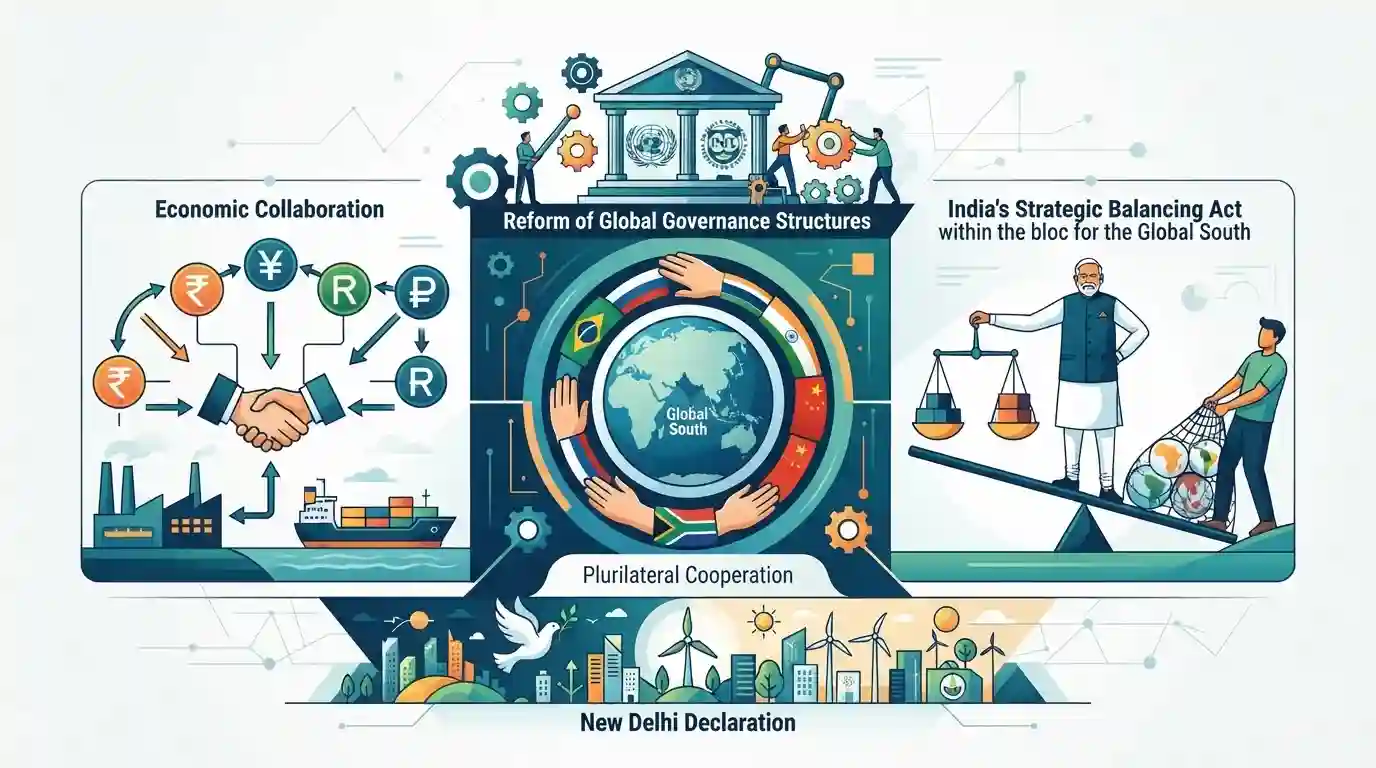
The article discusses the outcomes of the BRICS Summit and the New Delhi Declaration, focusing on plurilateral cooperation, reform of global governance structures, economic collaboration, and India's strategic balancing act within the bloc for the Global South.
Key Points
- The BRICS Summit concluded with the adoption of the New Delhi Declaration, emphasizing multilateralism, reformed global governance, and sustainable development.
- Discussions focused on expanding economic cooperation, reducing dollar dependency through local currency trade mechanisms, and strengthening financial resilience among member states.
- India played a central role in balancing diverse geopolitical interests within the bloc, advocating for equitable representation of the Global South in international institutions.
- The summit addressed emerging global challenges including supply chain security, digital transformation, and climate change finance.
Important Terms
BRICS

An intergovernmental organization comprising major emerging economies—Brazil, Russia, India, China, and South Africa (along with expanded members)—aiming to promote peace, security, development, and cooperation among emerging markets.
UPSC context
GS Paper 2 (International Relations - Bilateral, Regional and Global Groupings and Agreements involving India). Tests understanding of plurilateral diplomacy.
New Delhi Declaration
The landmark outcome document adopted at the BRICS Summit, outlining member commitments on global governance reform, sustainable development, economic cooperation, and multilateralism.
UPSC context
GS Paper 2 (International Relations). Tests India's leadership role, foreign policy objectives, and multilateral consensus-building for the Global South.
Static Concepts Connected
What are the core pillars and institutional mechanisms of BRICS?
- Evolution: Established initially as BRIC in 2009, South Africa joined in 2010 (BRICS), and expansion added new members in 2024.
- Financial Arm: New Development Bank (NDB) headquartered in Shanghai, providing infrastructure and sustainable development funding.
- CRA Mechanism: Contingent Reserve Arrangement (CRA) provides a framework for short-term balance of payments support.
Cross-Topic Patterns
BRICS + G20 + Global South diplomacy
India's advocacy for the Global South inside BRICS intersects with its G20 Presidency priorities, specifically the African Union's permanent membership and reformed multilateralism.
De-dollarisation & Reserve Currency Economics
Decollarisation and local currency settlement mechanisms link plurilateral groupings like BRICS directly to RBI and IMF swap-line architecture.

Expect a multi-statement UPSC MCQ testing specific declarations of BRICS vs G20 vs SCO, especially regarding governance reform and local currencies.
Linked PYQs · 3
Linked PYQs · 3
- 2022MainsGS2
How will I2U2 (India, Israel, UAE and USA) grouping transform India's position in global politics?
- 2024MainsGS2
‘The West is fostering India as an alternative to reduce dependence on China's supply chain and as a strategic ally to counter China's political and economic dominance.’ Explain this statement with examples.
- 2019MainsGS2
‘The long-sustained image of India as a leader of the oppressed and marginalised nations has disappeared on account of its new found role in the emerging global order.’ Elaborate.
