New Delhi Declaration outlines BRICS focus on global governance
Source:Indian Express ↗
ఇది ఎందుకు ముఖ్యం
BRICS is a critical pillar of India's multi-alignment strategy and a key platform for amplifying the voice of the Global South in global economic and political governance.
సారాంశం
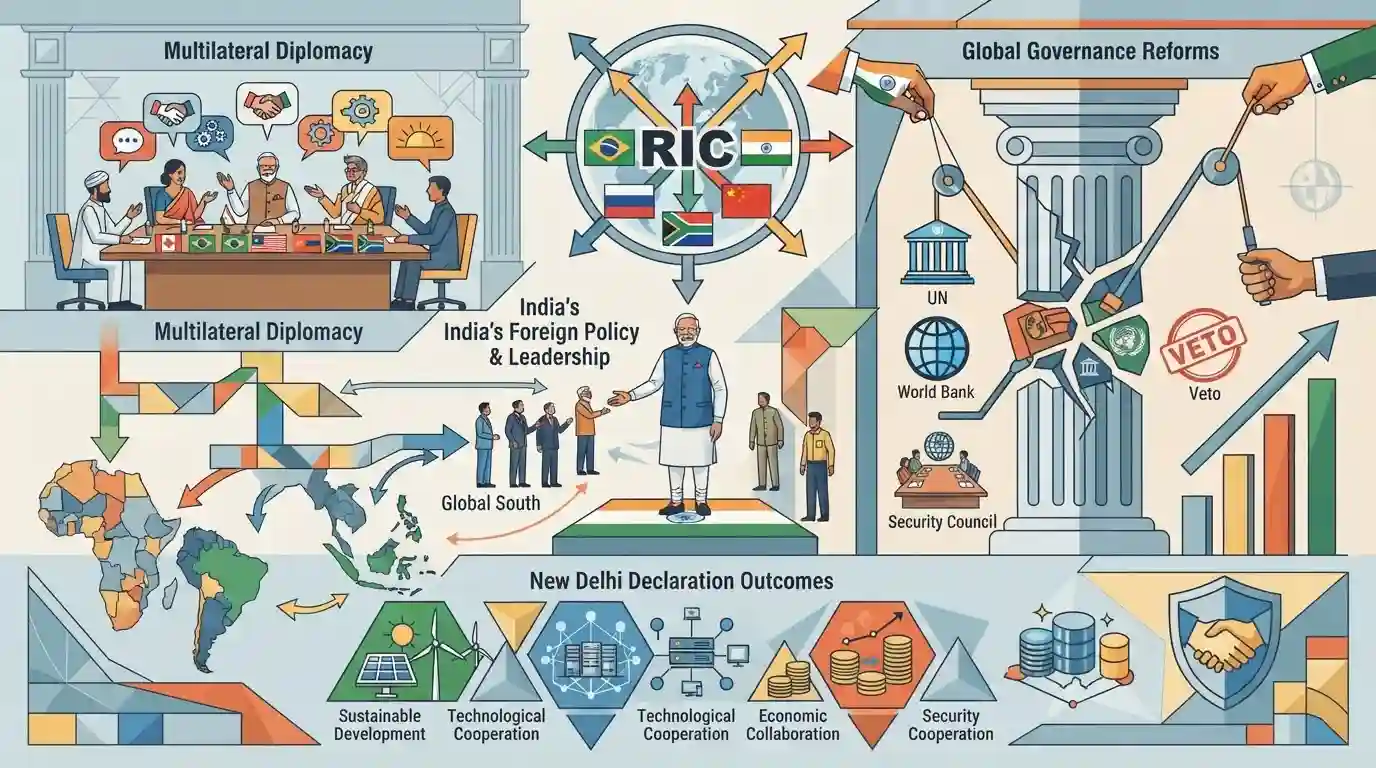
An analysis of the BRICS Summit outcomes and the New Delhi Declaration, highlighting India's role in shaping multilateral diplomacy, reforming global governance institutions, and championing the aspirations of the Global South.
ముఖ్య అంశాలు
- The BRICS summit outcomes and New Delhi Declaration focus on strengthening multilateralism, reforming global governance structures like the UN Security Council, and addressing the priorities of the Global South.
- The grouping continues to navigate its expanded footprint following recent inclusions, balancing diverse geopolitical interests among member states.
- Emphasis is placed on economic cooperation, financial stability, and sustainable development amidst evolving global trade dynamics.
ముఖ్యమైన పదాలు
New Delhi Declaration

A landmark consensus document adopted during the BRICS summit, outlining the bloc's shared vision for reforming global governance, boosting multilateral cooperation, and amplifying the voice of the Global South.
UPSC context
UPSC Mains GS Paper II: International Relations — Important International institutions, agencies and fora, their structure, mandate, and India's foreign policy objectives.
BRICS
An intergovernmental organization comprising major emerging economies, originally Brazil, Russia, India, China, and South Africa, expanded to include other developing nations to foster multipolarity and reform global economic governance.
UPSC context
UPSC Mains GS Paper II: Bilateral, regional and global groupings and agreements involving India and/or affecting India's interests.
United Nations
An international organization founded in 1945 committed to maintaining international peace and security, developing friendly relations among nations, and promoting international cooperation, heavily referenced in BRICS reform agendas.
UPSC context
UPSC Mains GS Paper II: Important International institutions and global governance structures, specifically focusing on UN reforms.
ప్రిలిమ్స్ ఉచ్చు
BRICS secretariat directives mandate binding economic targets for member nations.
Aspirants often assume BRICS has a binding charter and a centralized permanent secretariat like the UN or WTO, when it operates purely on consensus and annual rotating summits.
అనుసంధానమైన స్థిర భావనలు
What are the core pillars and evolution milestones of the BRICS grouping?
- O'Neill Acronym: Coining acronym: Coined as BRIC by Jim O'Neill in 2001, with South Africa joining in 2010 to form BRICS.
- Three Pillars: Core Pillars: Operates on three pillars: Political and Security, Economic and Financial, and Cultural and People-to-People exchanges.
- NDB Creation: New Development Bank: Headquartered in Shanghai, established by BRICS to fund infrastructure and sustainable development projects.
అంతర-అంశ నమూనాలు
BRICS Expansion vs Indian Energy Security
BRICS expansion into energy-heavyweights (like Iran and UAE) intersects directly with India's energy security matrix and crude diversification strategies.
De-dollarization & Bretton Woods Reform Limits
Push for alternative payment systems and de-dollarization inside BRICS directly challenges Western financial hegemony managed via IMF-World Bank quotas.

Expect statement-based Qs on BRICS architecture changes, UNSC reform demands, and India's balancing act between Global South & West.
అనుసంధాన PYQలు · 2
అనుసంధాన PYQలు · 2
- 2012MainsGS2
Compare the significance of IBSA and BRICS in the context of India's multilateral diplomacy.
- 2025MainsGS2
"The reform process in the United Nations remains unresolved, because of the delicate imbalance of East and West and entanglement of the USA vs. Russo-Chinese alliance.” Examine and critically evaluate the East-West policy confrontations in this regard.
