BRICS New Delhi Declaration and Global Governance Goals
Source:Indian Express ↗
Why It Matters
BRICS is a vital pillar of India's multi-aligned foreign policy and plays an instrumental role in shaping alternative global governance architectures, making its summit outcomes important for Mains GS2.
Summary
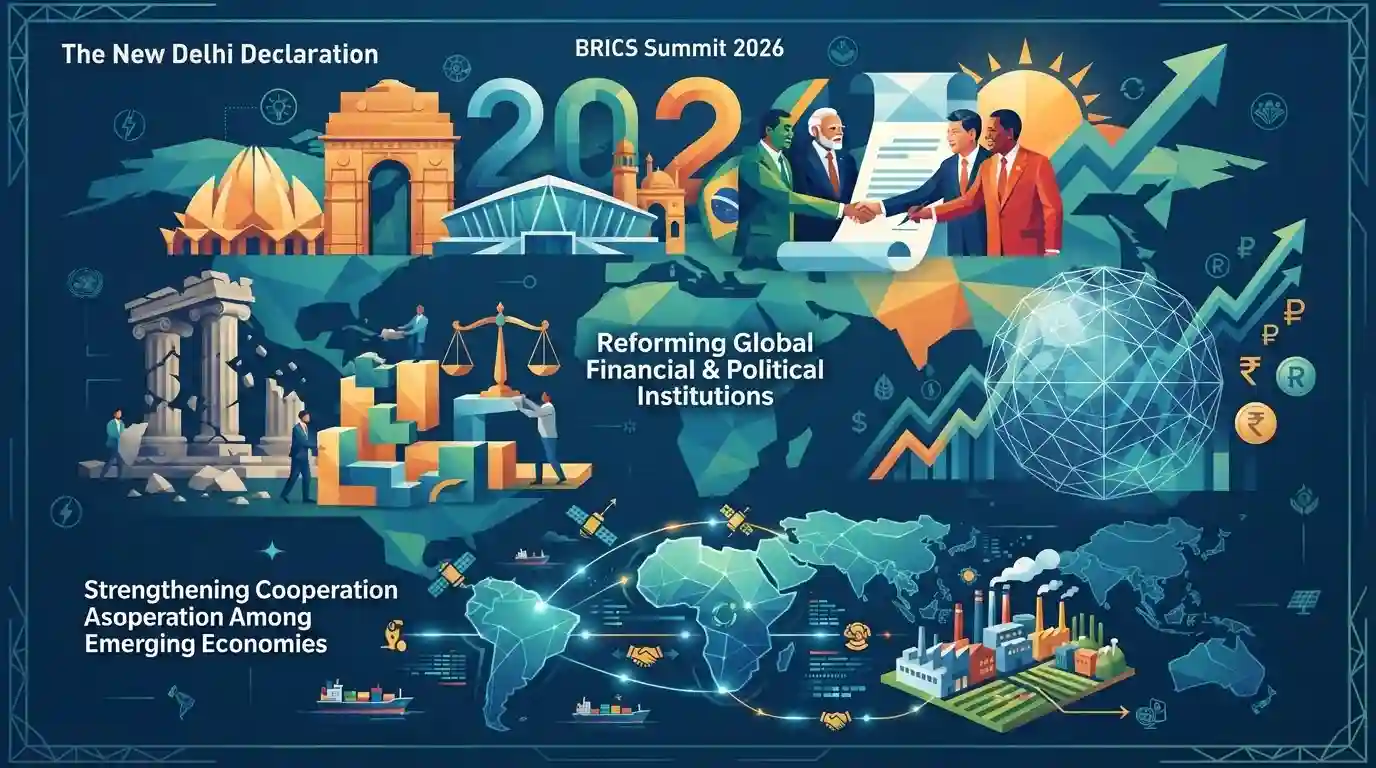
The article details the outcomes and significance of the BRICS Summit 2026, highlighting the New Delhi Declaration, efforts toward reforming global financial and political institutions, and strengthening cooperation among emerging economies.
Key Points
- The BRICS Summit 2026 concluded with the adoption of the New Delhi Declaration, outlining key multilateral and economic cooperation initiatives.
- Discussions centered on reforming global governance structures like the UN Security Council and promoting financial resilience through local currency trade.
- The summit addressed the expansion of the bloc and strategic geopolitical challenges affecting emerging economies.
Important Terms
New Delhi Declaration

A foundational multilateral outcome document adopted at the 18th BRICS Summit in New Delhi (2026), focusing on global governance reform, resilient supply chains, multilateral trade, and peaceful conflict resolution.
UPSC context
GS Paper 2 (International Relations - Bilateral, Regional and Global Groupings and Agreements involving India). Tests knowledge of multilateral diplomacy and emerging global governance.
BRICS
An intergovernmental organization comprising major emerging economies (Brazil, Russia, India, China, South Africa, and recent expanding members), aimed at deepening economic, political, and cultural cooperation.
UPSC context
GS Paper 2 (International Relations). Tests understanding of plurilateral groupings, global south dynamics, and India's strategic foreign policy priorities.
Static Concepts Connected
How are decisions made within the BRICS grouping and what is the New Development Bank?
- Consensus Based: BRICS operates on the principle of consensus, ensuring that all member states must agree on joint declarations and major initiatives.
- NDB Mandate: Headquartered in Shanghai, it was established by BRICS nations to mobilize resources for infrastructure and sustainable development projects in emerging markets.
- Voting Power: Each founding member contributed equally to its initial authorized capital, distinguishing it from traditional Western-dominated institutions like the World Bank.
Cross-Topic Patterns
BRICS reform demands & historical NIEO parallel
BRICS calls for alternative financial architectures mirror the long-standing Non-Aligned Movement stance on a New International Economic Order (NIEO), testing India's diplomatic balancing act between Western partnerships and Global South solidarity.

BRICS institutional reforms (UNSC, IMF) combined with local currency settlement will likely feature in a multi-statement IR question.
Linked PYQs · 1
Linked PYQs · 1
- 2012MainsGS2
Compare the significance of IBSA and BRICS in the context of India's multilateral diplomacy.
