New Delhi Declaration and BRICS Stance on EU Carbon Border Tax
Source:Indian Express ↗
Why It Matters
This article is crucial for UPSC preparation as it highlights how the BRICS grouping coordinates policy positions against unilateral trade and climate instruments like the EU's CBAM, reflecting broader tensions between developed and developing nations regarding climate equity and trade protectionism.
Summary
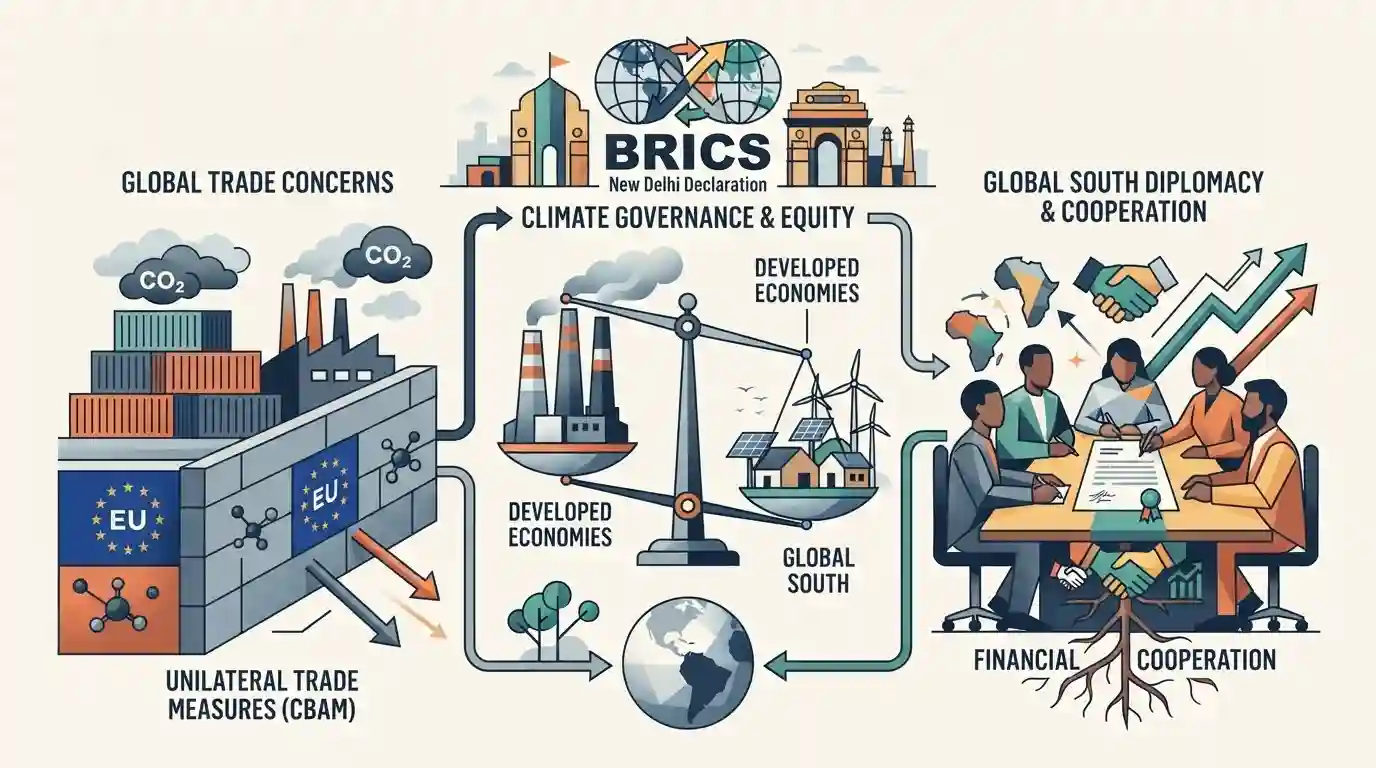
The 2026 BRICS Summit concluded with the adoption of the New Delhi Declaration, which highlighted collective concerns from emerging economies regarding unilateral trade measures like the EU's Carbon Border Adjustment Mechanism (CBAM), climate governance, and equity for the Global South.
Key Points
- The BRICS Summit in New Delhi resulted in a joint declaration addressing key global economic, environmental, and geopolitical issues.
- BRICS nations strongly criticized unilateral protectionist measures such as the European Union's Carbon Border Adjustment Mechanism (CBAM), citing concerns over climate-related trade barriers affecting developing economies.
- The declaration addressed global climate governance, positions on fossil fuels, and the advocacy for the interests of the Global South within multilateral institutions.
Important Terms
Carbon Border Adjustment Mechanism (CBAM)

A climate-linked trade policy tool introduced by the European Union that imposes a carbon price on imported carbon-intensive goods to prevent carbon leakage and equalize carbon costs.
UPSC context
UPSC Mains GS Paper 2 & 3: Environment, climate governance, and international trade disputes/protectionism.
BRICS
An intergovernmental grouping of major emerging economies designed to foster multilateral cooperation, reform global financial architecture, and amplify the voice of the Global South.
UPSC context
UPSC Mains GS Paper 2: International Relations and important international groupings.
Static Concepts Connected
What are the core principles of the UNFCCC and Paris Agreement regarding climate action?
- CBDR-RC Framework: CBDR-RC principle anchors global climate negotiations based on historical responsibility and respective capacities.
- NDC Mechanism: Nationally Determined Contributions form the bottom-up architecture for emission reduction targets under the Paris Agreement.
- Transparency Standards: Enhanced transparency framework ensures reporting on mitigation, adaptation, and support provided or received.
What is the Carbon Border Adjustment Mechanism (CBAM) and its primary WTO concerns?
- Carbon Equalization: Tariff mechanism equalizes carbon prices on imports into the EU to prevent domestic carbon leakage.
- Equity Concerns: Developing nations argue it violates the UNFCCC principle of equity and common but differentiated responsibilities.
- WTO Compatibility: Concerns exist regarding its potential violation of GATT national treatment and non-discrimination rules.
Cross-Topic Patterns
CBAM versus WTO Trade Rules
The debate over CBAM reveals the friction between WTO non-discrimination principles and unilateral environmental protectionism disguised as carbon tariffs.
Climate Justice vs Western Net-Zero Agendas
BRICS' resistance to rigid net-zero deadlines highlights the fault lines between historical emitters and developing nations demanding equitable carbon space.

Expect assertion-reason questions on CBAM's WTO compatibility and BRICS' common-but-differentiated responsibilities stance.
Linked PYQs · 2
Linked PYQs · 2
- 2024MainsGS2
Critically analyse India's evolving diplomatic, economic and strategic relations with the Central Asian Republics (CARs) highlighting their increasing significance in regional and global geopolitics.
- 2025MainsGS3
What is Carbon Capture, Utilization and Storage (CCUS)? What is the potential role of CCUS in tackling climate change?
