BRICS Expansion and India West Asia Diplomacy
Source:Indian Express ↗
Why It Matters
It highlights India's balancing act within expanding multilateral groupings like BRICS and its strategic imperatives in West Asia, directly connecting to syllabus themes on India's foreign policy and global groupings.
Summary
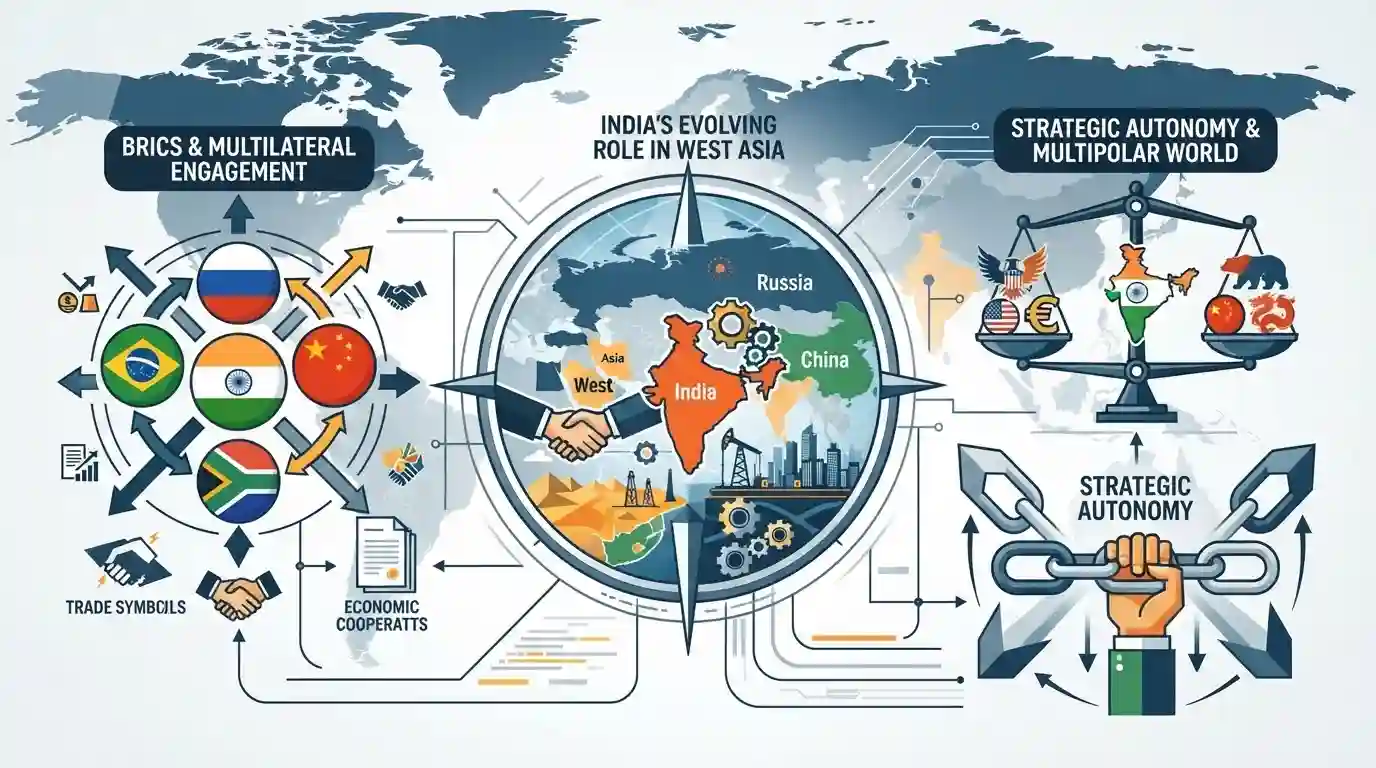
The article discusses the strategic implications of the BRICS summit, focusing on India's evolving diplomatic role in West Asia, multilateral engagement, and the challenges of maintaining strategic autonomy in a multipolar world.
Key Points
- The expansion of BRICS brings new diplomatic opportunities and challenges for India, particularly regarding its relations with West Asia and Western partners.
- India's foreign policy must navigate multilateral platforms like BRICS while balancing its strategic autonomy and deepening ties with Middle Eastern nations.
- The changing geopolitical dynamics in West Asia require India to adapt its energy security and regional engagement strategies carefully.
Important Terms
BRICS

An intergovernmental organization comprising major emerging economies—Brazil, Russia, India, China, South Africa, and recent inductees—aimed at reforming global governance, promoting multilateralism, and amplifying the voice of the Global South.
UPSC context
Important for GS Paper II (International Relations - Bilateral, Regional, and Global Groupings affecting India's interests). Tests the candidate's understanding of plurilateral diplomacy.
Prelims Trap
BRICS functions as a unified anti-Western bloc seeking to replace Western-led financial and security architectures globally.
Aspirants often assume BRICS is a monolithic anti-Western alliance. India explicitly uses BRICS for multi-alignment and reform of global governance, not to counter the West.
Static Concepts Connected
What are the core tenets and evolution of India’s foreign policy approach towards West Asia?
- Energy & Diaspora: Historically anchored in energy security, diaspora protection, and remittance inflows from Gulf Cooperation Council (GCC) nations.
- De-hyphenation Policy: De-hyphenation separates relationships with Israel, Iran, and Arab states, allowing independent diplomatic engagement without regional conflict spillovers.
- Strategic Diversification: Expanding into comprehensive strategic partnerships covering defense cooperation, counter-terrorism, renewable energy, and critical technology infrastructure.
Cross-Topic Patterns
BRICS expansion + Energy Security + De-hyphenation
India's independent ties with West Asian monarchies and Israel run parallel to multilateral platforms like BRICS, demonstrating pragmatic multi-alignment in energy security.
Strategic Autonomy + Western Partnerships + Multilateralism
Balancing Western partnerships (Quad/I2U2) with anti-hegemonic groupings (BRICS/SCO) tests India's non-aligned legacy and strategic autonomy doctrine.

BRICS expansion involving West Asian petrostates + India's de-hyphenation policy will feature in multi-statement IR questions.
Linked PYQs · 2
Linked PYQs · 2
- 2025MainsGS2
"Energy security constitutes the dominant kingpin of India's foreign policy, and is linked with India's overarching influence in Middle Eastern countries.” How would you integrate energy security with India's foreign policy trajectories in the coming years?
- 2022MainsGS2
How will I2U2 (India, Israel, UAE and USA) grouping transform India's position in global politics?
