BRICS Summit New Delhi Declaration and Multilateral Reforms
Source:The Hindu ↗
Why It Matters
The BRICS summit provides crucial insights into India's evolving foreign policy, its leadership role among emerging economies, and efforts to reform global governance structures.
Summary
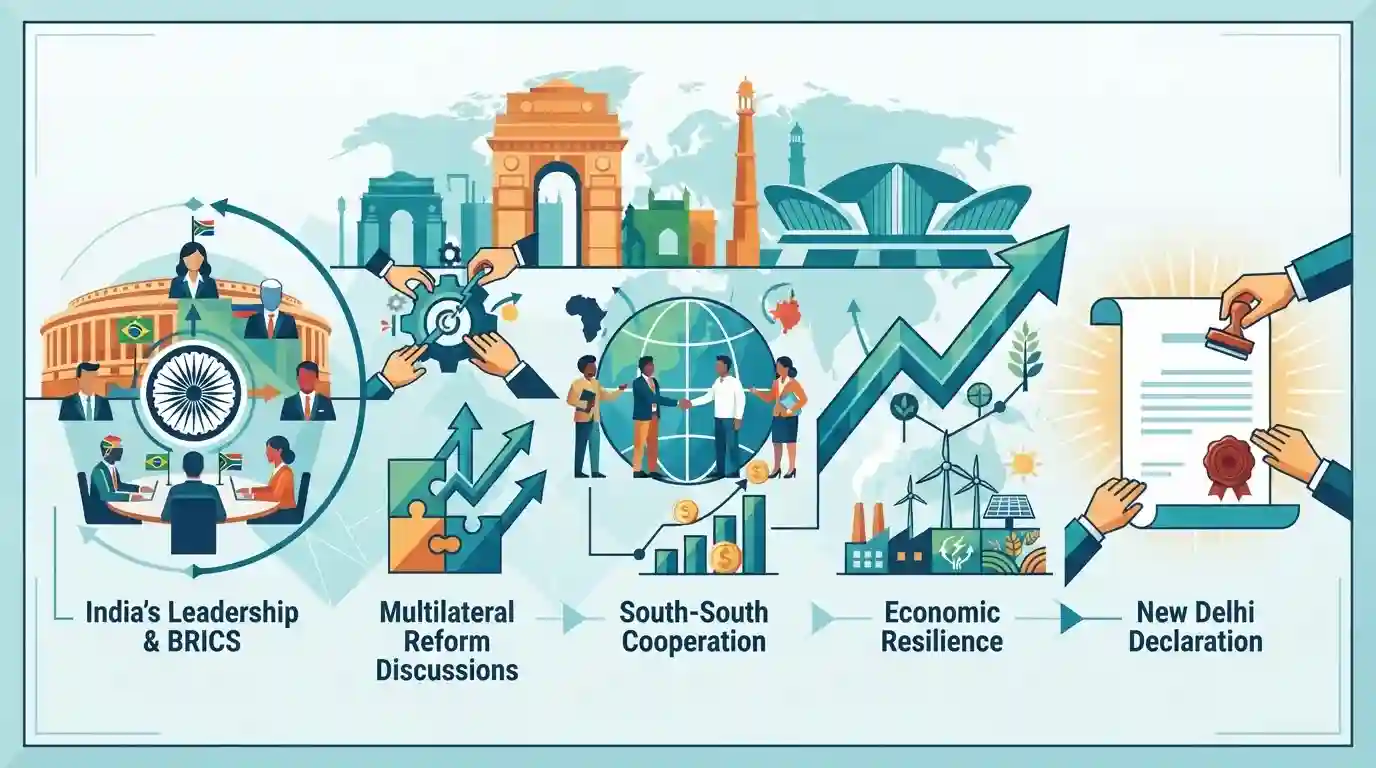
The article covers the live updates and key developments from the BRICS Summit hosted under India's leadership, featuring discussions on multilateral reform, South-South cooperation, economic resilience, and the adoption of the New Delhi Declaration.
Key Points
- The BRICS Summit hosted by India focused on major geopolitical, economic, and developmental challenges facing the Global South.
- Discussions centered on reforming multilateral institutions like the UN, WTO, and international financial architecture.
- Adoption of key outcome documents such as the New Delhi Declaration emphasizing cooperation in trade, technology, security, and sustainable development.
- India highlighted its strategic vision for inclusive multilateralism and resilient supply chains.
Important Terms
BRICS

An intergovernmental organization comprising major emerging economies—Brazil, Russia, India, China, South Africa, and newly added partner countries—aimed at promoting global economic cooperation and reforming international governance institutions.
UPSC context
Important for UPSC GS Paper II under International Relations and Multilateral Groupings, assessing India's diplomatic posture and Global South leadership.
New Delhi Declaration
The foundational outcome document adopted at the BRICS Summit, outlining member nations' shared commitments on multilateral reform, economic resilience, UN Security Council expansion, and South-South cooperation.
UPSC context
Important for UPSC GS Paper II (International Relations), testing knowledge of declarations, consensus building, and India's multilateral diplomacy agenda.
Prelims Trap
The New Delhi Declaration is a legally binding multilateral treaty ratified by all BRICS member parliaments.
BRICS declarations are consensus-based policy guidelines and political commitments, not legally binding international treaties ratified by national legislatures.
Static Concepts Connected
What are the key institutional pillars and financing mechanisms of the BRICS grouping?
- New Development Bank (NDB):: Headquartered in Shanghai, it provides sovereign loans for infrastructure and sustainable development projects in emerging economies.
- Contingent Reserve Arrangement (CRA):: A liquidity support framework designed to protect BRICS economies from short-term balance-of-payments pressures and global currency volatility.
- Consensus Principle:: BRICS operates strictly on consensus, meaning all member states must agree on major declarations and expansion decisions.
Cross-Topic Patterns
BRICS vs Western Multilateralism
BRICS consensus-building parallels non-aligned historical frameworks, testing how Global South coalitions navigate Western-led financial regimes like IMF and FATF.
Digital Public Infrastructure and Resource Diplomacy
Incorporating DPI and critical minerals into BRICS bridges technology governance with resource diplomacy, mirroring India's G20 priorities.

BRICS expansion criteria + UNSC reform veto dynamics likely to be tested via statement-based prelims questions.
Linked PYQs · 3
Linked PYQs · 3
- 2012MainsGS2
Compare the significance of IBSA and BRICS in the context of India's multilateral diplomacy.
- 2025PrelimsGS1
Consider the following statements with regard to BRICS : I. 16th BRICS Summit was held under the Chairship of Russia in Kazan. II. Indonesia has become a full member of BRICS. III. The theme of the 16th BRICS Summit was Strengthening Multiculturalism for Just Global Development and Security. Which of the statements given above is/are correct?
- 2014PrelimsGS1
With reference to a grouping of countries known as BRICS, consider the following statements: 1. The First Summit of BRICS was held in Rio de Janeiro in 2009. 2. South Africa was the last to join the BRICS grouping. Which of the statements given above is/are correct?
