US President Criticizes BRICS De-Dollarisation Push
Source:The Hindu ↗
Why It Matters
The article is highly relevant for UPSC aspirants as it touches upon the core themes of changing global dynamics, the role of multilateral institutions like BRICS, and the geopolitical implications of de-dollarisation. Understanding the friction between established Western hegemony and emerging economies is crucial for both Mains (GS2 and GS3) and the Interview stage.
Summary
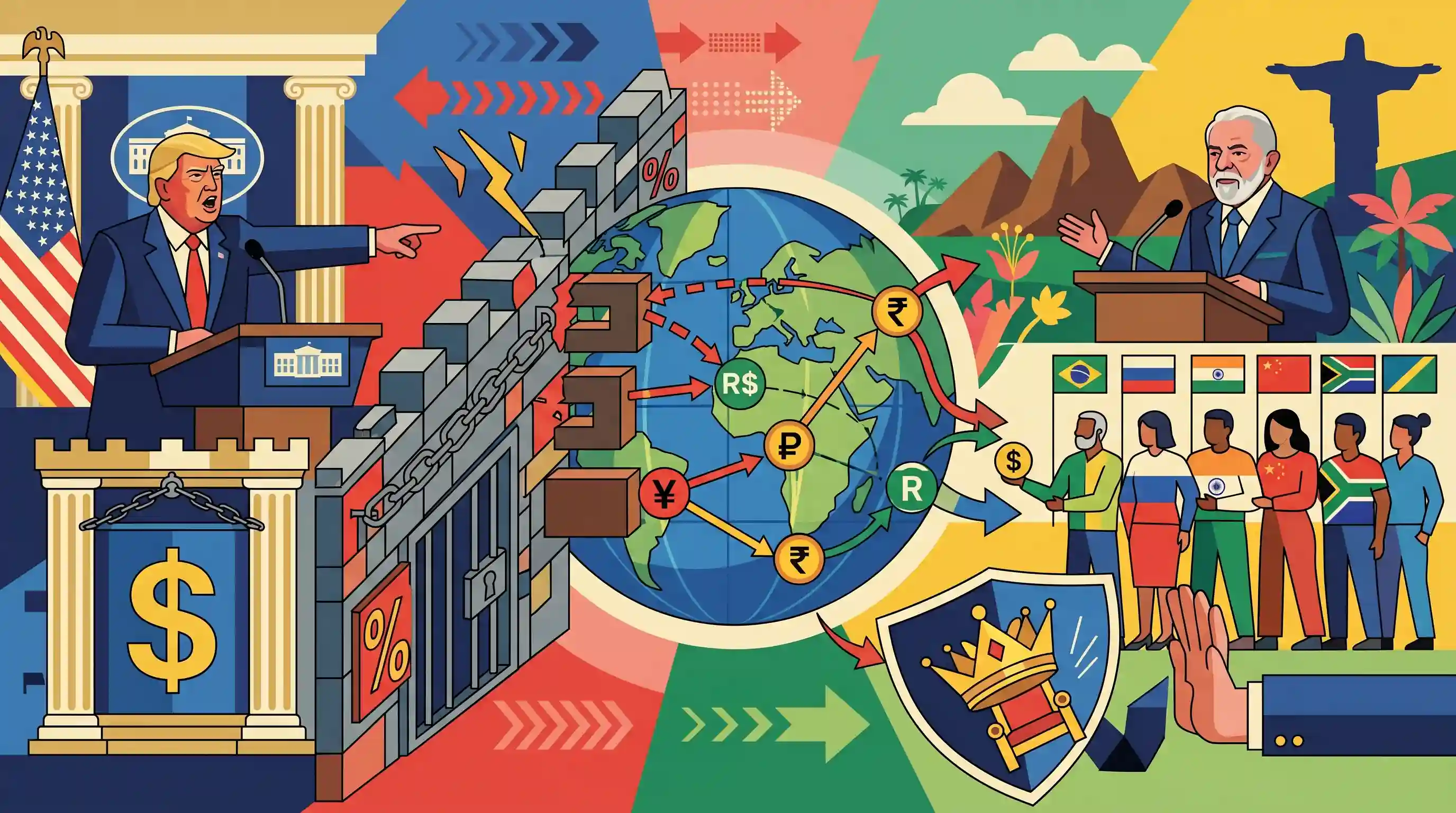
U.S. President Donald Trump has sharply criticized the BRICS grouping, accusing it of attempting to "degenerate" the U.S. dollar's status as the global reserve currency. During a White House Cabinet meeting, Trump warned that any BRICS member nation challenging the dollar standard would face a blanket 10% tariff. His remarks coincided with the 17th BRICS Summit in Brazil, prompting Brazilian President Luiz Inácio Lula da Silva to retort that the world does not want an 'emperor'. This geopolitical clash underscores growing tensions over global de-dollarisation efforts, trade protectionism, and the shifting economic order driven by the expanded BRICS bloc.
Key Points
- U.S. President Donald Trump accused the BRICS bloc of aiming to undermine the U.S. economy and displace the U.S. dollar as the global reserve currency.
- Trump threatened to impose a 10% tariff on all BRICS member countries if they continued their push toward de-dollarisation.
- The remarks coincided with the 17th BRICS Summit in Brazil, drawing pushback from Brazilian President Lula da Silva who stated the world does not want an 'emperor'.
- The exchange highlights escalating geopolitical friction regarding U.S. financial hegemony, protectionist trade policies, and the growing influence of the recently expanded BRICS grouping.
Important Terms
BRICS

An intergovernmental grouping of major emerging economies—originally Brazil, Russia, India, China, and South Africa—expanded in 2024 to include Egypt, Ethiopia, Iran, Saudi Arabia, and UAE.
UPSC context
GS Paper 2 (International Relations). Tests knowledge of global groupings, South-South cooperation, and India's role in a multipolar world.
De-dollarisation
The strategic process where nations reduce reliance on the U.S. dollar for international trade, foreign exchange reserves, and financial transactions to mitigate geopolitical and exchange rate risks.
UPSC context
GS Paper 3 (Economy) and GS Paper 2. Relevant for global financial stability, sanctions, and the internationalization of the Rupee.
Global Reserve Currency
A foreign currency held in significant quantities by central banks and used for international transactions; the U.S. dollar currently dominates, accounting for nearly 60% of global reserves.
UPSC context
GS Paper 3 (Economy). Evaluates understanding of international monetary systems, the Bretton Woods legacy, and global trade dynamics.
Protectionism
Economic policy of shielding domestic industries from foreign competition through barriers such as tariffs, quotas, and subsidies, often driven by economic nationalism or "America First" agendas.
UPSC context
GS Paper 2 (Effect of policies of developed countries). Tests impact on India's exports, global supply chains, and multilateral trade rules.
Tariff
A tax or duty imposed by a government on imported goods, making them more expensive to domestic consumers and protecting local producers from foreign competition.
UPSC context
GS Paper 3 (Economy). Important for understanding trade wars, WTO compliance, and bilateral trade negotiations.
Global South
A term representing developing and least-developed nations, primarily in Africa, Asia, and Latin America, seeking to reform global governance to be more inclusive and equitable.
UPSC context
GS Paper 2. Central to India's foreign policy identity as a "voice" for underrepresented nations in global forums.
Prelims Trap
"BRICS has officially launched a unified common currency to replace the US Dollar in all intra-BRICS trade."
BRICS promotes trade settlement in existing *local currencies* (Rupee, Yuan, Rouble) via systems like BRICS Pay. They have not created a unified fiat currency like the Euro.
Static Concepts Connected
What factors support a currency's status as a 'Global Reserve Currency'?
- High Liquidity: Deep, accessible, and stable financial markets (like US Treasury bonds) allowing foreign central banks to park vast reserves safely.
- Global Pricing: Widespread acceptance for pricing global commodities (e.g., the Petrodollar system for crude oil) and full capital account convertibility.
- Network Dominance: Integration into global clearing and messaging architectures (like SWIFT), making international cross-border transactions efficient and globally recognized.
How does local currency trade settlement (e.g., Rupee trade) function?
- Vostro Accounts: Domestic banks open Special Rupee Vostro Accounts (SRVA) on behalf of correspondent banks of the partner country.
- Trade Netting: Importers pay in local currency into this account, which is subsequently used to pay domestic exporters, entirely bypassing the US Dollar.
- Sanction Shield: It reduces Forex reserve depletion and shields domestic economies from external currency shocks and US-led financial sanctions.
Cross-Topic Patterns
Digital Public Goods + De-dollarisation
India's push for UPI internationalization aligns conceptually with 'BRICS Pay'. Both seek to bypass the Western-controlled SWIFT network, offering alternative cross-border settlement mechanisms for the Global South.
Weaponized Tariffs vs. WTO MFN Rules
Unilateral tariff threats bypass WTO's Most Favored Nation (MFN) principles. This economic coercion accelerates the Global South's shift towards regional trading blocs and resilient internal supply chains.

Expect a Prelims question on BRICS+ members, linking new additions (Indonesia) with local currency settlement mechanisms and BRICS Pay.
Linked PYQs · 3
Linked PYQs · 3
- 2012MainsGS2
Compare the significance of IBSA and BRICS in the context of India's multilateral diplomacy.
- 2014PrelimsGS1
With reference to a grouping of countries known as BRICS, consider the following statements: 1. The First Summit of BRICS was held in Rio de Janeiro in 2009. 2. South Africa was the last to join the BRICS grouping. Which of the statements given above is/are correct?
- 2025PrelimsGS1
Consider the following statements with regard to BRICS : I. 16th BRICS Summit was held under the Chairship of Russia in Kazan. II. Indonesia has become a full member of BRICS. III. The theme of the 16th BRICS Summit was Strengthening Multiculturalism for Just Global Development and Security. Which of the statements given above is/are correct?
