BRICS Meeting Expected to Boost Industrial Investment in Rajasthan
Source:socialnews-xyz ↗
Why It Matters
It highlights India's evolving leadership role in multilateral forums like BRICS, emphasizes cooperative strategies in sectors like photovoltaics and SMEs, and showcases the integration of sub-national entities (like Rajasthan) in global diplomacy and investment promotion.
Summary
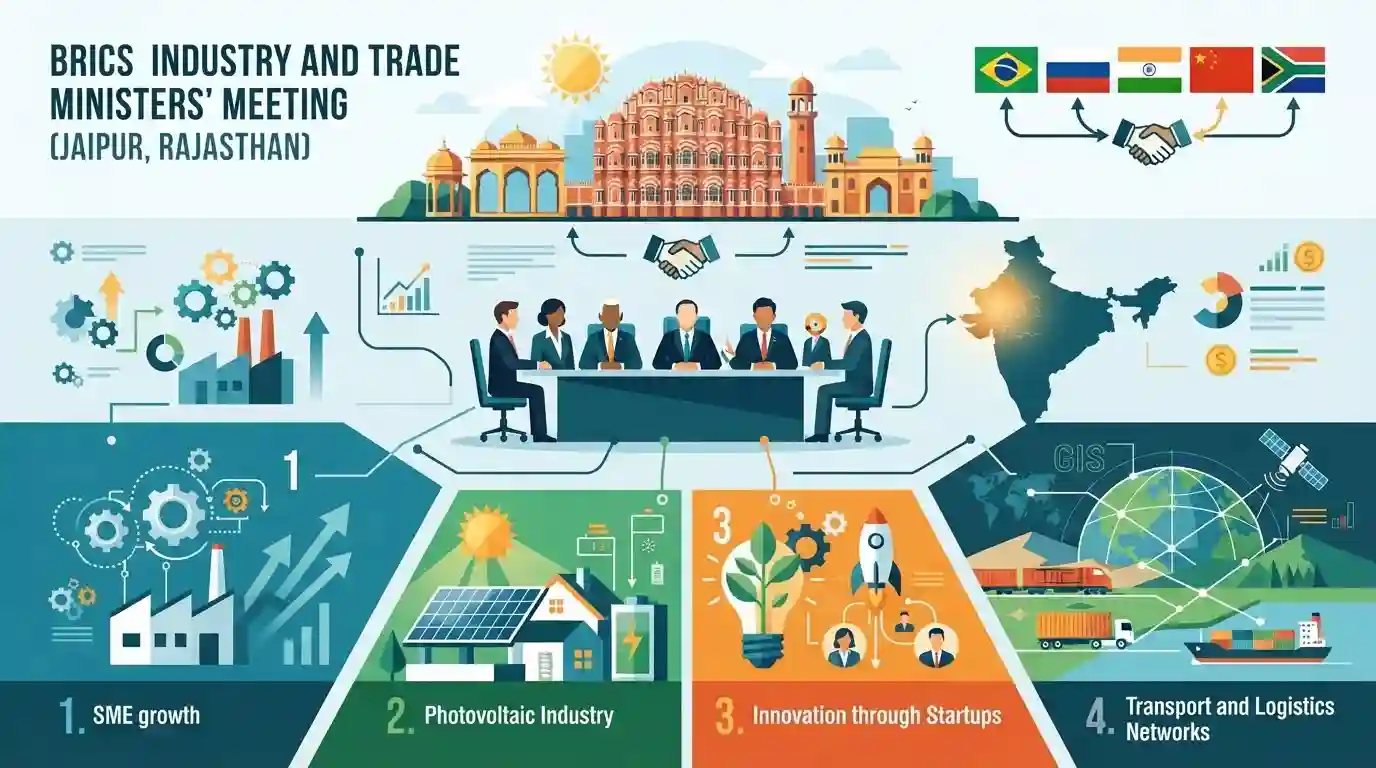
The BRICS Industry and Trade Ministers' Meeting was held in Jaipur, Rajasthan, providing a platform to enhance investment and industrial growth in the state. Hosted during India's BRICS presidency, the summit focused on the Partnership on New Industrial Revolution (PartNIR). Union Minister Piyush Goyal announced significant progress across four priority areas: frameworks for the BRICS SME Working Group and the Working Group on the Photovoltaic Industry, an action plan for innovation through startups, and the strengthening of transport and logistics networks via GIS-based planning.
Key Points
- Jaipur, Rajasthan, hosted the BRICS Industry and Trade Ministers' Meeting, aimed at fostering international cooperation and boosting state industrial investment.
- The meeting took place under India's BRICS presidency, reflecting a transition of leadership following Brazil's tenure in 2025.
- Discussions heavily featured the Partnership on New Industrial Revolution (PartNIR) to leverage complementary strengths among member nations.
- Key outcomes included finalising the cooperation framework for the BRICS SME Working Group and the Terms of Reference for the BRICS Working Group on the Photovoltaic Industry.
- The agenda also included an action plan for startup-driven innovation and the improvement of transport and city logistics networks using GIS-based infrastructure planning.
Important Terms
Partnership on New Industrial Revolution (PartNIR)

A strategic BRICS initiative established to deepen collaboration in digitalization, industrialization, innovation, and investment, enabling member states to capitalize on the Fourth Industrial Revolution (4IR).
UPSC context
GS Paper II (International Relations) & III (Technology); tests understanding of multilateral frameworks driving technology-led industrial growth.
BRICS
An influential intergovernmental alliance of major emerging economies—originally Brazil, Russia, India, China, and South Africa—collaborating on economic, political, and security cooperation to reform global governance.
UPSC context
GS Paper II (Bilateral & Multilateral Groupings); tests knowledge of global geopolitical dynamics and South-South cooperation platforms.
BRICS SME Working Group
A specialized working group under the PartNIR framework designed to strengthen policy alignment, share best practices, and integrate micro, small, and medium enterprises (MSMEs) into global industrial value chains.
UPSC context
GS Paper III (Indian Economy/MSMEs); tests awareness of international frameworks boosting small industries, technology access, and sustainable growth.
BRICS Working Group on the Photovoltaic Industry
A structured cooperation mechanism within the BRICS framework focused on clean energy transition, expanding solar technology sharing, and aligning strategies for solar power equipment manufacturing.
UPSC context
GS Paper III (Renewable Energy & Environment); tests understanding of multilateral clean energy alliances and sustainable technology transfers.
Prelims Trap
"PartNIR is a new initiative launched during India's 2026 BRICS Presidency."
PartNIR is not a new 2026 initiative; it was proposed in 2018 (Johannesburg). The 2026 meeting merely operationalises practical frameworks under it.
Static Concepts Connected
What is the BRICS Partnership on New Industrial Revolution (PartNIR)?
- Origin: Proposed in 2018 (Johannesburg Declaration) to maximize opportunities from the Fourth Industrial Revolution and manage structural economic transformations.
- Core Objective: Deepens BRICS cooperation in digitalization, industrialization, innovation, and inclusiveness to build joint capacity and leverage complementary strengths.
- Institutional Partner: Works closely with UNIDO (UN Industrial Development Organization) to align industrial strategies with global Sustainable Development Goals (SDGs).
How do Solar Photovoltaic (PV) systems differ from Solar Thermal systems?
- Photovoltaic (PV): Converts sunlight directly into electricity using semiconductor materials (photovoltaic effect). Highly modular, ideal for distributed rooftop systems and immediate consumption.
- Solar Thermal: Concentrates sunlight to heat a fluid, creating steam to drive electric turbines. Better suited for large-scale utility grids requiring built-in thermal energy storage.
Cross-Topic Patterns
BRICS Photovoltaic Push & ISA
The BRICS PV Working Group aligns with India's ISA objectives, enabling a Global South counterweight in clean energy supply chains and reducing dependence on single-nation solar imports.
Expanded BRICS & Supply Chain Integration
Integrating SMEs across the new 10-member BRICS framework helps India tap into Middle Eastern and African markets, enhancing the 'Make in India' footprint globally.

Expect a Prelims question mixing the expanded 10-member BRICS bloc with PartNIR and India's 2026 presidency initiatives like the PV Group.
Linked PYQs · 4
Linked PYQs · 4
- 2021RPSC_PRELIMSGS1
’Mission Become an Exporter’ has been initiated for people aspiring to become exporters
- 2025RPSC_PRELIMSGS1
The Ease of Doing Business ranking for states is issued by
- 2023RPSC_PRELIMSGS1
Which agency has been given the responsibility of implementing the PM-KUSUM scheme (Component A) in Rajasthan, which involves the establishment of solar power plants with a capacity of 0.5 MW to 2 MW?
- 2016RPSC_PRELIMSGS1
The photovoltaic cell is related to
