BRICS New Delhi Declaration and Consensus Building Among Members
Source:The Hindu ↗
ఇది ఎందుకు ముఖ్యం
It sheds light on the internal mechanics, consensus-building capacity, and geopolitical negotiations within the expanded BRICS grouping, which is a major pillar of India's multi-aligned foreign policy and multilateral diplomacy.
సారాంశం
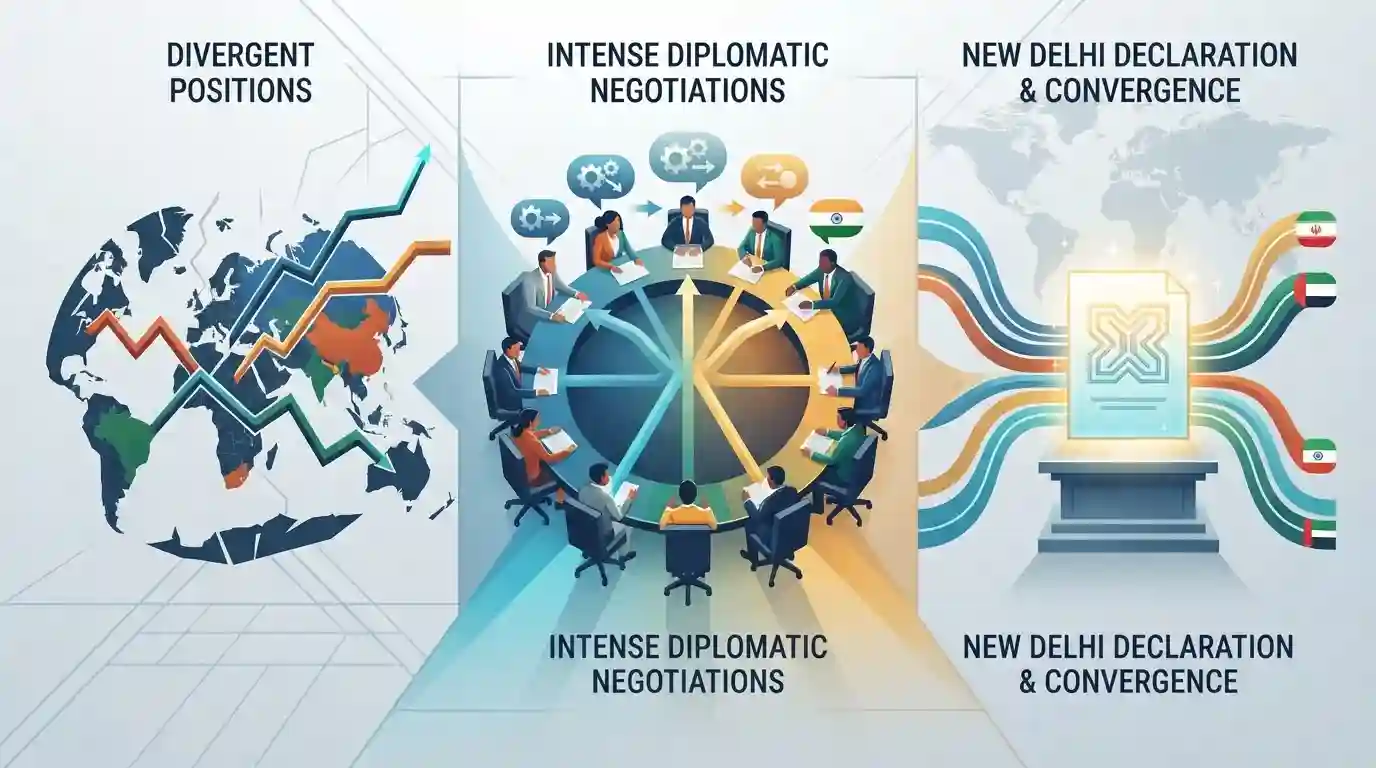
The article discusses the issuance of the New Delhi Declaration by BRICS, highlighting how intense diplomatic negotiations helped reconcile differences as member nations like the UAE and Iran softened their rigid stances, reflecting the bloc's evolving dynamics.
ముఖ్య అంశాలు
- BRICS issued the New Delhi Declaration following internal consensus building.
- The UAE and Iran backed down from tough positions, enabling a unified diplomatic outcome within the bloc.
- Highlights the growing complexity, internal bargaining, and evolving consensus-building mechanisms within the expanded BRICS grouping.
ముఖ్యమైన పదాలు
New Delhi Declaration

A joint outcome document adopted at a BRICS summit reflecting member states' consensus on geopolitical, economic, and security issues, including counter-terrorism, multilateralism, and regional stability.
UPSC context
Important for GS Paper II (International Relations - Global Groupings). Tests India's diplomatic leadership and multilateral consensus-building within expanded BRICS.
BRICS
An intergovernmental grouping of major emerging economies comprising Brazil, Russia, India, China, South Africa, and recently expanded members like Iran and the UAE.
UPSC context
Essential for GS Paper II (Bilateral, Regional and Global Groupings involving India). Evaluates the bloc's geopolitical evolution and impact on global governance.
UAE
A key West Asian strategic partner of India within the expanded BRICS grouping, whose diplomatic stance and regional security equations shape multilateral negotiations.
UPSC context
Relevant for GS Paper II (India's Bilateral Relations and West Asia policy). Tests India's ability to balance energy security, diaspora, and regional rivalries.
Iran
A West Asian member state of the expanded BRICS bloc whose strategic frictions with Gulf neighbors like the UAE test the internal cohesion and consensus-making of multilateral forums.
UPSC context
Important for GS Paper II (International Relations - West Asia and Multilateral Groupings). Tests India's diplomatic balancing act amid regional conflicts.
అనుసంధానమైన స్థిర భావనలు
What are the core foundational principles and expansion milestones of the BRICS grouping?
- Origin & Expansion: Original acronym BRIC coined by Jim O'Neill in 2001; South Africa joined in 2010 to form BRICS.
- Recent Growth: Expanded in 2024 to include Egypt, Ethiopia, Iran, Saudi Arabia, and the UAE, increasing its geopolitical heft.
- Core Mandate: Operates on consensus-building, emphasizing reform of global financial governance and multilateral institutions.
అంతర-అంశ నమూనాలు
BRICS Multilateralism + India's West Asia Policy
India's diplomatic balancing acts across West Asian rivals within multilateral platforms illustrate how non-alignment evolves into multi-alignment in contemporary forums.

Expanded BRICS consensus-building mechanisms and West Asian rivalries inside multilateral groupings are prime UPSC IR targets.
అనుసంధాన PYQలు · 2
అనుసంధాన PYQలు · 2
- 2012MainsGS2
Compare the significance of IBSA and BRICS in the context of India's multilateral diplomacy.
- 2025PrelimsGS1
Consider the following statements with regard to BRICS : I. 16th BRICS Summit was held under the Chairship of Russia in Kazan. II. Indonesia has become a full member of BRICS. III. The theme of the 16th BRICS Summit was Strengthening Multiculturalism for Just Global Development and Security. Which of the statements given above is/are correct?
