BRICS Expansion Brings Internal Differences Requiring Time to Resolve
Source:The Hindu ↗
Why It Matters
The expansion of BRICS and its internal dynamics are critical to India's foreign policy. Aspirants must understand how India navigates its strategic autonomy within an expanding bloc that features both its geopolitical rivals (China) and varying global alignments, making consensus-building a complex but essential diplomatic task.
Summary
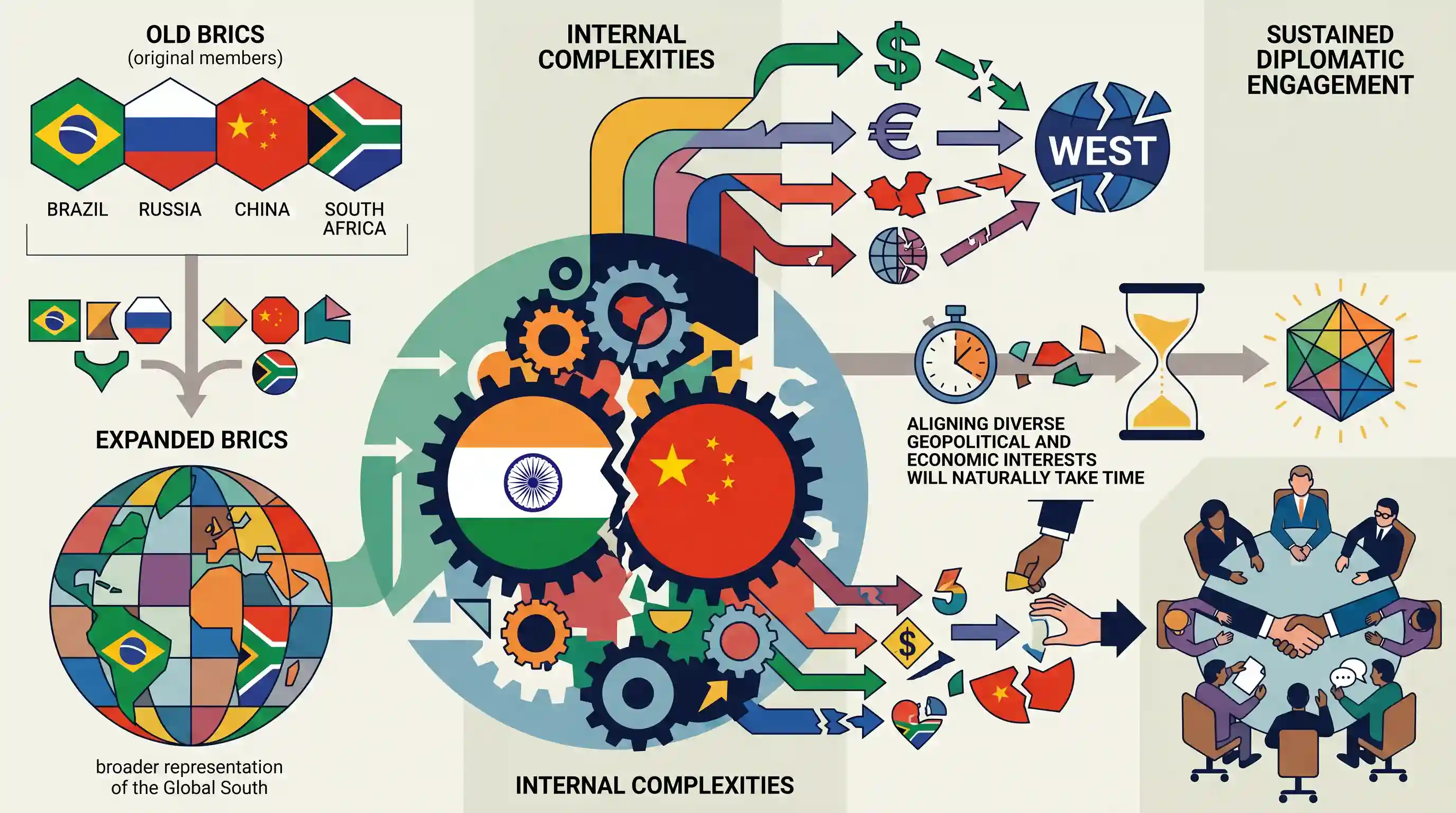
Brazil's Foreign Minister Mauro Vieira highlighted that the BRICS grouping is evolving with the addition of new members, which brings a broader representation of the Global South but also introduces new internal complexities. He noted that resolving differences and aligning the diverse geopolitical and economic interests of the expanded bloc will naturally take time. The statement underscores the challenges of achieving consensus in a multilateral forum that includes both rival powers (like India and China) and countries with differing stances toward the West, emphasizing the need for sustained diplomatic engagement.
Key Points
- Brazil's Foreign Minister Mauro Vieira acknowledged that BRICS is undergoing a significant evolutionary phase following the induction of new member states.
- Internal differences and divergent geopolitical interests among the expanded membership (including existing friction points like India-China relations) are recognized as challenges that will require time and patience to resolve.
- The expansion reflects a strategic shift for BRICS to represent a broader, more diverse coalition of the Global South, moving beyond its original identity of five major emerging economies.
- Despite the varied political systems and alignments within the bloc, the emphasis remains on fostering multilateralism and finding common ground on global governance reforms over time.
Important Terms
BRICS

A geopolitical bloc of emerging economies comprising Brazil, Russia, India, China, and South Africa, recently expanded to include Egypt, Ethiopia, Iran, and the UAE.
UPSC context
GS Paper 2: International Relations; critical for understanding India’s strategic autonomy and its role in reshaping global governance.
Global South
Refers to developing or underdeveloped nations primarily in Asia, Africa, and Latin America, often characterized by shared histories of colonialism and economic marginalization.
UPSC context
GS Paper 2: International Relations; focuses on India’s positioning as a leading voice for developing nations in the global order.
Multilateralism
A diplomatic framework where three or more countries collaborate through formal institutions or agreements to address common global challenges.
UPSC context
GS Paper 2: International Relations; tests knowledge of the crisis in the post-WWII world order and the rise of new institutions.
Consensus-based decision-making
A decision-making process in international forums where agreements are reached without a formal vote, requiring that no member expresses an official objection.
UPSC context
GS Paper 2: Important International Institutions; tests understanding of the democratic yet slow-moving nature of consensus in organizations like BRICS and WTO.
Minilateralism
Small, informal groups of countries (e.g., Quad, BRICS) that collaborate on specific issues without requiring the broad, universal participation seen in multilateralism.
UPSC context
GS Paper 2: International Relations; highly relevant for analyzing shifts in global diplomacy toward more flexible, interest-based alignments.
Prelims Trap
Argentina officially joined BRICS in 2024 along with Egypt, Ethiopia, Iran, Saudi Arabia, and the UAE.
While invited at the 2023 Johannesburg summit, Argentina formally declined to join following a change in government. Only five nations officially joined in Jan 2024.
Static Concepts Connected
What are the core financial architectures established by the BRICS grouping?
- New Development Bank: Headquartered in Shanghai, it mobilizes resources for infrastructure and sustainable development projects without the strict structural conditionalities typical of the IMF or World Bank.
- Contingent Reserve Arrangement: A framework providing support through liquidity and precautionary instruments in response to actual or potential short-term balance of payments pressures among member nations.
How does the IBSA grouping structurally differ from the expanded BRICS?
- Democratic foundation: IBSA (India, Brazil, South Africa) strictly comprises democratic nations, whereas BRICS includes highly diverse political systems like one-party states and monarchies (e.g., China, Iran, Saudi Arabia).
- Geopolitical alignment: IBSA focuses on South-South developmental cooperation without anti-Western undertones, whereas BRICS increasingly platforms narratives and institutions aimed at actively challenging Western-dominated global governance architectures.
Cross-Topic Patterns
BRICS expansion and West Asian geopolitics
The inclusion of regional rivals like Iran and Saudi Arabia tests BRICS's consensus model, mirroring the challenges of the SCO, and shifting the bloc's center of gravity heavily towards energy politics.
De-dollarization and Alternative Payment Systems
BRICS expansion discussions often intersect with Economy syllabus themes on dedollarization, specifically localized currency trading and the creation of alternative mechanisms to bypass the SWIFT network amidst Western sanctions.

Expect a 2026 Prelims question mapping newly added BRICS members or differentiating IBSA's democratic mandate from BRICS's expansion.
Linked PYQs · 2
Linked PYQs · 2
- 2012MainsGS2
Compare the significance of IBSA and BRICS in the context of India's multilateral diplomacy.
- 2025PrelimsGS1
Consider the following statements with regard to BRICS : I. 16th BRICS Summit was held under the Chairship of Russia in Kazan. II. Indonesia has become a full member of BRICS. III. The theme of the 16th BRICS Summit was Strengthening Multiculturalism for Just Global Development and Security. Which of the statements given above is/are correct?
