BRICS Summit Priorities on Climate and Resilience
Source:The Hindu ↗
Why It Matters
Understanding India's role in multilateral forums like BRICS and its leadership in advocating for climate resilience is crucial for GS Paper 2 (International Relations) and GS Paper 3 (Environment/Economy). It links diplomatic strategy with sustainable development and global climate finance goals.
Summary
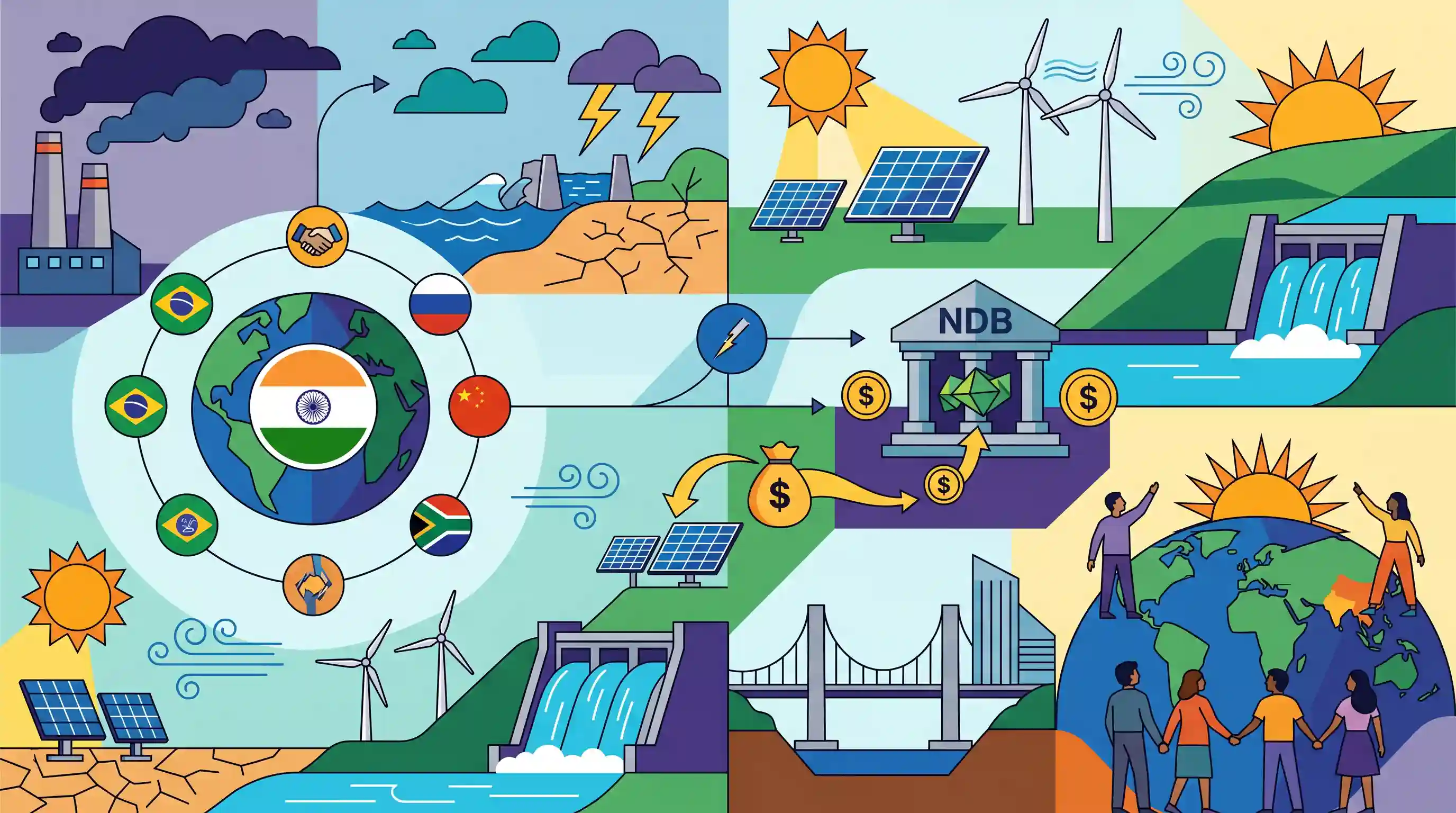
The article emphasizes that the upcoming BRICS summit, hosted by India, should prioritize a "green and resilient" agenda. It highlights the opportunity for India to steer the bloc towards enhanced cooperation on climate change, renewable energy, and sustainable development. By leveraging institutions like the New Development Bank (NDB) for climate finance and focusing on resilient infrastructure, BRICS can play a pivotal role in addressing the shared ecological and economic challenges faced by emerging economies, thereby strengthening the Global South's position in global climate action.
Key Points
- India's hosting of the BRICS summit provides a strategic opportunity to embed a green and resilient agenda into the bloc's development priorities.
- There is a pressing need for BRICS nations to collaborate on climate adaptation, renewable energy transitions, and building disaster-resilient infrastructure.
- The New Development Bank (NDB) can act as a crucial mechanism for mobilizing climate finance and funding sustainable projects across member states and the Global South.
- India can leverage its presidency to amplify the voices of emerging economies in global climate governance, balancing economic growth with ecological sustainability.
Important Terms
BRICS

An informal group of major emerging economies (initially Brazil, Russia, India, China, and South Africa) representing over 40% of the world's population and advocating for a multipolar global order.
UPSC context
GS Paper II: International Relations; crucial for understanding India's role in global governance and South-South cooperation.
New Development Bank (NDB)
A multilateral financial institution established by BRICS in 2014 to mobilize resources for infrastructure and sustainable development projects in emerging economies, providing an alternative to the World Bank.
UPSC context
GS Paper II & III: Important International institutions and Economy; tests knowledge of alternative financial architectures and green financing.
Global South
A geopolitical term for developing and emerging nations primarily in Asia, Africa, and Latin America, emphasizing shared economic challenges and a collective voice in global climate and trade negotiations.
UPSC context
GS Paper II: International Relations; relevant to India's leadership role and advocacy for equity in global forums.
Climate Finance
Local, national, or transnational financing—from public and private sources—intended to support climate change mitigation and adaptation actions, a key demand of developing nations for green transitions.
UPSC context
GS Paper III: Environment and Economy; critical for topics related to climate change negotiations and sustainable development.
Resilient Infrastructure
Infrastructure systems designed to withstand and recover quickly from shocks, particularly climate-related disasters, ensuring the continuity of essential services like energy, water, and transport.
UPSC context
GS Paper III: Disaster Management and Environment; reflects India's focus on initiatives like CDRI and sustainable urban planning.
Sustainable Development Goals (SDGs)
A set of 17 global goals established by the United Nations in 2015 to end poverty, protect the planet, and ensure prosperity for all by 2030.
UPSC context
GS Paper II & III: Governance and Social Justice; the standard framework for assessing developmental progress.
Prelims Trap
"The New Development Bank (NDB) limits its membership and sustainable project funding exclusively to the BRICS countries."
While founded by BRICS, the NDB is open to any UN member state. Bangladesh, UAE, and Egypt are members, reflecting its broader Global South mandate.
Static Concepts Connected
What is the mandate and structure of the New Development Bank (NDB)?
- Origin: Established by BRICS states via the 2014 Fortaleza Declaration to fund infrastructure and sustainable development.
- Equal Shareholding: Initial subscribed capital was distributed equally among the five founding members, preventing any single-nation veto power.
- Expanded Membership: Membership is open to all UN members. Recent additions include Bangladesh, UAE, and Egypt.
What is India's Coalition for Disaster Resilient Infrastructure (CDRI)?
- Launch: Initiated by India at the 2019 UN Climate Action Summit to climate-proof global infrastructure systems.
- Structure: A global partnership of governments, UN agencies, multilateral banks, and private sectors; not an intergovernmental treaty.
- Synergy with NDB: Acts as a knowledge-sharing platform that can guide multilateral climate finance mechanisms like the NDB.
Cross-Topic Patterns
NDB finance + CDRI synergies
India's focus on disaster-resilient infrastructure at BRICS directly intersects with its leadership in CDRI, aiming to channel NDB funds toward climate-proof projects in the Global South.
Expanded BRICS + UNFCCC leverage
With new members like UAE and Egypt, an enlarged BRICS acts as a powerful negotiating bloc at COP summits, demanding equitable climate finance from the Global North.

Expect a 2026 Prelims multi-statement question comparing the shareholding, climate mandates, and expanded membership of NDB versus AIIB.
Linked PYQs · 5
Linked PYQs · 5
- 2012MainsGS2
Compare the significance of IBSA and BRICS in the context of India's multilateral diplomacy.
- 2014MainsGS2
India has recently signed to become founding member of New Development Bank (NDB) and also the Asian Infrastructure Investment Bank (AIIB). How will the role of the two Banks be different ? Discuss the strategic significance of these two Banks for India.
- 2022MainsGS3
Do you think India will meet 50 percent of its energy needs from renewable energy by 2030 ? Justify your answer. How will the shift of subsidies from fossil fuels to renewables help achieve the above objective ? Explain.
- 2024MainsGS3
What is disaster resilience? How is it determined? Describe various elements of a resilience framework. Also mention the global targets of Sendai Framework for Disaster Risk Reduction (2015–2030).
- 2021MainsGS3
Explain the purpose of the Green Grid Initiative launched at World Leaders Summit of the COP26 UN Climate Change Conference in Glasgow in November, 2021. When was this idea first floated in the International Solar Alliance (ISA)?
