BRICS Consensus on Cross-Border Terrorism and Tariffs
Source:Indian Express ↗
Why It Matters
This article highlights India's ability to leverage multilateral forums like BRICS to build consensus against state-sponsored cross-border terrorism. It also showcases the unified stance of emerging economies against growing Western trade protectionism and their commitment to global climate agreements, which is highly relevant for GS2 (IR) and GS3 (Economy & Security) Mains answers.
Summary
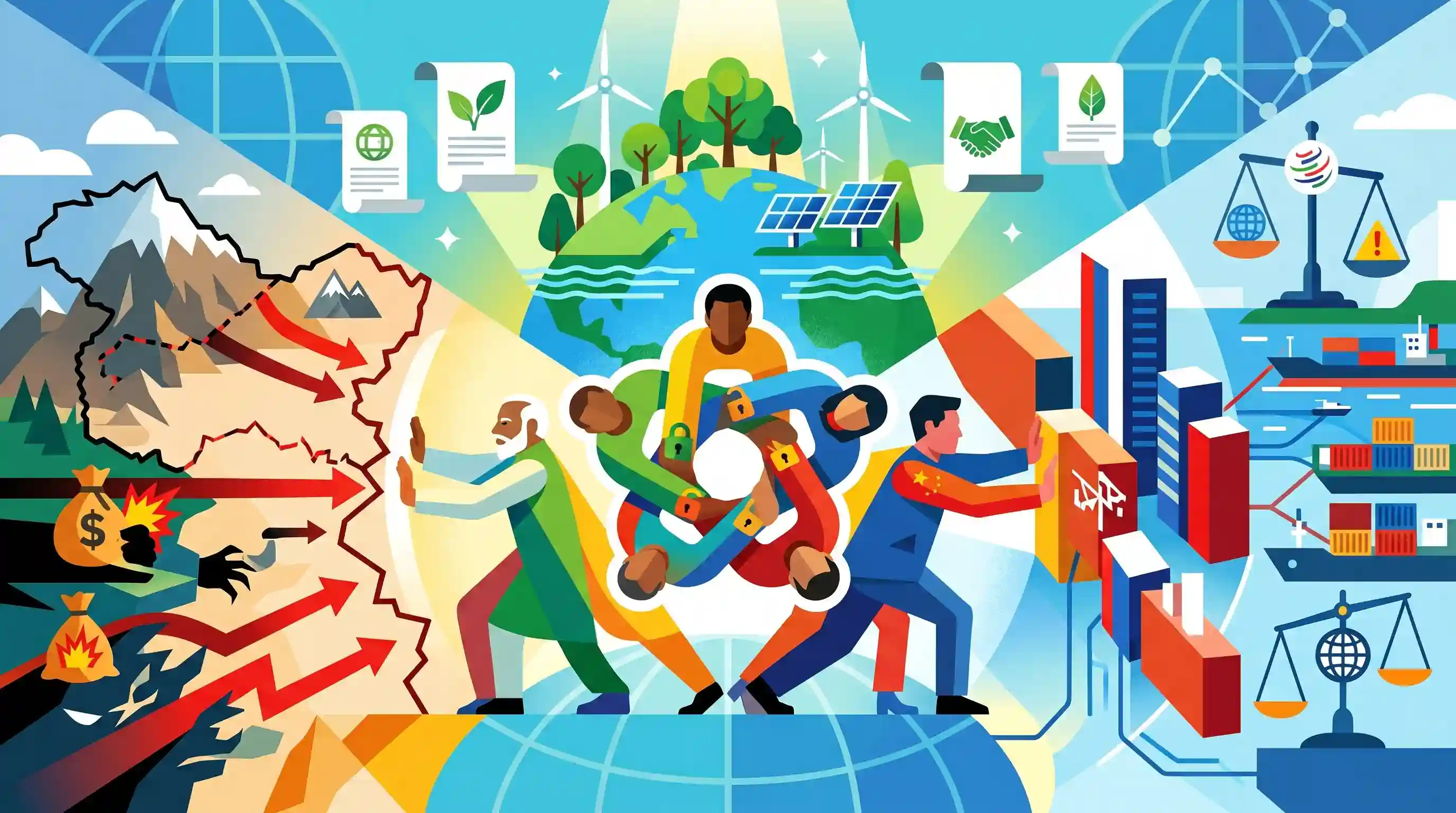
At a recent BRICS foreign ministers' meeting, the bloc issued a joint statement strongly condemning the 2025 Pahalgam terrorist attack in Jammu and Kashmir. Emphasizing zero tolerance, the ministers called for robust measures against cross-border terrorism, terror financing, and safe havens, marking a diplomatic win for India given China's participation. Additionally, the statement criticized rising global protectionism, arbitrary tariff wars, and unilateral trade measures that violate WTO rules—an oblique reference to US trade policies. The grouping also reaffirmed its steadfast commitment to multilateralism, the UNFCCC, and the Paris Agreement on climate change.
Key Points
- BRICS foreign ministers unanimously condemned the 2025 Pahalgam terrorist attack in J&K, calling for strict action against cross-border terrorism, terrorism-financing, and safe havens.
- The consensus is seen as a diplomatic victory for India, especially since China, an ally of Pakistan, backed the joint condemnation.
- The bloc raised concerns over the proliferation of unilateral trade tariffs and protectionist measures, criticizing them as inconsistent with WTO rules.
- Member nations reaffirmed their collective commitment to the UNFCCC and the Paris Agreement, pushing back against unilateral withdrawals from climate pacts.
Important Terms
BRICS

An influential intergovernmental organization of emerging economies—originally Brazil, Russia, India, China, and South Africa—expanded in 2024 to include Iran, Egypt, Ethiopia, and the UAE to promote South-South cooperation.
UPSC context
GS Paper II: International relations and global groupings; critical for understanding India’s role in a multipolar world and global governance reform.
Pahalgam Terrorist Attack (2025)
A major terrorist strike in Jammu and Kashmir on April 22, 2025. Its unanimous condemnation by BRICS foreign ministers in 2026 highlights India’s diplomatic success in gaining bloc-wide support against cross-border terrorism.
UPSC context
GS Paper III: Security challenges and management in border areas; tests India’s diplomatic strategy to isolate terror-supporting state actors.
World Trade Organization (WTO)
The sole global international organization dealing with the rules of trade between nations. It provides a forum for negotiating agreements and resolving disputes to ensure smooth, predictable, and free global trade.
UPSC context
GS Paper III: Issues related to international trade and intellectual property rights; vital for analyzing India's trade policy and economic sovereignty.
WTO rules
The legal framework and agreements—primarily GATT and GATS—negotiated by member states to prevent trade discrimination. Arbitrary tariffs and unilateral protectionist measures are often cited as violations of these rules.
UPSC context
GS Paper III: Impact of global protectionism and trade wars on India's economy and its exports.
UNFCCC
The United Nations Framework Convention on Climate Change (1992) is the foundational treaty aimed at stabilizing atmospheric greenhouse gas concentrations to prevent dangerous human interference with the climate system.
UPSC context
GS Paper III: Environmental conservation and climate change; fundamental for global environmental governance and India’s climate commitments.
Paris Agreement
A legally binding 2015 international treaty within the UNFCCC framework. It aims to limit global warming to well below 2 degrees Celsius, preferably 1.5 degrees, compared to pre-industrial levels.
UPSC context
GS Paper III: Global environmental targets and India’s Nationally Determined Contributions (NDCs) for sustainable development.
Prelims Trap
The Comprehensive Convention on International Terrorism (CCIT) is an active, legally binding UN treaty supported by BRICS consensus.
The CCIT is still just a draft. Proposed by India in 1996, it remains deadlocked at the UN over disagreements on universally defining "terrorism".
Static Concepts Connected
What is the Comprehensive Convention on International Terrorism (CCIT)?
- Indian Initiative: Proposed by India at the UN General Assembly in 1996 to establish a comprehensive global counter-terrorism framework.
- Universal Definition: Seeks to provide a universal legal definition of terrorism, binding all states to outlaw terror financing and deny safe havens.
- Current Status: Remains deadlocked at the UN due to lack of consensus on defining terrorism, particularly regarding national liberation movements.
How do unilateral environmental tariffs conflict with global trade regimes?
- MFN Principle: WTO rules dictate equal tariff treatment (MFN). Unilateral carbon taxes on imports, like CBAM, can be legally challenged as discriminatory.
- CBDR vs Protectionism: Developing nations argue unilateral tariffs violate the UNFCCC principle of Common But Differentiated Responsibilities (CBDR), acting as disguised protectionism.
Cross-Topic Patterns
Climate measures as trade barriers
The BRICS critique of "unilateral trade measures" directly links UNFCCC climate goals to WTO rules, targeting policies like the EU's Carbon Border Adjustment Mechanism (CBAM) as disguised protectionism.
SCO and BRICS anti-terror alignment
India successfully leverages both the SCO's RATS mechanism and BRICS joint statements to systematically box in Pakistan on cross-border terror, forcing China into an uncomfortable consensus.

Mains 2026: Expect a question on how the Global South via BRICS uses WTO rules and CBDR to counter Western climate tariffs like EU CBAM.
Linked PYQs · 3
Linked PYQs · 3
- 2016MainsGS2
Increasing cross-border terrorist attacks in India and growing interference in the internal affairs of several member-states by Pakistan are not conducive for the future of SAARC (South Asian Association for Regional Cooperation)." Explain with suitable examples.
- 2025MainsGS3
What are the challenges before the Indian economy when the world is moving away from free trade and multilateralism to protectionism and bilateralism? How can these challenges be met?
- 2016PrelimsGS1
With reference to the Agreement at the UNFCCC Meeting in Paris in 2015, which of the following statements is/are correct? 1. The Agreement was signed by all the member countries of the UN and it will go into effect in 2017. 2. The Agreement aims to limit the greenhouse gas emissions so that the rise in average global temperature by the end of this century does not exceed 2°C or even 1.5°C above pre-industrial levels. 3. Developed countries acknowledged their historical responsibility in global warming and committed to donate $ 1000 billion a year from 2020 to help developing countries to cope with climate change. Select the correct answer using the code given below.
