India Champions Two-State Solution and Climate Equity at BRICS Meet
Source:The Hindu ↗
Why It Matters
This summit underscores India's strategic balancing act within BRICS. It highlights India's nuanced positions on the Middle East conflict, global maritime security, and international climate negotiations, showcasing its leadership role as a voice for the Global South while maintaining constructive relations with the West.
Summary
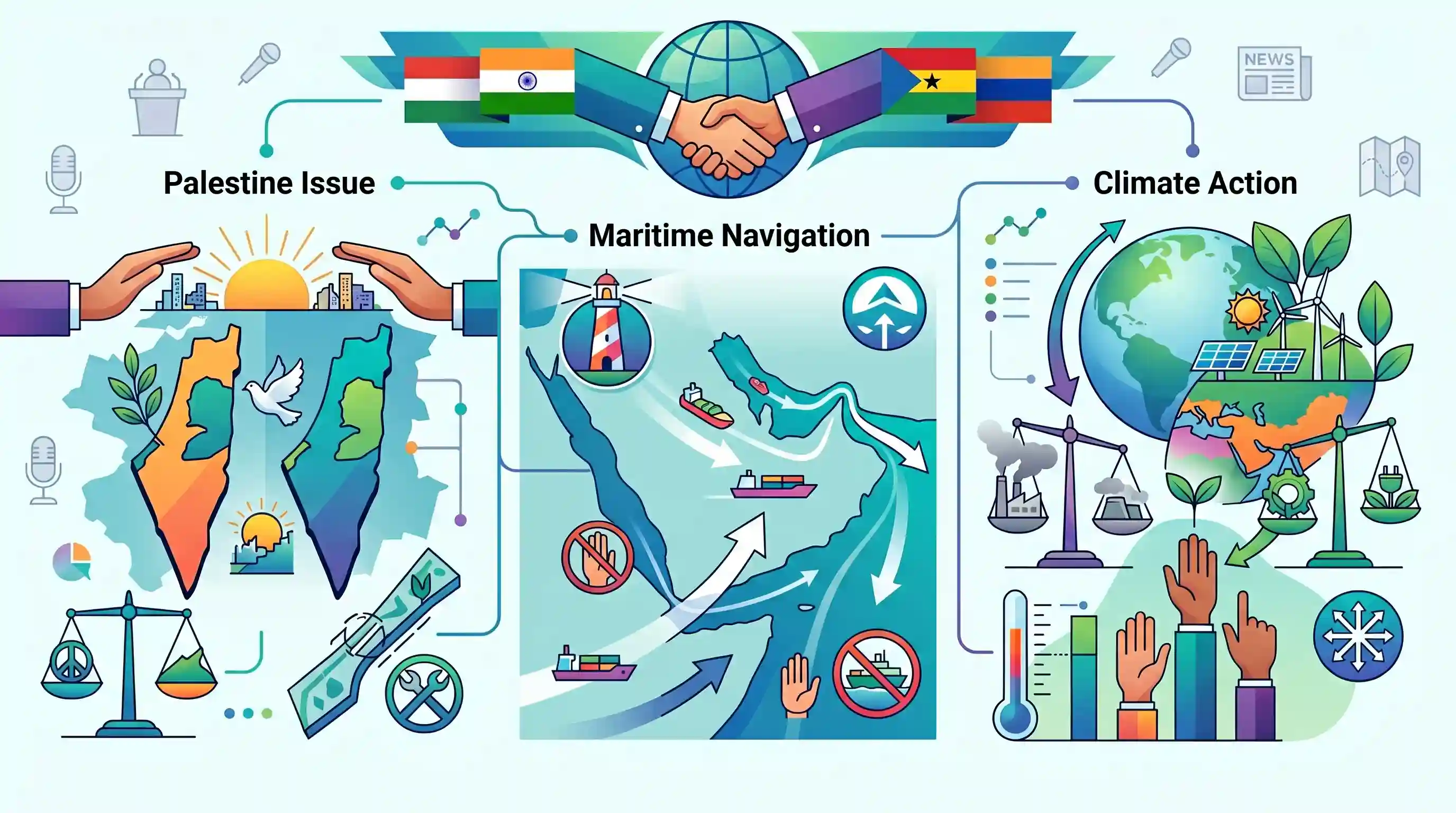
During the BRICS Foreign Ministers' summit in New Delhi, External Affairs Minister S. Jaishankar articulated India's stance on several pressing global challenges. He reiterated India's steadfast support for a two-state solution to resolve the Palestine issue and called for stabilizing the situation in Gaza. Addressing geopolitical disruptions, he emphasized the critical need for unimpeded maritime navigation through the Red Sea and the Strait of Hormuz. Furthermore, Jaishankar championed the Global South's interests by insisting that climate action must be rooted in the principle of equity and Common but Differentiated Responsibilities and Respective Capabilities (CBDR-RC).
Key Points
- At the BRICS Foreign Ministers' summit, EAM S. Jaishankar reaffirmed India's commitment to a two-state solution for the Israel-Palestine conflict and called for an end to the Gaza crisis.
- He highlighted the necessity of maintaining safe and unimpeded maritime flows through critical international waterways, specifically mentioning the Strait of Hormuz and the Red Sea.
- India advocated for an inclusive international framework, focusing on reforming global governance institutions rather than framing BRICS as an inherently anti-Western bloc.
- On climate change, Jaishankar emphasized the need for equity, stressing that developed countries must adhere to the principle of Common but Differentiated Responsibilities and Respective Capabilities (CBDR-RC).
Important Terms
BRICS

An association of major emerging economies (Brazil, Russia, India, China, South Africa) seeking global governance reform and economic cooperation. It recently expanded to include nations like Iran, Egypt, and the UAE.
UPSC context
GS-II: Global Groupings. Tests understanding of India’s strategic autonomy and its role in promoting a multipolar world order through non-Western platforms.
Two-State Solution
A proposed diplomatic framework to resolve the Israel-Palestine conflict by establishing an independent Palestinian state alongside Israel, typically based on pre-1967 borders with mutually agreed land swaps.
UPSC context
GS-II: International Relations. Tests knowledge of West Asian geopolitics and India’s long-standing, balanced foreign policy supporting both Israeli security and Palestinian statehood.
Common but Differentiated Responsibilities and Respective Capabilities (CBDR-RC)
A UNFCCC principle acknowledging that while all states share responsibility for addressing climate change, developed nations bear a greater historical burden and possess more resources for mitigation.
UPSC context
GS-III: Environment. Tests understanding of climate justice, international environmental treaties, and India’s advocacy for equity in global climate action.
Global South
A geopolitical and economic term referring to developing or less-developed nations, primarily in Africa, Asia, and Latin America, characterized by shared histories of colonialism and marginalization.
UPSC context
GS-II: International Relations. Tests India’s leadership role as a "voice" for developing nations and its strategic alignment with the developing world.
Strait of Hormuz
A critical maritime chokepoint between the Persian Gulf and the Gulf of Oman. It is the world’s most important oil transit route, handling roughly 20% of global consumption.
UPSC context
GS-I: Geography; GS-II: IR. Tests awareness of strategic waterways and the regional stability essential for India’s energy security.
Red Sea
A vital seawater inlet of the Indian Ocean connecting to the Mediterranean via the Suez Canal. It is a key corridor for India’s trade with Europe and Africa.
UPSC context
GS-I: Geography; GS-II: IR. Tests knowledge of maritime security challenges and their impact on global trade and India’s economic interests.
Prelims Trap
"The Strait of Hormuz is a critical chokepoint connecting the Red Sea to the Mediterranean."
The Strait of Hormuz actually connects the Persian Gulf to the Gulf of Oman. The Red Sea's access points are the Suez Canal and the Bab el-Mandeb strait. UPSC frequently swaps these.
Static Concepts Connected
What is the principle of Common but Differentiated Responsibilities (CBDR-RC)?
- Origin: Formalized during the 1992 Earth Summit (UNFCCC) in Rio de Janeiro.
- Core premise: Acknowledges all states share an obligation to address environmental destruction, but unequal historical responsibility and economic capacity dictate different burdens.
- Policy application: It mandates that developed nations take the lead in emissions reduction and provide climate finance to developing countries.
What are the primary maritime chokepoints in West Asia?
- Strait of Hormuz: Links the Persian Gulf to the Gulf of Oman and Arabian Sea. Bordered by Iran, Oman, and the UAE.
- Bab el-Mandeb: Connects the Red Sea to the Gulf of Aden and Arabian Sea. Bordered by Yemen on the Arabian Peninsula, and Djibouti/Eritrea in Africa.
- Suez Canal: An artificial sea-level waterway in Egypt connecting the Mediterranean Sea to the Red Sea, separating Africa from Asia.
Cross-Topic Patterns
BRICS Expansion & Multilateral Reform
India leverages BRICS to amplify Global South issues and push UN/WTO reform, deliberately balancing its Quad membership through strategic autonomy rather than adopting an explicit anti-Western stance.
West Asia Chokepoints & Energy Security
Disruptions in the Red Sea and Strait of Hormuz directly impact India's crude imports and inflation, fusing core macroeconomic stability with international maritime security and freedom of navigation.

Expect a 2026 Prelims multi-statement question mapping West Asian maritime chokepoints combined with India's climate stance on CBDR-RC.
Linked PYQs · 5
Linked PYQs · 5
- 2012MainsGS2
Compare the significance of IBSA and BRICS in the context of India's multilateral diplomacy.
- 2018MainsGS2
“India’s relations with Israel have, of late, acquired a depth and diversity, which cannot be rolled back.” Discuss.
- 2024PrelimsGS1
Consider the following statements : Statement-I : Sumed pipeline is a strategic route for Persian Gulf oil and natural gas shipments to Europe. Statement-II : Sumed pipeline connects the Red Sea with the Mediterranean Sea. Which one of the following is correct in respect of the above statements?
- 2020MainsGS3
Explain intra-generational and inter-generational issues of equity from the perspective of inclusive growth and sustainable development.
- 2025MainsGS3
Write a review on India's climate commitments under the Paris Agreement (2015) and mention how these have been further strengthened in COP26 (2021). In this direction, how has the first Nationally Determined Contribution intended by India been updated in 2022?
