BRICS Condemns EU Carbon Border Adjustment Mechanism as Protectionist
Source:The Hindu ↗
આ શા માટે મહત્વનું છે
The article highlights the intensifying friction between global trade rules and climate governance. CBAM is viewed by developing nations as 'green protectionism' that bypasses the CBDR principle under UNFCCC. Understanding India's vulnerability (particularly in the steel sector) and its collective bargaining posture via BRICS is vital for analyzing international trade negotiations, climate finance deficits (mitigation vs. adaptation), and North-South geopolitical tensions.
સારાંશ
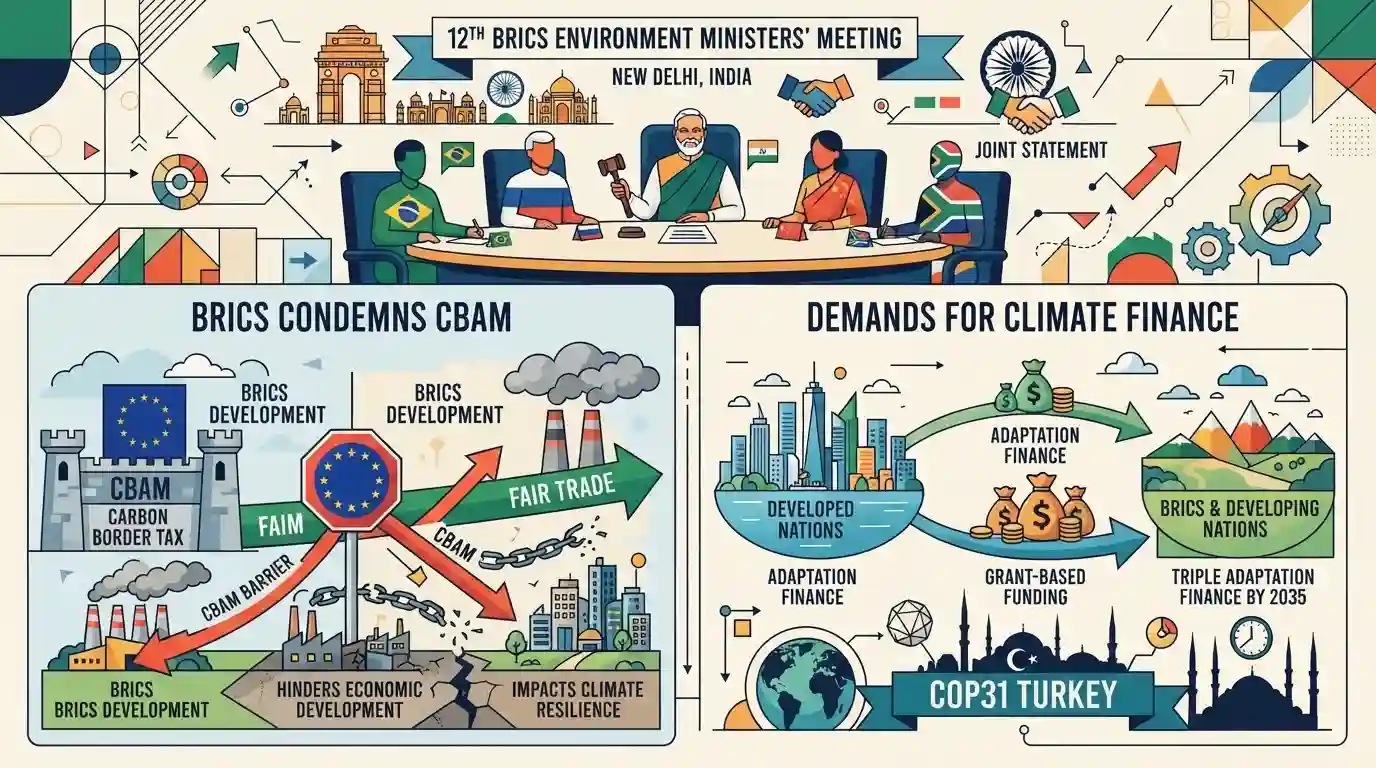
The 12th BRICS Environment Ministers' Meeting, held in New Delhi under India's chairship, adopted a joint statement condemning the European Union's Carbon Border Adjustment Mechanism (CBAM) as a unilateral and protectionist trade barrier. The member nations asserted that CBAM hinders developing countries' climate resilience and economic development. Additionally, BRICS demanded that developed countries honor their commitments to triple adaptation finance for developing nations by 2035, advocating for grant-based and concessional funding ahead of the COP31 climate conference in Turkey.
મુખ્ય મુદ્દા
- At the 12th BRICS Environment Ministers' Meeting in New Delhi, member nations adopted a joint statement opposing unilateral, punitive, and protectionist climate measures such as the EU's Carbon Border Adjustment Mechanism (CBAM).
- BRICS ministers argued that CBAM could undermine developing nations' capacity to address climate change and build economic resilience, pointing out that environmental policies should not serve as disguised trade barriers.
- India is heavily exposed to CBAM, with iron and steel making up nearly 90% of its covered exports to the EU; high-emission Indian steel firms have already seen reduced export volumes and revenues due to CBAM compliance.
- The joint statement called on developed nations to urgently triple adaptation climate finance to developing countries by 2035, adhering to commitments agreed at the 2025 UN climate conference.
- BRICS demanded that climate adaptation funding be new, additional, predictable, accessible, and heavily reliant on grants or concessional finance to avoid increasing the debt burden of developing states.
મહત્વપૂર્ણ શબ્દો
Carbon Border Adjustment Mechanism (CBAM)

An EU trade policy imposing a carbon tax on imported carbon-intensive goods, such as steel and cement. It aims to match domestic carbon pricing to ensure fair competition and prevent carbon leakage.
UPSC context
Crucial for GS-3 (Economy/Environment) to analyze non-tariff trade barriers, climate equity, and impacts on India's export competitiveness.
BRICS
An intergovernmental organization originally comprising Brazil, Russia, India, China, and South Africa, now expanded to include other emerging economies. It advocates for global multipolarity, economic cooperation, and reforms in global governance.
UPSC context
Key for GS-2 (International Relations) as it tests India's role in South-South cooperation and shifting global geopolitical dynamics.
Common But Differentiated Responsibilities (CBDR)
A core UNFCCC principle stating that while all nations must fight climate change, developed countries bear greater historical responsibility and must take the lead in mitigation and providing climate finance.
UPSC context
Essential for GS-3 (Environment) and GS-2 (IR) to argue climate justice, equity, and the global North-South divide in climate negotiations.
Carbon Leakage
A phenomenon where strict domestic climate policies push carbon-intensive industries to relocate to countries with weaker environmental regulations, thereby displacing rather than reducing overall global greenhouse gas emissions.
UPSC context
Tests GS-3 (Environment/Economy) concepts regarding the unintended consequences of unilateral climate policies like the EU's CBAM.
Paris Agreement
A legally binding 2015 global treaty under the UNFCCC aiming to limit global warming to well below 2°C above pre-industrial levels, relying on bottom-up Nationally Determined Contributions (NDCs).
UPSC context
Highly relevant for GS-3 (Environment), testing global climate frameworks, emission targets, and the operationalization of climate finance.
UNFCCC
A foundational 1992 multilateral environmental treaty aiming to stabilize atmospheric greenhouse gas concentrations. It provides the core legal and institutional framework for annual global climate negotiations, known as COPs.
UPSC context
Foundational for GS-3 (Environment) to understand international climate architecture, historical treaties, and India's long-term climate commitments.
પ્રિલિમ્સ ટ્રેપ
CBAM revenues are internationally earmarked to fund green transition projects in developing countries.
CBAM is an EU-specific domestic trade regulation. Revenues flow directly into the EU's budget as 'own resources', not to any UNFCCC or global climate fund.
સંલગ્ન સ્થિર ખ્યાલો
What is the EU's Carbon Border Adjustment Mechanism (CBAM)?
- Primary Objective: Prevents 'carbon leakage' by ensuring imported goods face carbon costs equivalent to domestic EU production.
- Sectoral Coverage: Targets six highly trade-exposed, energy-intensive sectors: Iron & Steel, Cement, Aluminium, Fertilisers, Electricity, and Hydrogen.
- Compliance Tool: Importers purchase financial certificates representing the carbon price that would have been paid under EU ETS rules.
What is the principle of CBDR-RC under the UNFCCC?
- Origin and Premise: Enshrined in the 1992 UNFCCC, acknowledging that all states must address climate change but have different capabilities and historical responsibilities.
- Historical Responsibility: Establishes that developed nations, having contributed the most to cumulative emissions, must take the lead in mitigation and funding.
- Resource Linkage: Developing nations' climate actions depend on the effective implementation of financial and technological commitments by developed countries.
આંતર-વિષય પેટર્ન
Green Protectionism vs. WTO Law
Analyzes how unilateral environmental tariffs like CBAM clash with WTO's non-discrimination principles (GATT Article III on National Treatment and Article I on Most-Favoured-Nation status).
Climate Finance and Debt Sustainability
Examines how debt-laden Global South economies face a compounding crisis when climate finance is delivered as non-concessional loans rather than grants, risking sovereign defaults.

CBAM's sectoral coverage and its compatibility with CBDR-RC/WTO norms will likely feature in a complex GS-3 Mains or Prelims question.
સંલગ્ન PYQ · 4
સંલગ્ન PYQ · 4
- 2025MainsGS3
What are the challenges before the Indian economy when the world is moving away from free trade and multilateralism to protectionism and bilateralism? How can these challenges be met?
- 2025MainsGS3
Write a review on India's climate commitments under the Paris Agreement (2015) and mention how these have been further strengthened in COP26 (2021). In this direction, how has the first Nationally Determined Contribution intended by India been updated in 2022?
- 2012MainsGS2
Compare the significance of IBSA and BRICS in the context of India's multilateral diplomacy.
- 2014MainsGS3
Should the pursuit of carbon credits and clean development mechanisms set up under UNFCCC be maintained even though there has been a massive slide in the value of a carbon credit? Discuss with respect to India's energy needs for economic growth.
