Strategic Evolution and Future of BRICS Grouping
Source:The Hindu ↗
Why It Matters
Understanding the internal dynamics and strategic trajectory of BRICS is critical for UPSC aspirants, as it directly relates to India's foreign policy maneuvering, its leadership aspirations in the Global South, and the broader push for a multipolar world order and reformed multilateralism.
Summary
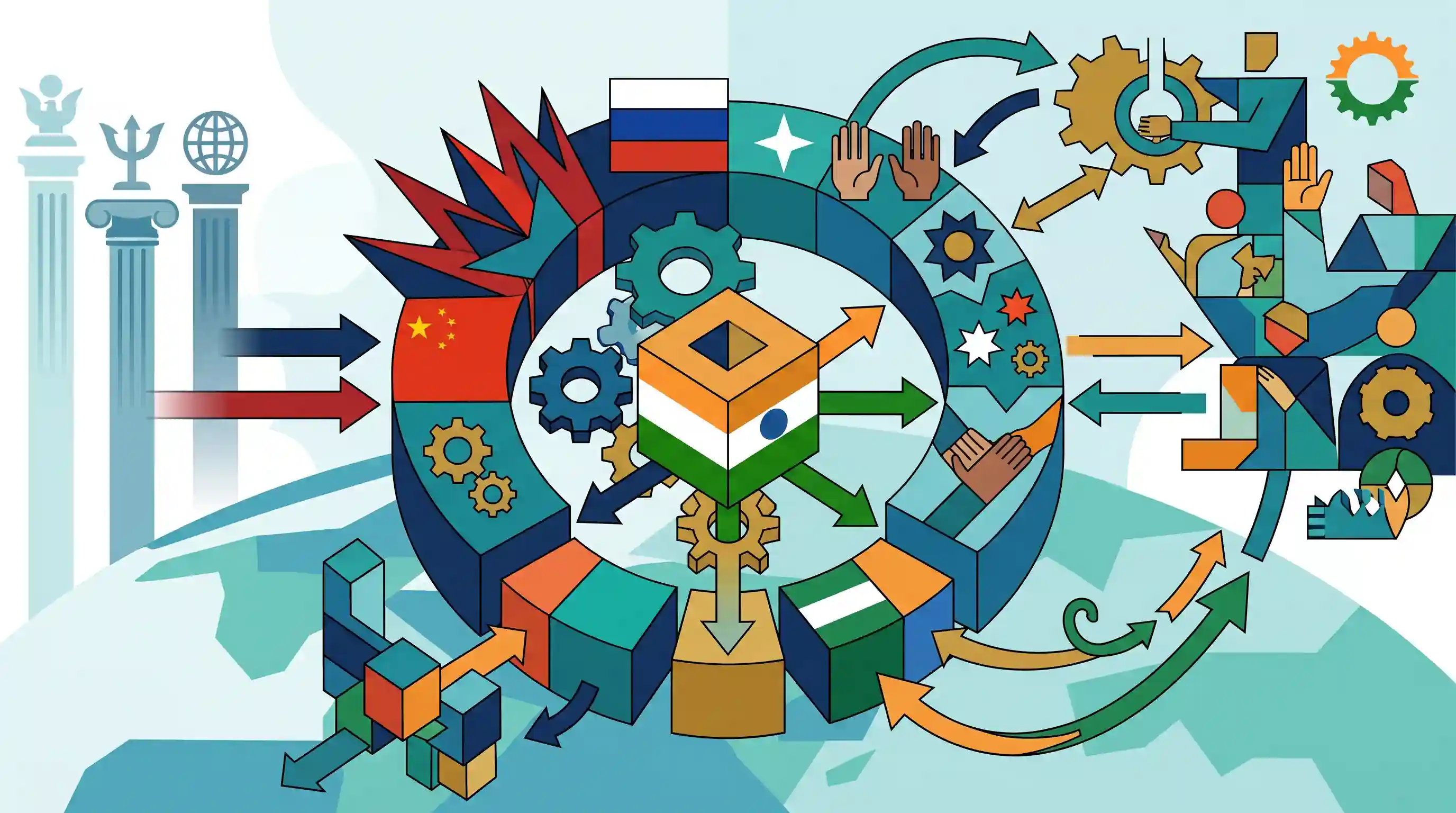
The article examines the strategic inflection point facing the BRICS grouping as it navigates expansion, internal geopolitical divergences, and an evolving global order. With the induction of new members, BRICS seeks to amplify the voice of the Global South and push for democratization in global governance architectures. However, the grouping finds itself at a crossroads due to competing internal visions. While Russia and China increasingly attempt to leverage BRICS as an anti-Western bulwark to challenge the established order, India remains steadfast in maintaining its character as a non-Western, consensus-driven platform focused on economic cooperation and multipolarity. India's crucial balancing role ensures that the forum is not weaponized or entirely dominated by Chinese geopolitical ambitions, thereby sustaining BRICS's relevance as a constructive bridge in a divided international system.
Key Points
- Evaluates the recent expansion of BRICS and its implications for the grouping's internal cohesion and decision-making mechanisms in a multipolar world.
- Highlights the ideological tug-of-war within BRICS, contrasting the Russia-China push for an explicitly anti-Western bloc against India's insistence on a non-Western, developmental platform.
- Discusses the necessity for BRICS to act as a catalyst for reforming outdated global governance structures, including the UN and Bretton Woods institutions.
- Examines India's strategic balancing act to prevent the forum from becoming a vehicle for Chinese geopolitical dominance, while simultaneously leveraging it to champion the Global South.
- Underlines the importance of institutional outputs like the New Development Bank in providing alternative financial architecture for emerging economies.
Important Terms
BRICS

An association of major emerging economies—originally Brazil, Russia, India, China, and South Africa—seeking to reform global governance and promote a multipolar world order. It recently expanded to include Egypt, Ethiopia, Iran, and UAE.
UPSC context
GS Paper II (International Relations). Tests knowledge of global groupings, India’s strategic autonomy, and leadership of the Global South.
Fortaleza Declaration
The 2014 agreement signed during the 6th BRICS Summit in Brazil. It institutionalized the group by establishing the New Development Bank (NDB) and the Contingent Reserve Arrangement (CRA).
UPSC context
GS Paper II. Relevant for identifying key milestones in BRICS evolution and the creation of alternative global financial architectures.
New Development Bank (NDB)
A multilateral development bank established by BRICS in 2014 to mobilize resources for infrastructure and sustainable development in emerging markets and developing countries, serving as an alternative to the World Bank.
UPSC context
GS Paper II & III. Important for understanding international financial institutions and India’s role in reshaping development finance.
United Nations Security Council (UNSC)
One of the six principal organs of the UN, charged with maintaining international peace. India seeks permanent membership and comprehensive reform to reflect current geopolitical realities.
UPSC context
GS Paper II. A core topic in Indian foreign policy regarding global governance reform and India’s aspirations for permanent membership.
Global South
A term used to describe developing, less-developed, or under-represented nations, primarily in Africa, Asia, and Latin America. BRICS aims to be a primary voice for this bloc.
UPSC context
GS Paper II. Central to India’s "Vishwa Bandhu" diplomacy and its role as a bridge between the West and developing nations.
Multipolarity
An international system where power is distributed among several major nations or blocs, rather than a single superpower. It is a core objective of Indian foreign policy.
UPSC context
GS Paper II. Tests understanding of India’s strategic vision for a balanced world order and its opposition to hegemonies.
Prelims Trap
The BRICS Contingent Reserve Arrangement (CRA) provides long-term infrastructure funding for member nations.
Aspirants often confuse CRA with the New Development Bank (NDB). NDB funds infrastructure projects, whereas the CRA provides short-term liquidity support (currency swaps) for Balance of Payments crises.
Static Concepts Connected
What are the key financial architectures established by BRICS under the 2014 Fortaleza Declaration?
- New Development Bank: Mobilizes resources for infrastructure and sustainable development projects in BRICS and other emerging economies.
- Contingent Reserve Arrangement: A framework providing short-term liquidity support through currency swaps to mitigate global liquidity pressures and Balance of Payment (BoP) crises.
What are the primary demands of the Global South regarding Bretton Woods institution reform?
- Quota Reforms: Realigning IMF voting quotas to accurately reflect the current economic weight and GDP contributions of emerging markets.
- Conditionality Reduction: Reducing the stringent, often one-size-fits-all austerity and policy conditionalities tied to IMF and World Bank lending.
- Leadership Diversification: Ending the unwritten convention that the World Bank is always led by an American and the IMF by a European.
Cross-Topic Patterns
Multi-alignment vs Anti-Western institutionalization
India's strategy in BRICS mirrors its SCO approach: engaging in non-Western forums for economic gains while actively pushing back against Chinese-led attempts to weaponize the groupings against the West.
BRICS Expansion + De-dollarization trends
The induction of energy giants like Iran and the UAE into BRICS accelerates the push for cross-border trade settlements in local currencies, systematically reducing reliance on the US petrodollar.

BRICS expansion (Iran, UAE, Ethiopia, Egypt) mapped against regional blocs (AU, Arab League) is a prime multi-statement target for 2026.
Linked PYQs · 5
Linked PYQs · 5
- 2012MainsGS2
Compare the significance of IBSA and BRICS in the context of India's multilateral diplomacy.
- 2025MainsGS2
"The reform process in the United Nations remains unresolved, because of the delicate imbalance of East and West and entanglement of the USA vs. Russo-Chinese alliance.” Examine and critically evaluate the East-West policy confrontations in this regard.
- 2024MainsGS2
‘The West is fostering India as an alternative to reduce dependence on China's supply chain and as a strategic ally to counter China's political and economic dominance.’ Explain this statement with examples.
- 2015PrelimsGS1
The 'Fortaleza Declaration', recently in the news, is related to the affairs of
- 2025PrelimsGS1
Consider the following statements with regard to BRICS : I. 16th BRICS Summit was held under the Chairship of Russia in Kazan. II. Indonesia has become a full member of BRICS. III. The theme of the 16th BRICS Summit was Strengthening Multiculturalism for Just Global Development and Security. Which of the statements given above is/are correct?
