India to Lead Seed Rights and Digital Farming Initiatives Under BRICS
Source:the-times-of-india ↗
Why It Matters
The adoption of the Indore Declaration showcases India's leadership in South-South cooperation, particularly in agricultural diplomacy, technology-driven farming, and sustainable food security. It highlights the international prominence of Indore (Madhya Pradesh) and aligns with national priorities led by Union Minister Shivraj Singh Chouhan.
Summary
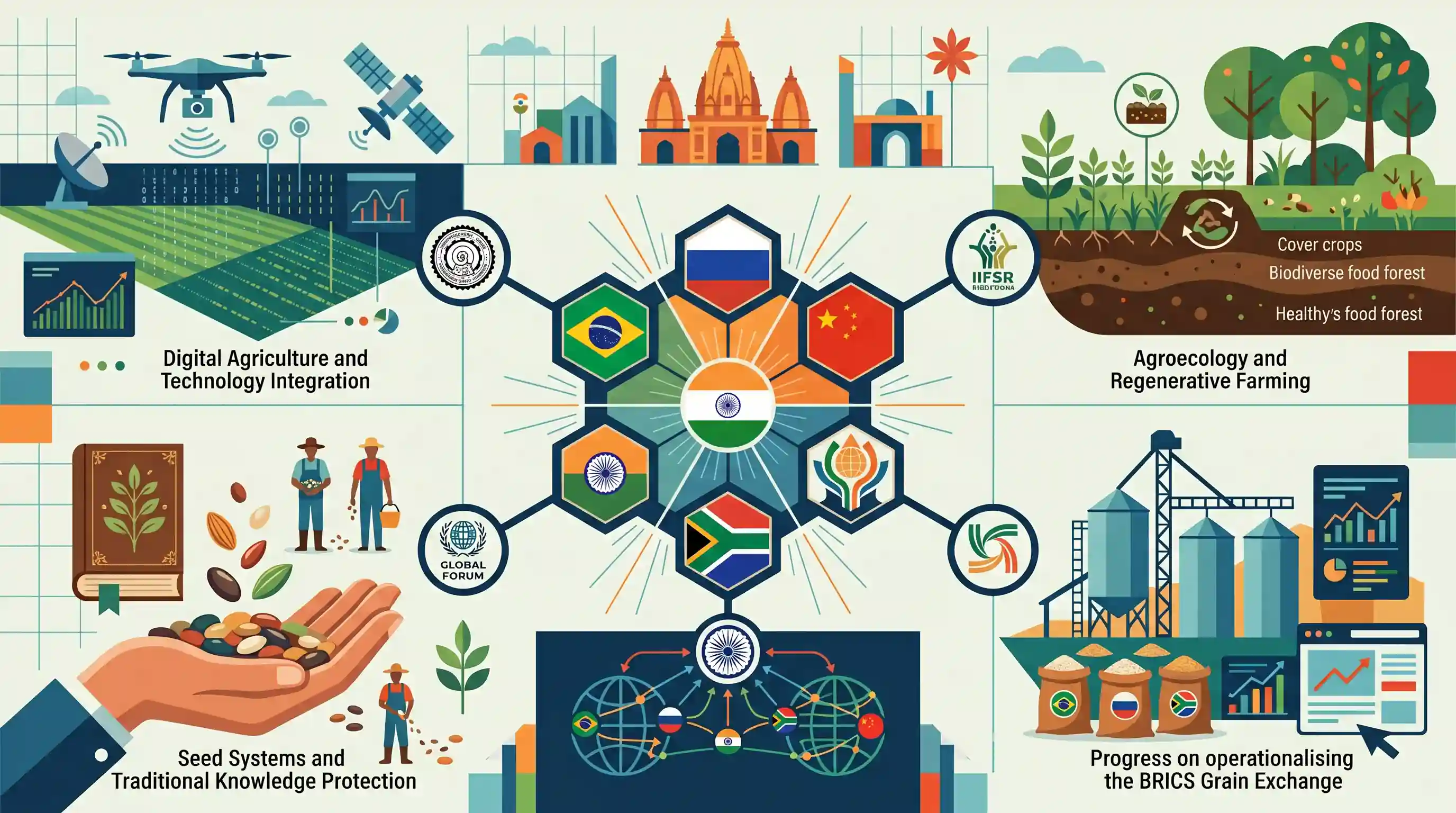
The BRICS nations adopted the 'Indore Declaration' during a five-day ministerial meeting in Indore, Madhya Pradesh, under India's presidency. The declaration establishes crucial initiatives to boost digital agriculture, seed rights, and climate-resilient farming, with India taking a coordination role in major newly proposed platforms. Union Agriculture Minister Shivraj Singh Chouhan announced that India will lead the Global Forum on Farmers' Rights in Seed Systems and the BRICS AGRIN Network, while premier Indian institutes (IIT Delhi and IIFSR Modipuram) will coordinate digital and agroecological networks respectively. Progress was also made toward operationalising the BRICS Grain Exchange.
Key Points
- Indore Declaration: Adopted by BRICS agriculture ministers and officials under India's presidency at a five-day meeting held in Indore, Madhya Pradesh.
- Global Forum on Farmers' Rights in Seed Systems: Established to promote farmers' rights, preserve traditional seed diversity, and protect indigenous agricultural knowledge, with India coordinating the initiative.
- BRICS AGRIN Network: Created for cooperation in agricultural inputs, genetic resources, and information-sharing, with India acting as the coordinator country.
- Regenerative Farming: BRICS Centres of Excellence Network in agroecology and regenerative agriculture will be established. The Indian Institute of Farming Systems Research (IIFSR), Modipuram under ICAR will lead the initial coordination.
- Digital Agriculture Network: Endorsed to promote AI, IoT, and geospatial technology in farming. IIT Delhi will handle initial coordination.
- BRICS Grain Exchange: Discussion progressed on operationalising this proposed trade platform to strengthen foodgrain supply chains within member states.
- BRICS Statistics: The bloc represents nearly 50% of the world's population, 42% of global agricultural land, and 42% of global foodgrain production.
Important Terms
Indore Declaration

A joint charter adopted unanimously at the 16th BRICS Agriculture Ministers' meeting in June 2026. It establishes a cooperative framework for food security, climate-resilient farming, and digital agricultural transformation.
UPSC context
GS II (International Relations) & GS III (Agriculture). Tests knowledge of multilateral agricultural policies and cooperative global frameworks.
BRICS AGRIN Network
The Agro-Inputs, Genetic Resources and Information Network established to facilitate data exchange, capacity building, and sharing of agricultural inputs and genetic assets among member nations.
UPSC context
GS II (Multilateral Forums) & GS III (Agriculture). Tests knowledge of agricultural seed sharing, input cooperation, and food security mechanisms.
Indian Institute of Farming Systems Research, Modipuram
A premier research institution under ICAR focused on integrated, sustainable, and organic farming models, tasked with initially coordinating the BRICS Network of Centres of Excellence on Agroecology.
UPSC context
GS III (Agriculture & Environment). Tests understanding of agroecology, regenerative farming practices, and institutional frameworks driving sustainable development.
Indian Institute of Technology (IIT) Delhi
One of India’s foremost public engineering and research institutions, designated under the Indore Declaration to coordinate the newly proposed BRICS Network on Digital Agriculture.
UPSC context
GS III (Science & Tech). Tests awareness of digital technology, artificial intelligence application in agriculture, and national institutional capacity.
BRICS
An influential plurilateral grouping consisting of Brazil, Russia, India, China, South Africa, and expanded members, representing nearly half the world’s population and 42% of global agricultural land.
UPSC context
GS II (International Relations). Tests understanding of plurilateral diplomacy, global geopolitics, and India’s strategic partnership with emerging economies.
Indian Council of Agricultural Research (ICAR)
An autonomous organization under the Ministry of Agriculture and Farmers Welfare, responsible for coordinating, guiding, and managing agricultural research and education in India.
UPSC context
GS III (Agriculture). Tests familiarity with India's apex agricultural scientific body and its strategic role in national food security.
Prelims Trap
The Indore Declaration is a multilateral BRICS framework aimed at urban waste management, circular sanitation economies, and municipal reforms.
Indore is famous for leading India's Swachh Survekshan (cleanliness) rankings, prompting aspirants to misassociate this declaration with urban sanitation instead of its actual agricultural/seed-rights focus.
Static Concepts Connected
Protection of Plant Varieties and Farmers' Rights (PPV&FR) Act, 2001
- Dual Protection Framework: India's unique legislation protecting both breeders' intellectual rights and farmers' traditional rights to save, sow, exchange, or sell seeds.
- UPOV Departure: Unlike the international UPOV convention, India allows farmers to sell unbranded seeds of protected varieties, safeguarding domestic food sovereignty.
- Benefit Sharing: Recognizes and rewards farmers and rural communities for preserving genetic resources through a dedicated National Gene Fund.
What is AgriStack under India's Digital Agriculture Mission?
- Core Architecture: A federated database linking land records, cropping patterns, and demographics to assign a unique Farmer ID for targeted public-private service delivery.
- Technology Integration: Aims to integrate AI, IoT, and GIS-based remote sensing to modernize crop estimation, pest warnings, and crop insurance payouts.
Cross-Topic Patterns
Seed Sovereignty vs Global IPR Regimes
Connects India's leadership on seed rights at BRICS to global disputes under WTO TRIPS and UPOV, highlighting India's defensive stance on keeping seeds out of rigid corporate patent regimes.
De-dollarisation of Agrarian Trade
Links the operationalization of the BRICS Grain Exchange to geopolitical efforts to trade agri-commodities in local currencies, bypassing Western-dominated trade clearing systems.

BRICS Indore Declaration and Grain Exchange will likely be framed in Mains as mechanisms for South-South trade resilience against Western sanctions.
Linked PYQs · 2
Linked PYQs · 2
- 2016MPPSC_PRELIMSGS1
Which of the following is not one of the BRICS countries?
- 2024MPPSC_PRELIMSGS1
In which district of Madhya Pradesh was the production of soybean initially started?
