BRICS Summit Adopts Indore Declaration on Agricultural Cooperation
Source:timesofindia ↗
Why It Matters
The Indore Declaration represents a major international milestone hosted in Madhya Pradesh, highlighting India's coordination of key agricultural, research, and digital initiatives within the expanded BRICS framework.
Summary
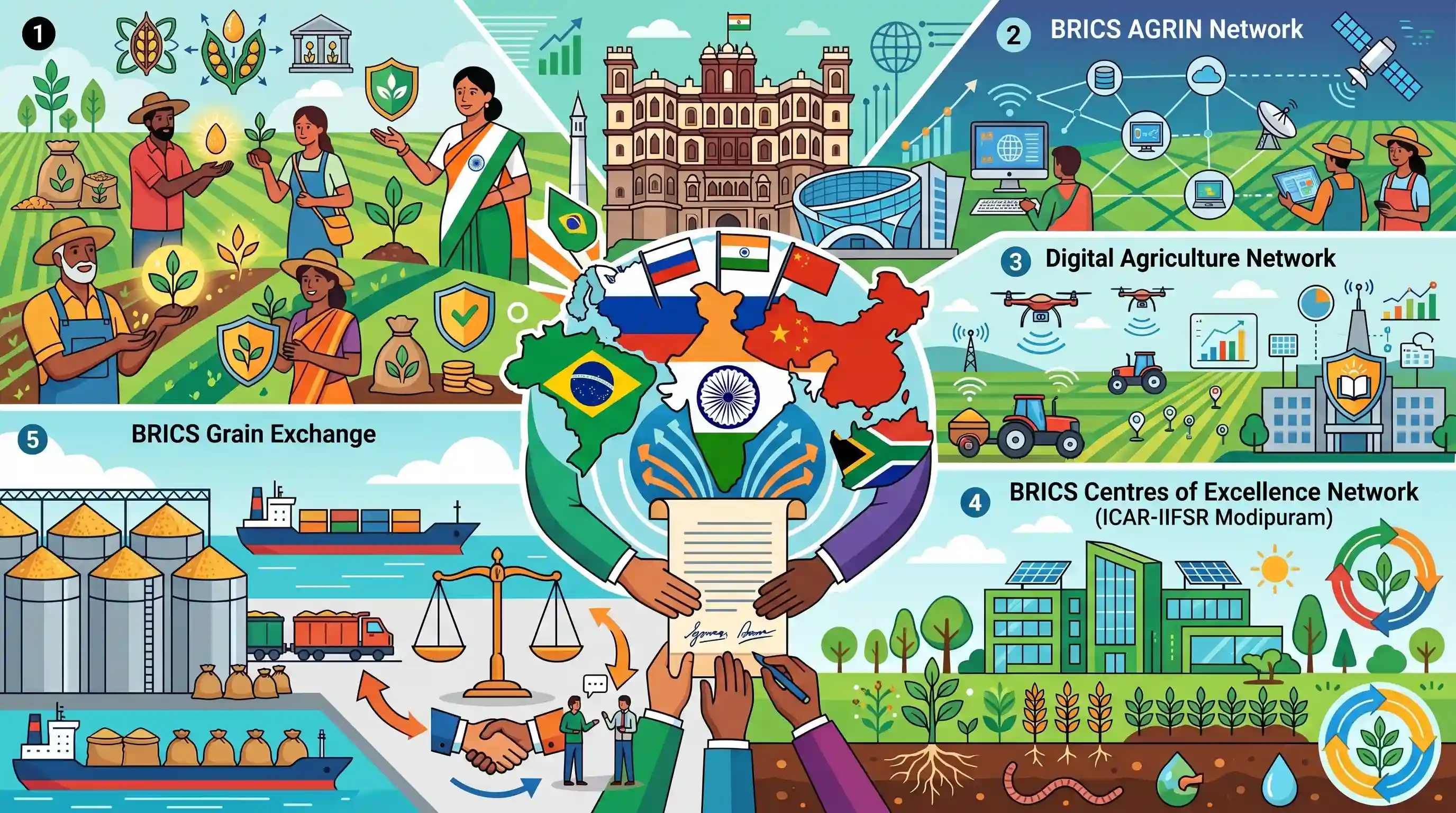
Under India's presidency, BRICS nations adopted the 'Indore Declaration' to deepen cooperation in agriculture. A series of key initiatives were launched, with India leading several coordinating efforts. These include the Global Forum on Farmers' Seed Rights, the BRICS AGRIN Network, and a Digital Agriculture Network (coordinated by IIT Delhi). Additionally, the ICAR-Indian Institute of Farming Systems Research in Modipuram will coordinate the BRICS Centres of Excellence Network in agroecology and regenerative agriculture, while discussions continue on operationalizing a BRICS Grain Exchange.
Key Points
- BRICS nations adopted the 'Indore Declaration' during a five-day meeting of agriculture ministers held under India's presidency in Indore, Madhya Pradesh.
- Reaffirmed commitments include strengthening food and nutrition security, supporting small and marginal farmers, improving agricultural trade, and promoting climate-resilient farming.
- India will coordinate the newly established 'Global Forum on Farmers' Rights in Seed Systems' to conserve indigenous seed diversity and protect traditional knowledge.
- The 'BRICS AGRIN Network' will be established for information-sharing and agricultural inputs, with India acting as the coordinating country.
- The 'BRICS Centres of Excellence Network' in agroecology and regenerative agriculture will be initially coordinated by the ICAR-Indian Institute of Farming Systems Research (IIFSR), Modipuram.
- The 'Digital Agriculture Network' (promoting AI, IoT, and geospatial technology) will be initially coordinated by IIT Delhi.
- Discussions will continue on operationalizing the proposed 'BRICS Grain Exchange' to strengthen foodgrain supply chains.
- BRICS nations represent nearly 50% of the world's population, 42% of global agricultural land, and contribute roughly 42% of global foodgrain production.
Important Terms
Indore Declaration

A joint agricultural charter adopted in June 2026 by BRICS Agriculture Ministers to deepen cooperation in food security, sustainable farming, agricultural trade, and technology-driven, farmer-centric solutions.
UPSC context
GS Paper II (International Relations) & Paper III (Agriculture); tests multilateral cooperation, food security frameworks, and agrarian diplomacy.
Global Forum on Farmers' Seed Rights
An initiative launched under the Indore Declaration to protect farmers' seed rights, conserve indigenous seed diversity, and preserve traditional agricultural knowledge, coordinated initially by India's PPV&FRA.
UPSC context
GS Paper III (IPR & Agriculture); tests plant variety protections, traditional agricultural knowledge systems, and international farmer rights.
BRICS AGRIN Network
A collaborative platform established under the Indore Declaration to facilitate information-sharing and technical cooperation in agricultural inputs, seeds, genetic resources, and best practices among member nations.
UPSC context
GS Paper II (Multilateral Groupings); tests agricultural supply chain integration and scientific cooperation among emerging economies.
BRICS Grain Exchange
A proposed trading platform for physical grain and derivatives designed to decouple global agricultural pricing from Western exchanges, bypass US dollar clearing, and secure regional food supply chains.
UPSC context
GS Paper II (Global Trade Dynamics); tests concepts of de-dollarization, trade architecture alterations, and food pricing geopolitics.
Digital Agriculture Network
An initiative under the Indore Declaration to enhance cooperation in artificial intelligence, geospatial technologies, and digital public infrastructure, with IIT Delhi coordinating India's contributions.
UPSC context
GS Paper III (Technology in Agriculture); tests digital public infrastructure, AI integration, and technological modernization in farming.
BRICS Centres of Excellence Network in agroecology and regenerative agriculture
A collaborative platform for research and capacity building in natural, organic, and regenerative farming, with ICAR-IIFSR Modipuram acting as India's lead coordinating centre.
UPSC context
GS Paper III (Sustainable Agriculture & Ecology); tests eco-friendly farming practices and international scientific collaborations.
Prelims Trap
The BRICS Grain Exchange was first conceptualized and proposed under the 2026 Indore Declaration.
The Grain Exchange was actually endorsed in the 2024 Kazan Declaration (Russia presidency); the 2026 Indore Declaration under India's presidency only continued operationalization discussions.
Static Concepts Connected
What is the Protection of Plant Varieties and Farmers' Rights (PPV&FR) Act, 2001?
- Dual Protection: Protects breeder rights for new varieties alongside farmers' rights to save, sow, exchange, or sell farm-saved seeds.
- TRIPS Compliance: Enacted to comply with WTO's TRIPS agreement while maintaining a unique 'sui generis' balance favoring traditional communities.
- Institutional Mechanism: Establishes a Registry and National Gene Fund to support conservation of plant genetic resources by tribal/rural communities.
What defines Agroecology and Regenerative Agriculture?
- Ecological Integration: Minimizes external chemical inputs by leveraging natural ecological interactions between plants, soil, animals, and humans.
- Soil Restoration: Focuses on restoring soil organic matter through cover cropping, no-till farming, and diverse crop rotations to sequester carbon.
- Socio-Environmental Balance: Strengthens farm resilience against climate shocks while ensuring food sovereignty and economic viability for smallholders.
Cross-Topic Patterns
BRICS Grain Exchange & De-dollarization
Creating a localized agricultural trading platform bypassing Western clearing houses links BRICS food security directly with de-dollarization and global trade finance reform.
Digital Agriculture & Soft Power Diplomacy
Scaling domestic models (like MP's UNNATI) to the BRICS Digital Agriculture Network demonstrates India using its digital public infrastructure (DPI) as a key diplomatic soft-power tool.

Match-the-following questions linking the Indore Declaration's initiatives (Seeds, Digital Agri, Agroecology) to their lead institutions.
Linked PYQs · 3
Linked PYQs · 3
- 2016MPPSC_PRELIMSGS1
Which of the following is not one of the BRICS countries?
- 2024MPPSC_PRELIMSGS1
UNNATI (Agri-GISl project of Madhya Pradesh Government is for :
- 2025MPPSC_PRELIMSGS1
Indian Institute of Petroleum is situated at:
