Brewers Body Urges Comprehensive Review of Bihar Prohibition Policy
Source:indiatimes ↗
Why It Matters
The Bihar liquor ban represents a classic policy conflict between public health/social welfare goals (under Article 47) and fiscal sustainability. Understanding its economic impacts, litigation burdens, and state revenue consequences is crucial for BPSC and GS Mains analyses.
Summary
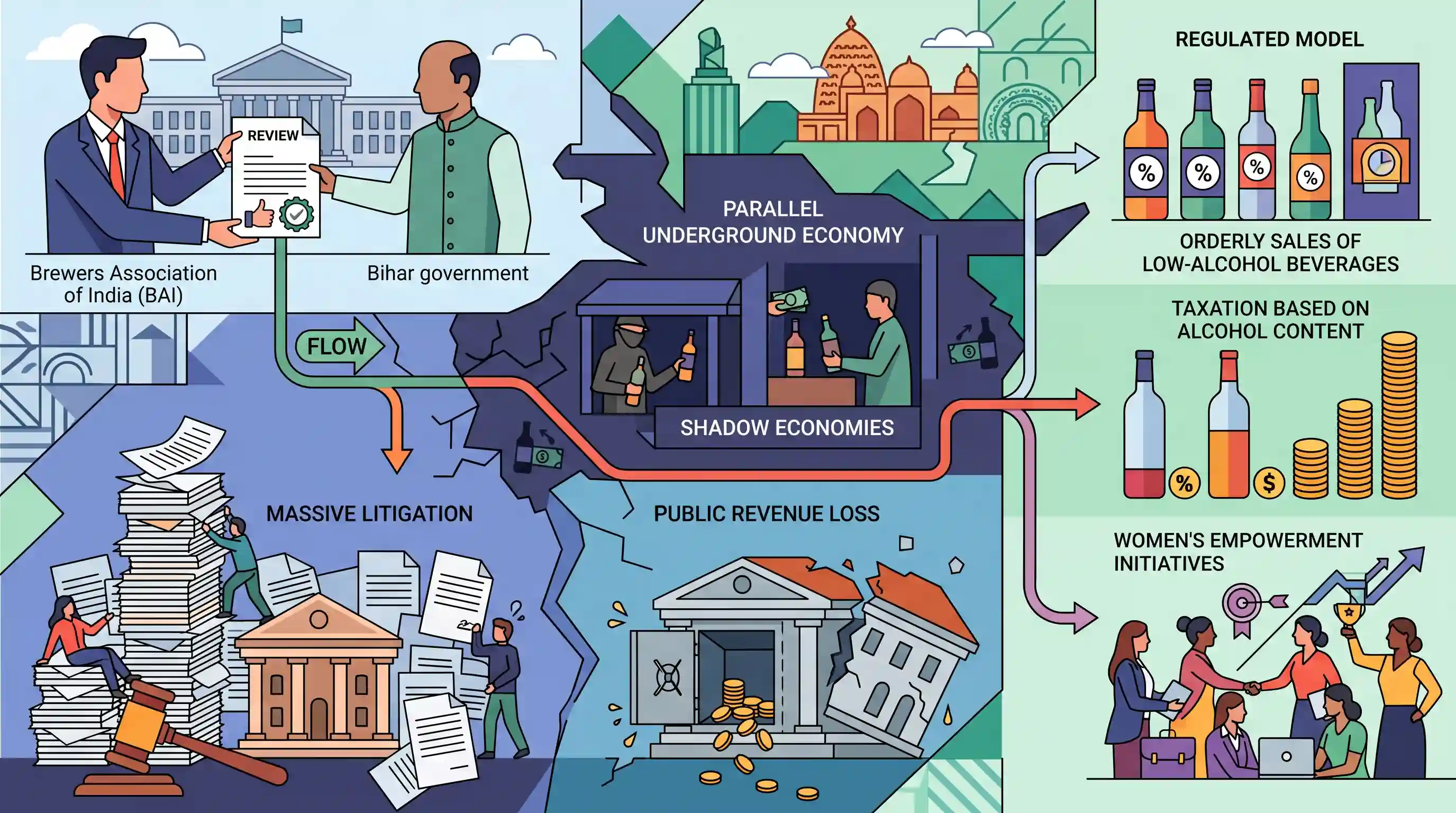
The Brewers Association of India (BAI) has formally written to the Bihar state administration calling for a comprehensive review and replacement of the Bihar Prohibition and Excise Act, 2016. The association argues that the policy has failed to curb alcohol consumption, created a large parallel underground economy, led to massive litigation (11.3 lakh cases), and caused a public revenue loss of nearly ₹60,000 crore. BAI proposes transitioning to a regulated model focused on low-alcohol beverages, taxation based on alcohol content, and women's empowerment initiatives.
Key Points
- The Brewers Association of India (BAI) has urged the Bihar government to review its complete liquor prohibition policy, which was enacted in 2016.
- The BAI claims that Bihar has foregone approximately ₹60,000 crore in excise revenue over the past decade due to the ban, exacerbating the fiscal challenges of a state that already has the lowest per capita income in India.
- The state's prohibition policy has led to over 11.3 lakh cases and more than 17 lakh arrests, heavily straining judicial and law enforcement machinery.
- To replace the total ban, the association has proposed a regulated model featuring the phased introduction of low-alcohol beverages (beer and wine), alcohol-content-based taxation, a women's welfare cess, and reserving 50% of factory-floor jobs for women.
- Prohibition is constitutionally supported by Article 47 (Directive Principles of State Policy), which directs the state to endeavor to bring about the prohibition of intoxicating drinks.
Important Terms
Bihar Prohibition and Excise Act, 2016

A state law enforcing a complete ban on the manufacture, sale, transit, and consumption of liquor and other intoxicants in Bihar, aiming to promote social welfare and public health.
UPSC context
GS Paper II (Polity and Governance); relevant for analyzing the social, economic, and implementation challenges of state-level prohibition policies.
Article 47 of the Constitution of India
A Directive Principle of State Policy instructing the State to raise nutrition levels, improve public health, and endeavour to bring about prohibition of intoxicating drinks and harmful drugs.
UPSC context
GS Paper II (Indian Constitution); tests understanding of Directive Principles of State Policy and their role in shaping public welfare initiatives.
Brewers Association of India (BAI)
The apex industry body representing India's leading beer manufacturers, aimed at promoting responsible drinking, advocacy for progressive policy reforms, and volume-of-alcohol-based taxation.
UPSC context
GS Paper III (Indian Economy); relevant for studying the role of corporate advocacy, tax policies, and the business environment.
State Excise Revenue
A significant indirect tax collected by state governments on the manufacture, sale, and distribution of alcohol, serving as a primary source of internal fiscal resource mobilization.
UPSC context
GS Paper III (Indian Economy); relevant for understanding fiscal federalism, state-level taxation powers, and government budgeting dynamics.
Prelims Trap
The power to regulate or prohibit intoxicating liquors is a Concurrent List subject, allowing Parliament to enact national prohibition laws.
Under Entry 8 of the State List (List II), states have exclusive legislative power over intoxicating liquors. Parliament cannot pass a uniform national prohibition law.
Static Concepts Connected
What is the constitutional framework governing alcohol in India?
- Seventh Schedule: Entry 8 of the State List (List II) gives exclusive legislative power over intoxicating liquors to state governments.
- Article 47 DPSP: Directs states to endeavor to bring about the prohibition of intoxicating drinks and harmful drugs, except for medicinal purposes.
- GST Exclusion: Article 366(12A) constitutionally excludes alcoholic liquor for human consumption from GST, preserving state excise and VAT autonomy.
Cross-Topic Patterns
DPSPs vs. Fundamental Rights
Prohibition laws test the balance between Article 47’s state welfare directive and Article 21's right to privacy, individual autonomy, and personal liberty.
State fiscal autonomy and GST
Excluding alcohol from GST protects state-level fiscal cushions, but complete prohibition leaves financially stressed states highly dependent on central tax devolution.

State excise autonomy, Article 47, and the judicial strain of regulatory laws are prime for a multi-statement question on federalism.
Linked PYQs · 3
Linked PYQs · 3
- 2024-EBPSC_PRELIMSGS1
What was the Per Capita Net State Domestic Product at Current Prices for Bihar for the fiscal year 2022-23, based on the base year 2011-12?
- 2023BPSC_PRELIMSGS1
The concept of the Directive Principles of State Policy in the Indian Constitution was borrowed from the Constitution of
- 2022BPSC_PRELIMSGS1
The fiscal deficit in Bihar during 2021-22 is estimated as
