Leprosy Eradication Challenges Stigma and Legal Reforms in India
Source:The Hindu ↗
কেন এটি গুরুত্বপূর্ণ
It addresses India's persistent public health challenges regarding neglected tropical diseases like leprosy, touching upon social stigma, healthcare delivery at the grassroots, and legal reforms needed for vulnerable populations.
সারসংক্ষেপ
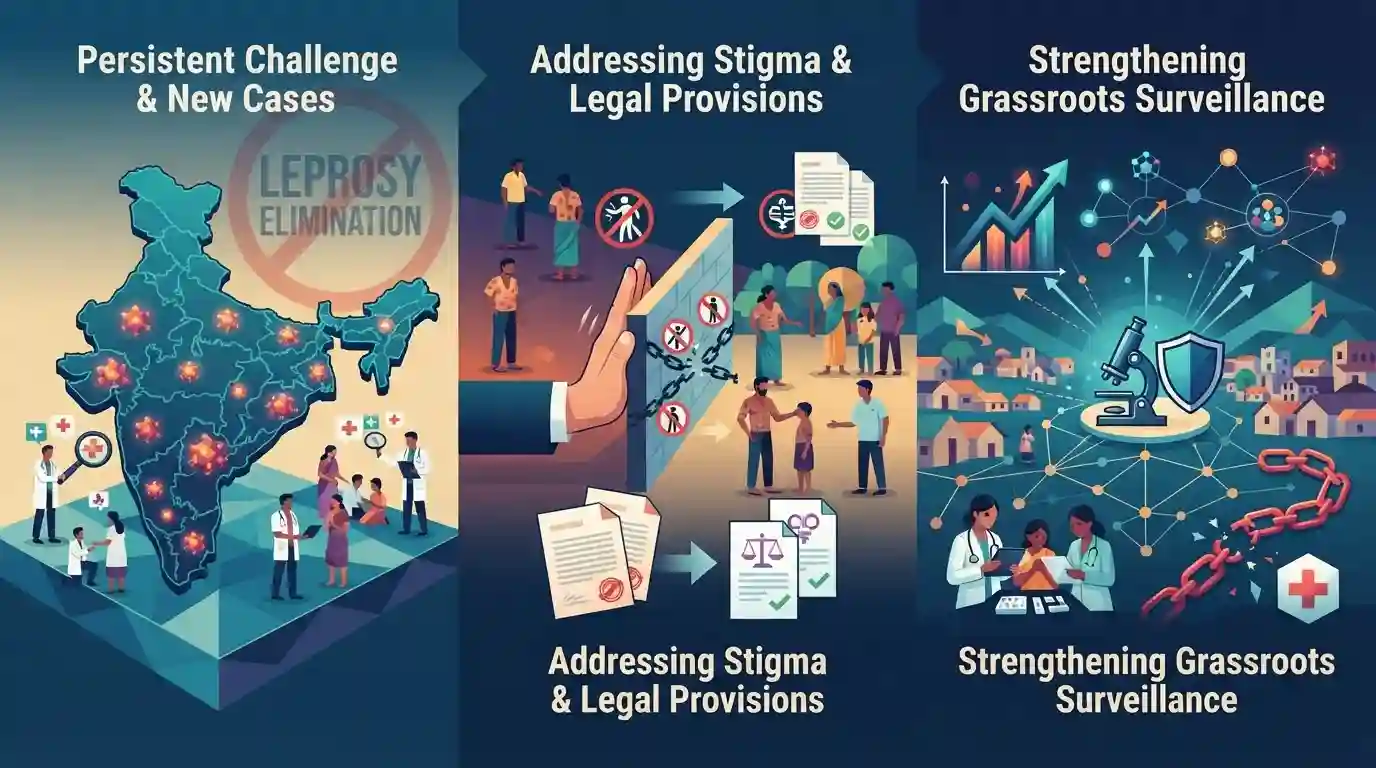
The editorial discusses the persistent challenge of leprosy in India, highlighting that despite declaring elimination as a public health problem nationally, new cases continue to emerge significantly. It emphasizes the need to address social stigma, eliminate discriminatory legal provisions, and strengthen grassroots public health surveillance to truly break the chain of transmission.
মূল বিষয়
- India accounts for a major share of the global leprosy burden, continuing to report thousands of new cases annually.
- Stigma, discrimination, and social isolation remain major barriers to early detection and treatment compliance.
- Legal reforms, such as repealing discriminatory colonial-era laws and outdated provisions (like grounds for divorce based on leprosy), are essential for social integration.
- Public health strategies require decentralized grassroots screening, integration with primary healthcare, and robust contact tracing to break the chain of transmission.
প্রিলিমস ফাঁদ
National elimination of leprosy as a public health problem means zero new cases are reported annually in India.
Declaring national elimination as a public health problem (prevalence rate of less than 1 case per 10,000 population) does not mean the disease has been eradicated or that new case reporting has ceased.
সংযুক্ত স্থির ধারণা
What are the key public health strategies under the National Leprosy Eradication Programme (NLEP) in India?
- Free MDT Treatment: Multi-Drug Therapy (MDT) is provided free of cost at all public health facilities to completely cure the disease and prevent drug resistance.
- Grassroots Screening: Active case detection campaigns (ACDC) and focal screening are carried out at the grassroots level to find hidden cases early.
- Mainstreaming Services: Integration of leprosy screening and treatment into the general healthcare system rather than vertical isolation camps.
আন্তঃবিষয় প্যাটার্ন
Leprosy and vulnerable social sector welfare
Leprosy elimination intersects with the National Health Mission (NHM) and vulnerable section welfare, testing administrative capacity to reach remote communities without fueling social stigma.
Colonial laws, public health, and judicial reforms
Repealing archaic colonial legislation like the Lepers Act links public health reforms with ongoing judicial efforts to purge discriminatory statutes from Indian law.

Leprosy eradication + NLEP + discriminatory laws may feature in a multi-statement social sector governance question.
সংযুক্ত PYQ · 2
সংযুক্ত PYQ · 2
- 2024MainsGS2
In a crucial domain like the public healthcare system the Indian State should play a vital role to contain the adverse impact of marketisation of the system. Suggest some measures through which the State can enhance the reach of public healthcare at the grassroots level.
- 2018MainsGS2
Appropriate local community-level healthcare intervention is a prerequisite to achieve 'Health for All' in India. Explain.
