Global South Response to US Tariffs
Source:The Hindu ↗
Why It Matters
This visit encapsulates key contemporary International Relations themes for UPSC: the Global South's strategic response to rising Western protectionism, the ongoing push for democratization of global governance (UNSC reforms), and the deepening of bilateral relations between major emerging economies (India and Brazil) in strategic sectors like critical minerals and digital infrastructure.
Summary
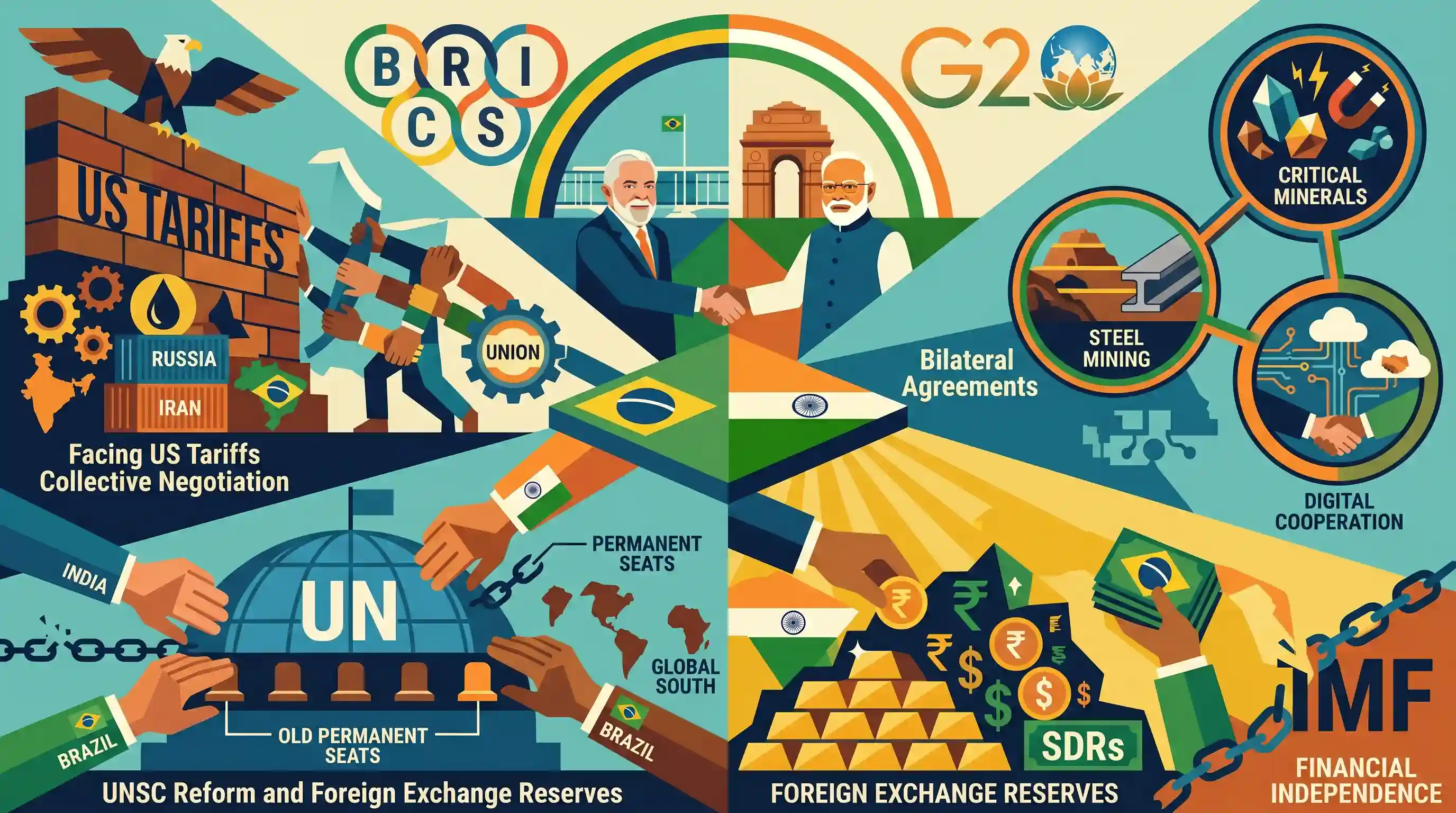
Brazilian President Luiz Inácio Lula da Silva visited New Delhi, calling for a unified front among countries facing new global tariffs imposed by the United States. He suggested that nations should 'unionise' and negotiate collectively rather than individually. Highlighting shared challenges, he noted India and Brazil face high US tariffs tied to their BRICS membership and trade with Russia and Iran. Lula forcefully advocated for expanding the UN Security Council with permanent seats for India, Brazil, and other regional powers, citing the UN's current lack of efficacy. He also praised India's historical focus on amassing foreign exchange reserves, which inspired Brazil's own financial independence from the IMF. Additionally, the visit marked the signing of key bilateral agreements on critical minerals, steel mining, and digital cooperation.
Key Points
- Brazilian President Lula urged nations facing recent sweeping US global tariffs to 'unionise' and negotiate collectively as a bloc to counter protectionist policies.
- Both India and Brazil currently face steep 50% US tariffs, driven by their BRICS membership, trade relations with Iran, and imports of Russian oil.
- Lula advocated strongly for UN Security Council reforms, pushing for permanent seats for nations like India, Brazil, and other regional powers, criticizing the UN's current inability to enact real change.
- Recalling lessons from India's economic policies in 2005, Lula emphasized the importance of building robust foreign exchange reserves to secure financial independence from institutions like the IMF.
- India and Brazil expanded their strategic relationship by signing bilateral pacts covering cooperation in critical minerals, steel mining, and a new digital partnership.
Important Terms
UN Security Council

One of six main UN organs tasked with maintaining international peace. It has 15 members: 5 permanent (P5) with veto power and 10 non-permanent members elected for two-year terms.
UPSC context
GS Paper II: International Institutions. Focuses on UNSC reform, India’s bid for permanent membership, and the G4’s role in global governance.
BRICS
An informal group of major emerging economies—originally Brazil, Russia, India, China, and South Africa—focused on reforming global financial architecture, fostering trade, and promoting a multipolar world order.
UPSC context
GS Paper II: Global Groupings. Tests understanding of South-South cooperation, New Development Bank, and challenges to Western-led financial systems.
IMF
A global organization of 190 countries working to foster monetary cooperation and financial stability. It acts as a 'lender of last resort' for countries facing balance-of-payments crises.
UPSC context
GS Paper III: Economy. Crucial for understanding global financial stability, quota reforms, and India’s historical 1991 balance-of-payments crisis.
G4 Nations
A coalition of four countries—Brazil, Germany, India, and Japan—who support each other's bids for permanent seats on the United Nations Security Council (UNSC) to reflect current global realities.
UPSC context
GS Paper II: International Relations. Relevant for India’s diplomatic strategy to expand its influence in the UN system.
Critical Minerals
Elements like lithium, cobalt, and rare earths essential for modern technologies, including semiconductors and green energy. They are vital for national security and economic development.
UPSC context
GS Paper III: Resources/Economy. Tests knowledge of supply chain resilience, India's Mineral Security Partnership, and energy transition goals.
Foreign Exchange Reserves
Assets held by a central bank in foreign currencies, gold, and SDRs. They provide a buffer against external shocks and ensure the country can meet international payment obligations.
UPSC context
GS Paper III: Indian Economy. Vital for understanding exchange rate management, balance of payments, and monetary policy stability.
Prelims Trap
"The G4 grouping, which advocates for UNSC reforms, comprises India, Brazil, South Africa, and Germany."
Aspirants frequently confuse G4 (India, Brazil, Germany, Japan) with BRICS or IBSA. South Africa is not in the G4; it pushes the Ezulwini Consensus.
Static Concepts Connected
What constitutes India's Foreign Exchange Reserves?
- Foreign Currency Assets: The largest component, comprising major global currencies (USD, Euro, Pound, Yen) and foreign government securities.
- Gold Reserves: Held by the RBI as a secure store of value and hedge against inflation and currency risks.
- Special Drawing Rights: International reserve assets created by the IMF, allocated to member countries in proportion to their quotas.
- Reserve Tranche Position: The un-drawn portion of India's quota in the IMF that can be accessed without conditions.
What are the core demands and members of the G4 grouping?
- Membership: India, Brazil, Germany, and Japan. They mutually support each other's bids for permanent seats in the UNSC.
- Council Expansion: Expanding the UNSC from 15 to 25 or 26 members, adding new permanent and non-permanent seats.
- African Representation: Ensuring historical injustices are corrected by mandating permanent representation for African nations alongside G4 members.
Cross-Topic Patterns
Critical minerals & supply chain resilience
The India-Brazil pact on rare earths (niobium/lithium) mirrors India's Mineral Security Partnership (MSP) and Australia deals, signalling a persistent push to de-risk from Chinese monopolies in EV supply chains.
Trade weaponization & De-dollarization
U.S. tariffs targeting BRICS nations for trading with Russia and Iran highlight the weaponization of global trade, which will accelerate BRICS' push for local-currency settlement systems.

Expect a multi-statement question on India-Brazil overlaps: G4, BRICS, BASIC, IBSA, and their joint critical mineral supply chain efforts.
Linked PYQs · 5
Linked PYQs · 5
- 2015MainsGS2
Discuss the impediments India is facing in its pursuit of a permanent seat in UN Security Council.
- 2016MainsGS2
The broader aims and objectives of WTO are to manage and promote international trade in the era of globalization. But the Doha round of negotiations seem doomed due to differences between the developed and the developing countries." Discuss in the Indian perspective.
- 2012MainsGS2
Compare the significance of IBSA and BRICS in the context of India's multilateral diplomacy.
- 2013PrelimsGS1
Which one of the following groups of items is included in India's foreign-exchange reserves?
- 2025MainsGS2
"With the waning of globalization, post-Cold War world is becoming a site of sovereign nationalism.” Elucidate.
