Brazil BRICS Summit and US Tariff Diplomacy Pressures
Source:The Hindu ↗
Why It Matters
The article illustrates the practical limitations and internal divisions of the expanded BRICS grouping. It highlights how US economic leverage (tariff threats) directly shapes the multilateral agenda of emerging economies, marking a shift from aggressive de-dollarization to cautious non-alignment. This is crucial for understanding India's strategic positioning within non-Western platforms.
Summary
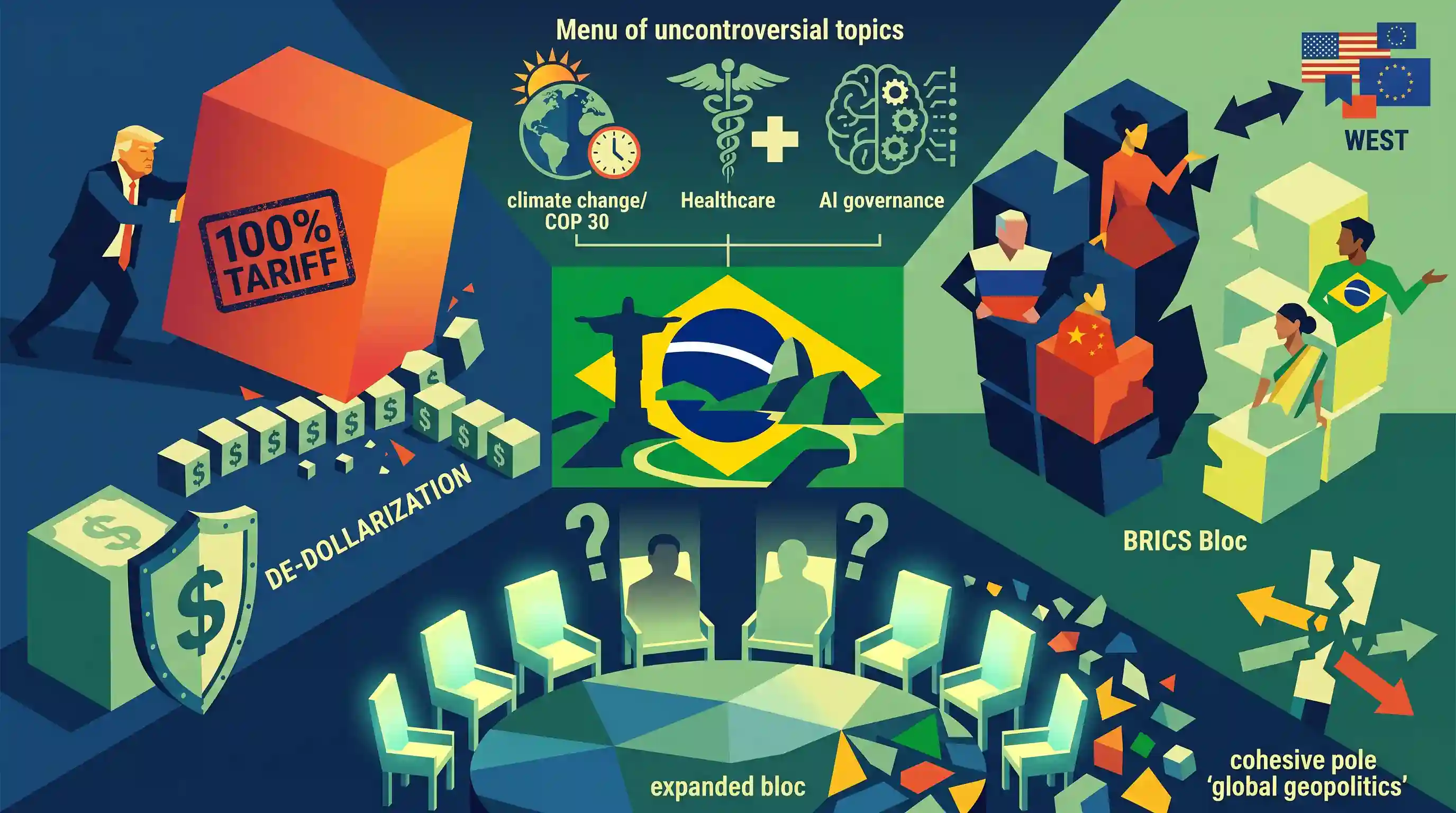
Brazil is hosting the 2025 BRICS summit in Rio de Janeiro, deliberately steering the agenda toward uncontroversial topics like healthcare, climate change (ahead of COP 30), and AI governance. This moderation aims to avoid triggering US President Donald Trump's threatened 100% tariffs over attempts to undermine the US dollar, effectively shelving de-dollarization plans. The summit highlights growing internal divides between anti-Western members and non-aligned nations like India and Brazil. The notable absence of key leaders, including China's Xi Jinping and Russia's Vladimir Putin, raises questions about the newly expanded bloc's ability to act as a cohesive pole in global geopolitics.
Key Points
- Brazil is hosting the 2025 BRICS summit in Rio de Janeiro with an agenda focused on less controversial topics like climate change, AI governance, healthcare, and trade.
- The summit's moderate tone is deliberately designed to avoid provoking US President Donald Trump, who recently threatened 100% tariffs on countries attempting to undermine the US dollar.
- Brazil has confirmed that BRICS currently has no plans to create an alternative currency, retreating from previous pushes for de-dollarization.
- Notable absences of leaders like China's Xi Jinping, Russia's Vladimir Putin, and Iran's Masoud Pezeshkian reflect internal fragmentation within the newly expanded bloc.
- The summit highlights a strategic divide within BRICS between members pushing for a strong anti-Western stance (Russia, China) and those preferring non-alignment (India, Brazil).
Important Terms
BRICS

Intergovernmental organization of major emerging economies (Brazil, Russia, India, China, South Africa) and new members. It promotes South-South cooperation, economic integration, and a multipolar global order through institutions like the New Development Bank.
UPSC context
GS Paper II: Global groupings involving India. Tests understanding of India’s role in emerging world orders and multilateral diplomacy.
COP 30
The 30th session of the UNFCCC Conference of Parties (2025) in Belém, Brazil. Focused on implementing the Paris Agreement, forest conservation, and scaling climate finance for developing nations via the "Belém Package."
UPSC context
GS Paper III: Environment. Tests awareness of international climate treaties and global environmental governance frameworks.
De-dollarization
The process where nations reduce reliance on the U.S. dollar for trade, reserves, and settlements. It involves using local currencies or alternative payment systems to bypass dollar-denominated networks like SWIFT.
UPSC context
GS Paper III: Indian Economy. Tests knowledge of global currency shifts and their impact on India’s strategic financial autonomy.
Global South
A collective term for developing and less-industrialized nations in Asia, Africa, and Latin America. These countries prioritize equitable development, institutional reform (UNSC/IMF), and South-South cooperation to address shared challenges.
UPSC context
GS Paper II: International Relations. Tests India's leadership role and interests in representing developing nations.
Multilateralism
A collaborative global governance framework where multiple nations act together through international organizations (e.g., WTO, UN) to solve common challenges, opposing unilateralism or restrictive bilateral power-bloc politics.
UPSC context
GS Paper II: IR. Tests understanding of international institutions and India’s advocacy for a "reformed multilateralism."
Protectionism
Economic policy of restricting imports through tariffs, quotas, or regulations to protect domestic industries. In 2025, it manifested as U.S. threats of 100% tariffs against BRICS de-dollarization efforts.
UPSC context
GS Paper III: Economy. Tests knowledge of global trade barriers and the impact of external trade policies on India.
Prelims Trap
"BRICS has officially launched an alternative common currency to replace the US Dollar in intra-bloc trade."
Aspirants confuse past rhetoric with actual policy. BRICS has no common currency, relies on Local Currency Settlement (LCS), and has currently shelved de-dollarization plans.
Static Concepts Connected
Which countries officially became new BRICS members during the 2024 expansion?
- New Members: Egypt, Ethiopia, Iran, and the United Arab Emirates (UAE) officially joined the bloc on January 1, 2024.
- Declined Invitation: Argentina was invited but formally declined to join following a change in government leadership.
- Pending Status: Saudi Arabia was invited, but its formal operational integration into the bloc has remained somewhat ambiguous and delayed compared to the others.
How does the Local Currency Settlement (LCS) system work as an alternative to de-dollarization?
- Bilateral Mechanism: LCS allows two nations to invoice and settle bilateral trade using their respective domestic currencies instead of a third-party vehicle currency like the US Dollar.
- Exchange Rate: It relies on direct cross-currency exchange rates, reducing transaction costs by avoiding the double-conversion spread usually required when using the USD.
- Vostro Accounts: Authorized banks open Special Rupee Vostro Accounts (SRVAs) in partner countries to hold balances and facilitate these direct transactions.
Cross-Topic Patterns
Weaponization of Tariffs in Geopolitics
The US threatening 100% tariffs over de-dollarization links trade protectionism directly to monetary hegemony, echoing previous Section 232 national security tariffs but applied aggressively to currency markets.
India's Multi-alignment Tightrope
The internal BRICS divide mirrors India's broader foreign policy doctrine: participating in non-Western forums like BRICS and SCO without endorsing anti-Western postures, carefully balancing its active Quad membership.

Expect a 2026 Prelims question mixing the 2024 BRICS expansion members with statements on the delayed 'common currency' and NDB's mandate.
Linked PYQs · 3
Linked PYQs · 3
- 2012MainsGS2
Compare the significance of IBSA and BRICS in the context of India's multilateral diplomacy.
- 2025MainsGS3
What are the challenges before the Indian economy when the world is moving away from free trade and multilateralism to protectionism and bilateralism? How can these challenges be met?
- 2025MainsGS2
"With the waning of globalization, post-Cold War world is becoming a site of sovereign nationalism.” Elucidate.
