Sex Differences in Brain Ageing and Alzheimer Disease Susceptibility
Source:Indian Express ↗
Why It Matters
Understanding sex-specific biological mechanisms—such as the role of X chromosome genetics and menopause—in neurodegenerative diseases is crucial for developing targeted therapies and formulating inclusive geriatric healthcare policies, ultimately addressing historical gender gaps in medical research.
Summary
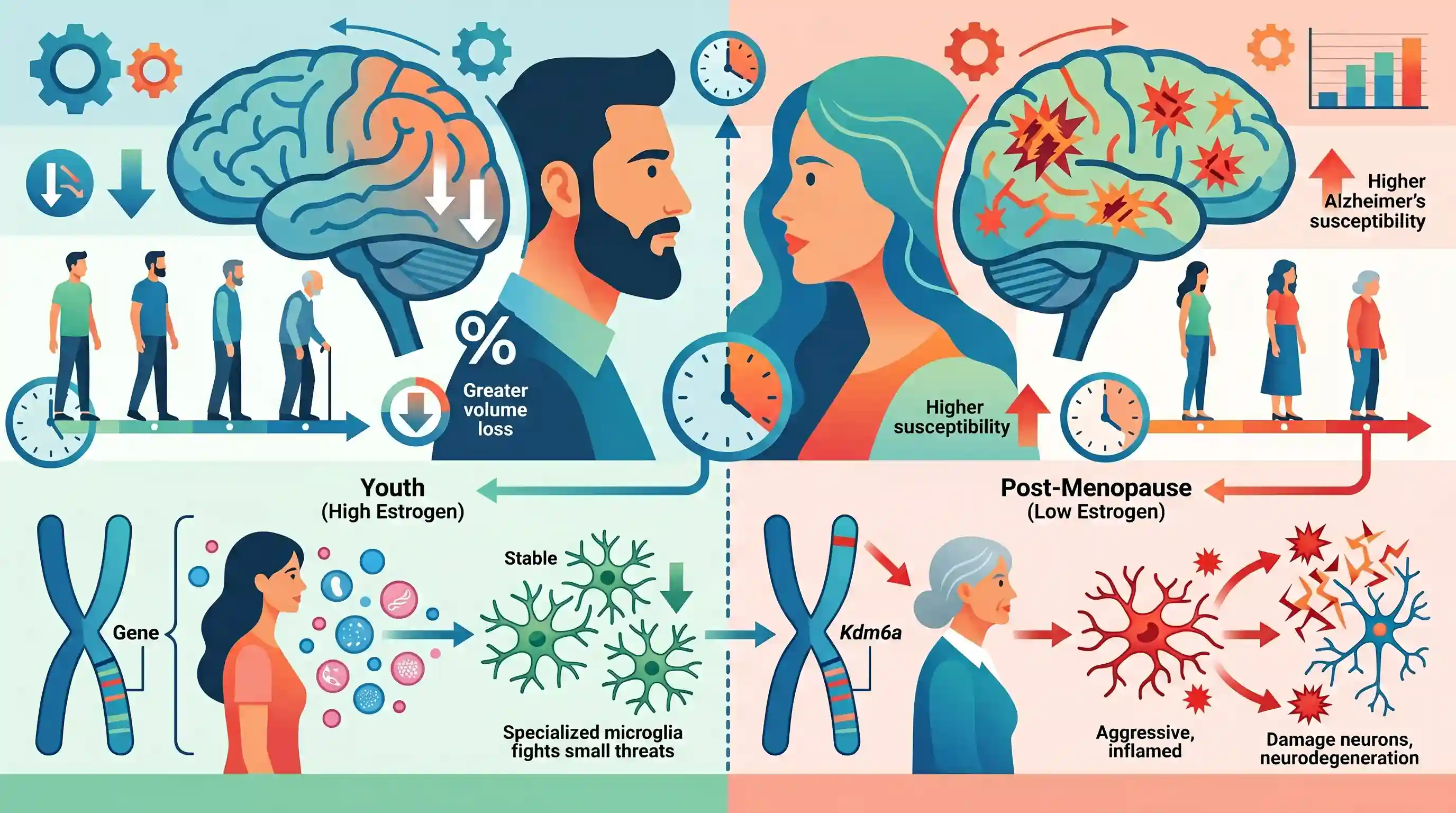
A recent study published in PNAS reveals that while men's brains age faster, women paradoxically face a higher risk of Alzheimer's disease. The research disentangles normal brain ageing from neurodegeneration, showing that male brains experience greater volume reduction over time. In contrast, women's higher Alzheimer's susceptibility is likely linked to genetic and hormonal factors, particularly the Kdm6a gene on the X chromosome, which drives inflammation in the brain's immune cells (microglia). This inflammation, though protective during youth, becomes detrimental post-menopause when estrogen levels drop, underscoring significant sex-based differences in biology and disease progression.
Key Points
- Male brains age faster and show greater volume reduction than female brains, particularly in the postcentral cortex, which processes touch and pain.
- Despite experiencing slower normal brain ageing, women have a significantly higher risk of developing Alzheimer's disease and dementia.
- Alzheimer's disease is driven by the accumulation of amyloid and tau proteins, which is a distinct biological process from normal structural brain ageing.
- The Kdm6a gene on the X chromosome drives inflammation in microglia (the brain's immune cells) and is more active in women due to the presence of two X chromosomes.
- While brain inflammation may be protective in youth, the drop in estrogen levels after menopause unleashes the neurodegenerative effects of the Kdm6a gene, increasing Alzheimer's susceptibility in women.
Important Terms
Alzheimer’s Disease

An irreversible, progressive neurodegenerative disorder causing brain cell death and shrinkage. It is the leading cause of dementia, characterized by amyloid-beta plaque buildup and tau protein tangles.
UPSC context
GS Paper 3 (Science: Diseases) and GS Paper 2 (Health). Tests knowledge of non-communicable diseases and aging-related public health challenges.
Neurodegeneration
A category of disorders characterized by the progressive and irreversible loss of structure or function of neurons. Common examples include Alzheimer’s, Parkinson’s, and Amyotrophic Lateral Sclerosis (ALS).
UPSC context
GS Paper 3 (Developments in Science). Relevant for understanding the biological basis of chronic illnesses in an aging population.
Microglia
The primary resident immune cells of the Central Nervous System (CNS) that act as macrophages. They clear pathogens and debris but can also drive chronic neuroinflammation in diseased states.
UPSC context
GS Paper 3 (Science: Biology). Tests understanding of human physiology and the CNS-specific immune response.
Kdm6a Gene
An X-linked gene that regulates sex-biased gene expression. Recent research identifies it as a driver of microglial inflammation in females, contributing to higher Alzheimer’s risk post-menopause.
UPSC context
GS Paper 3 (Biotechnology/Genetics). Pertains to scientific breakthroughs explaining sex-based disparities in disease vulnerability.
X Chromosome
One of two sex chromosomes (XX in females, XY in males). It carries ~800–1,100 genes, and 'escape' from X-inactivation in females can lead to higher expression of specific genes.
UPSC context
GS Paper 3 (Genetics). Fundamental for questions on sex-linked inheritance, genetic disorders, and biological sex determination.
Estrogen
The primary female sex hormone that provides neuroprotection and maintains mitochondrial health. Its significant decline during menopause is linked to increased vulnerability to cognitive decline.
UPSC context
GS Paper 3 (Biology/Human Physiology). Relevant for health-related topics, particularly reproductive health and geriatric care.
PNAS (Proceedings of the National Academy of Sciences)
The official journal of the US National Academy of Sciences. It is one of the world's most-cited multidisciplinary scientific serials, publishing high-impact original research.
UPSC context
General Science Literacy. Often cited in Prelims-related news as a source of major international scientific discoveries.
Menopause
The biological stage marking the end of a woman’s menstrual cycles, characterized by a sharp drop in estrogen. It is a critical period for heightened neuroinflammatory risk.
UPSC context
GS Paper 2 (Health: Social Issues). Important for understanding life-cycle health transitions and sex-specific healthcare needs.
Prelims Trap
"Female brains experience faster structural volume reduction, driving their higher Alzheimer's risk."
The study actually found that men's brains experience faster structural volume reduction, but women get Alzheimer's more due to distinct genetic/hormonal mechanisms.
Static Concepts Connected
What differentiates Alzheimer’s disease from normal structural brain ageing?
- Amyloid-beta plaques: Abnormal accumulation of amyloid proteins between nerve cells in the brain.
- Tau tangles: Twisted fibers of tau protein that build up inside neurons, disrupting essential nutrient transport.
- Distinct mechanism: Alzheimer's is driven by these specific protein aggregations, whereas normal ageing involves general volume reduction.
What are microglia and what is their role in the Central Nervous System?
- CNS immune cells: They act as the resident innate immune cells (macrophages) in the brain and spinal cord.
- Debris clearance: They perform phagocytosis to clear out dead neurons, damaged cells, and infectious agents.
- Inflammatory risk: While protective in youth, chronic microglial activation and inflammation can drive neurodegenerative diseases later.
Cross-Topic Patterns
X-Chromosome & Autoimmune disease risk
The double X chromosome in females increases gene expression, linking this Alzheimer's mechanism to why women also face significantly higher rates of autoimmune diseases like Lupus.
Feminization of Ageing in India
As Indian women generally outlive men, their higher susceptibility to dementia necessitates gender-sensitive geriatric healthcare policies that integrate neurological and post-menopausal support.

Expect a 2026 Prelims statement differentiating normal brain atrophy from Alzheimer's markers (Amyloid/Tau) and Microglia's immune role.
Linked PYQs · 3
Linked PYQs · 3
- 2021PrelimsGS1
Magnetite particles, suspected to cause neurodegenerative problems, are generated as environmental pollutants from which of the following? 1. Brakes of motor vehicles 2. Engines of motor vehicles 3. Microwave stoves within homes 4. Power plants 5. Telephone lines Select the correct answer using the code given below.
- 2020MainsGS2
In order to enhance the prospects of social development, sound and adequate health care policies are needed particularly in the fields of geriatric and maternal health care. Discuss.
- 2021PrelimsGS1
In the context of hereditary diseases, consider the following statements : 1. Passing on mitochondrial diseases from parent to child can be prevented by mitochondrial replacement therapy either before or after in vitro fertilization of egg. 2. A child inherits mitochondrial diseases entirely from mother and not from father. Which of the statements given above is/are correct?
