Banda Records Highest Temperatures as Heatwave Grips Uttar Pradesh
Source:times-of-india ↗
Why It Matters
UPPSC Prelims regularly tests students on local winds (like 'Loo' matching questions), climatic zones of Uttar Pradesh, and regional temperature extremes (particularly in the Bundelkhand region including Jhansi and Banda).
Summary
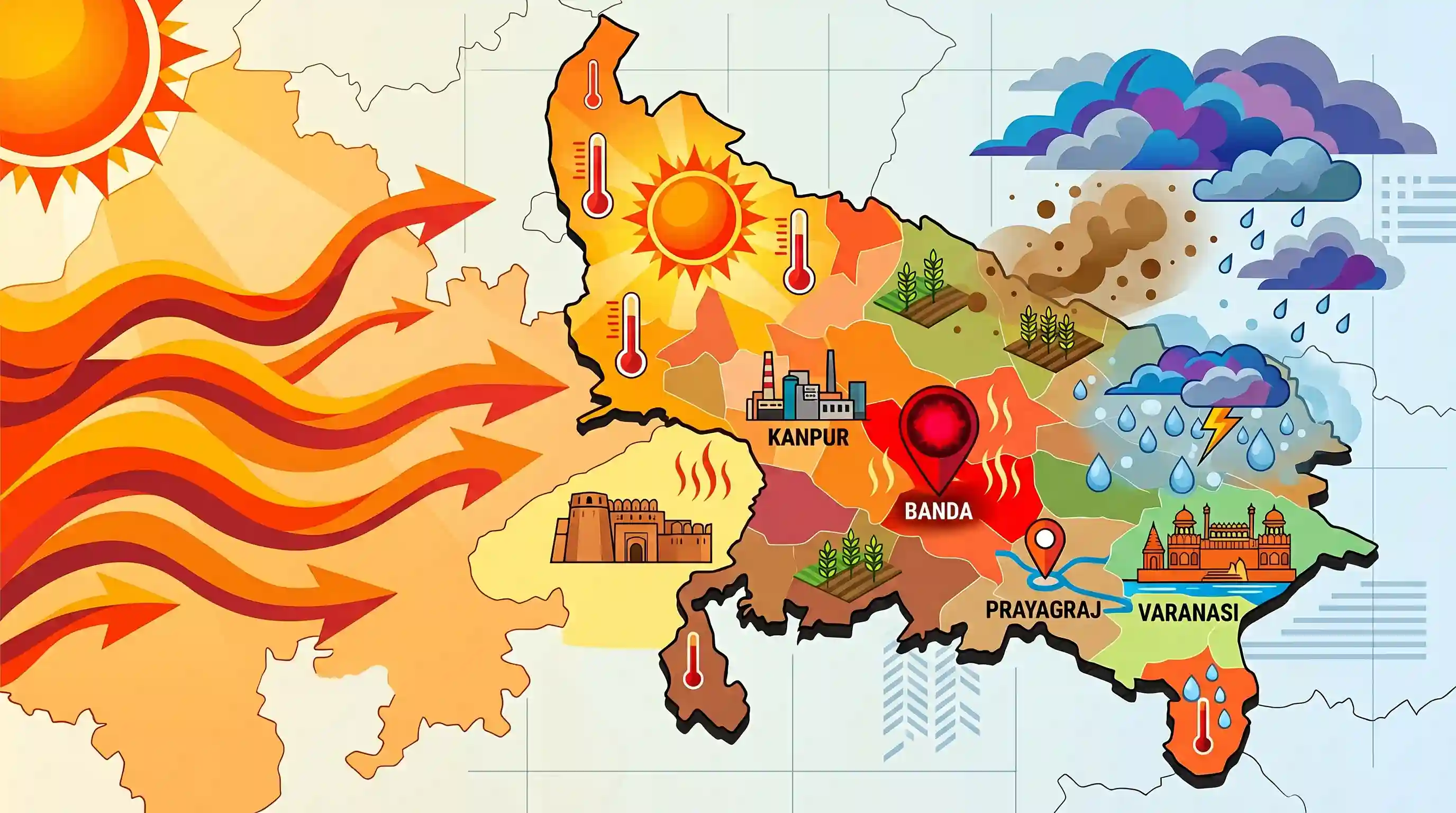
The Meteorological Department predicted intense heat across Uttar Pradesh driven by hot westerly winds blowing from Rajasthan. Banda remained the hottest place in the country for three consecutive days at 43.2°C. While extreme heat dominated cities like Prayagraj, Varanasi, Kanpur, and Jhansi, localized convective developments triggered isolated light showers and dust storms, which temporarily increased humidity and sultriness.
Key Points
- Banda in Uttar Pradesh recorded a maximum temperature of 43.2 degrees Celsius, making it the hottest place in India for three consecutive days.
- Other major UP cities registered extreme temperatures: Prayagraj (43°C), Varanasi (42.6°C), Kanpur City (42.2°C), and Jhansi (41.8°C).
- Senior scientist Mohammad Danish from the Lucknow Regional Meteorological Centre attributed the intense heatwave conditions to hot westerly winds (Loo) blowing from Rajasthan.
- Local convective developments led to isolated thundershowers, dust storms, and light rain, which temporarily increased relative humidity and intensified sultry conditions.
Important Terms
India Meteorological Department

India's national meteorological agency under the Ministry of Earth Sciences, established in 1875, responsible for weather observations, forecasting, and issuing early warnings for natural disasters like cyclones and heatwaves.
UPSC context
GS Paper I (Geography) and GS Paper III (Disaster Management); tests knowledge of institutional frameworks for climate monitoring.
Regional Meteorological Centre, Lucknow
An upgraded regional weather forecasting hub of the IMD inaugurated in June 2026, responsible for localized, impact-based weather monitoring, forecasts, and early warning services across Uttar Pradesh and Uttarakhand.
UPSC context
GS Paper I (Geography) and State PCS; tests knowledge of regional meteorology and localized disaster preparedness.
Loo
A strong, hot, dry, and dust-laden local summer wind that blows from the west over the Indo-Gangetic plains of North India and Pakistan during May and June, often causing fatal heatwaves.
UPSC context
GS Paper I (Climatology - Local Winds); tests understanding of local wind mechanisms and climate impacts.
Convective Rainfall
Precipitation that occurs when intense solar heating of the Earth's surface causes warm, moist air to rise rapidly, cool, condense, and form localized, heavy showers or thunderstorms.
UPSC context
GS Paper I (Climatology); tests the atmospheric thermodynamic processes of air mass instability and precipitation types.
Agro-Climatic Zones of Uttar Pradesh
Nine distinct geographic regions in Uttar Pradesh classified by the Planning Commission based on parameters like rainfall, temperature, soil types, and topography to facilitate localized agricultural planning.
UPSC context
GS Paper III (Agriculture) and UPPSC; tests knowledge of regional geography and crop-suitability mapping for sustainable farming.
Prelims Trap
IMD declares a heatwave across India based on a single, uniform temperature threshold of 40°C, irrespective of coastal or hilly terrain.
IMD uses differentiated thresholds: 40°C for plains, 37°C for coastal regions, and 30°C for hilly regions, rather than a flat nationwide threshold.
Static Concepts Connected
What are the official criteria used by the IMD to declare a Heatwave in India?
- Terrain Thresholds: Requires maximum temperatures to reach at least 40°C in plains, 37°C in coastal areas, and 30°C in hilly regions.
- Normal Deviation: Declared when departure from normal temperature is 4.5°C to 6.4°C; departures above 6.4°C are classified as severe.
- Absolute Limits: Regardless of normal temperatures, an absolute maximum reading of 45°C triggers a heatwave and 47°C triggers a severe heatwave.
What is Wet-bulb Temperature and how does it measure heat stress?
- Thermodynamic Definition: It is the lowest temperature to which air can be cooled by evaporating water into it at a constant pressure.
- Humidity Integration: By integrating ambient air temperature and relative humidity, it reflects how effectively the human body can cool itself via sweat.
- Survivability Limit: A sustained wet-bulb reading of 35°C (and newer studies suggest 31°C) represents the absolute upper limit of human survivability.
Cross-Topic Patterns
Agro-Climatic Vulnerability & Crop Shifts
Severe heatwaves in vulnerable zones like Bundelkhand accelerate groundwater depletion, forcing a transition from water-intensive crops to climate-resilient millets.
Riverbed Mining & Microclimate Alteration
Excessive sand mining along the Ken riverbed strips protective sedimentary layers, exposing rocky substrates that act as local heat sinks and amplify regional heatwaves.

Expect a multi-statement question linking IMD heatwave criteria, wet-bulb thermodynamics, and regional pre-monsoon winds in 2026.
Linked PYQs · 4
Linked PYQs · 4
- 2024UPPSC_PRELIMSGS1
Match List-I with List-II and choose the correct answer using the codes given below the lists. List-I (Famous Local Storm): (A) Mango shower (B) Blossom shower (C) Norwesters (D) Loo List-II (Place/Area): 1. Punjab to Bihar 2. Kerala 3. Karnataka Coastal Areas 4. West Bengal
- 2024UPPSC_PRELIMSGS1
Match List-I with List-II and choose the correct answer using the code given below the lists: List-I (Famous Local Storm): (A) Mango shower (B) Blossom shower (C) Norwesters (D) Loo List-II (Place/Area): 1. Punjab to Bihar 2. Kerala 3. Karnataka Coastal Areas 4. West Bengal
- 2014UPPSC_PRELIMSGS1
The number of agro-climate zones in Uttar Pradesh is
- 2017UPPSC_PRELIMSGS1
How many agro climatic zones are found in Uttar Pradesh?
