Telangana Inclusive Livelihood Programme Extension for PVTGs
Source:The Hindu ↗
Why It Matters
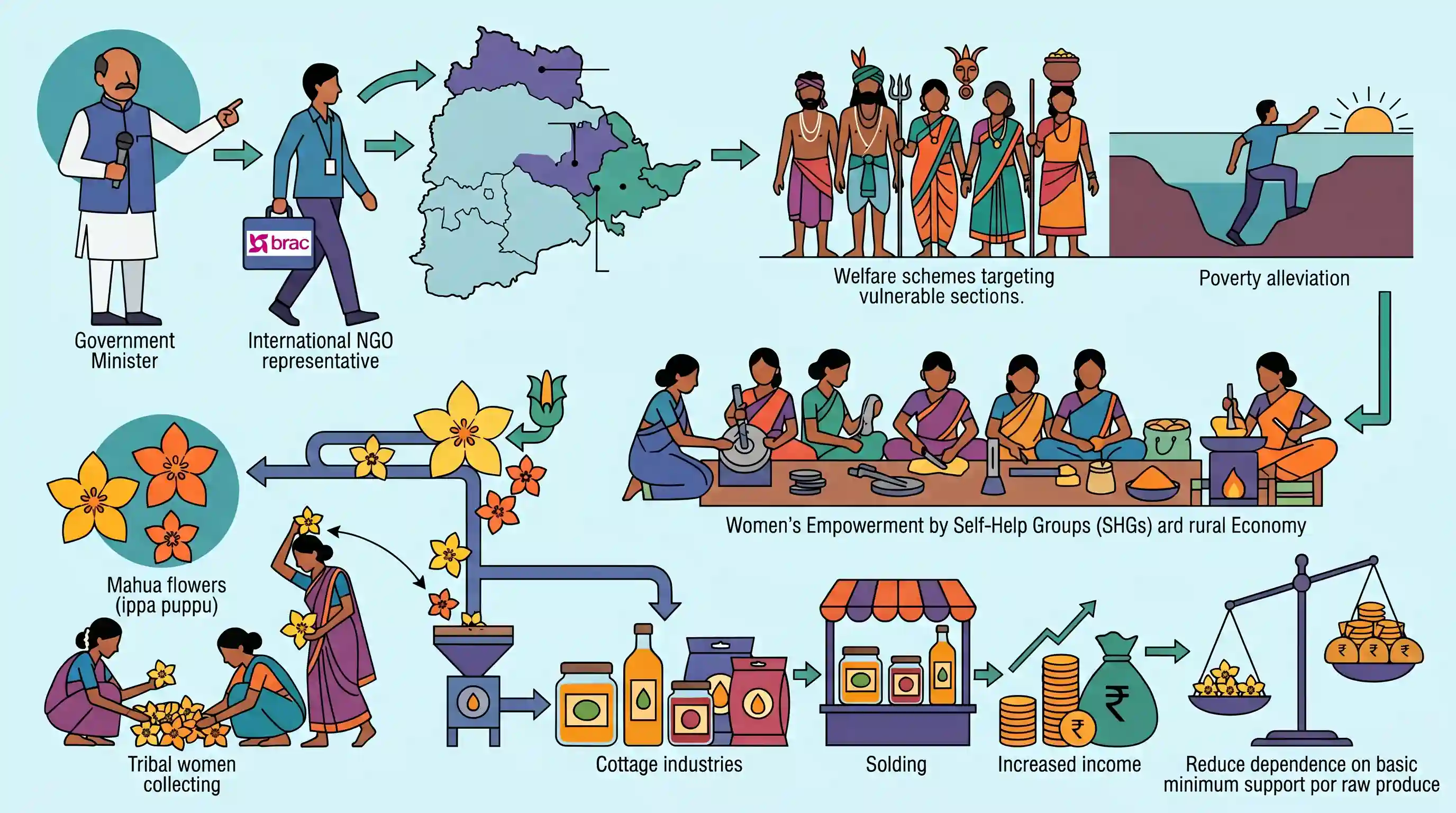
The article highlights a practical governance model combining state machinery (SERP), international NGOs (BRAC), and local tribal communities to tackle extreme poverty. It is highly relevant for GS2 (Governance/Social Justice) regarding the role of NGOs and policies for vulnerable groups like PVTGs, and for GS3 (Economy) concerning value addition to Minor Forest Produce for rural livelihood generation.
Summary
Telangana's Panchayat Raj and Rural Development Minister has instructed the international NGO BRAC to expand the Telangana Inclusive Livelihood Programme (TGILP) beyond its current operations in Bhadradri Kothagudem and Kumram Bheem Asifabad. The program is designed to eradicate extreme poverty among Particularly Vulnerable Tribal Groups (PVTGs). To ensure sustainable livelihoods, the government is prioritizing the development of cottage industries that utilize local forest resources, such as Mahua flowers (Ippa puppu). By training tribal women to produce value-added goods, the initiative seeks to increase rural incomes and reduce dependency on basic minimum support prices for raw forest produce.
Key Points
- The Telangana government has urged international NGO BRAC to expand the Telangana Inclusive Livelihood Programme (TGILP) to more tribal-dominated districts in the state.
- The TGILP primarily focuses on extreme poverty eradication, specifically targeting Particularly Vulnerable Tribal Groups (PVTGs) and tribal women.
- A key strategy discussed is the creation of cottage industries by processing local Non-Timber Forest Produce (NTFP), such as Mahua flowers (Ippa puppu), into value-added goods.
- The initiative aims to empower tribal communities by training them in product diversification, moving their economic reliance beyond mere Minimum Support Price (MSP) collection.
Important Terms
Telangana Inclusive Livelihood Programme (TGILP)

A sequenced poverty alleviation initiative in Telangana targeting the extremely poor, including PVTGs and SCs. It utilizes the "Graduation Approach," combining asset transfers, skill training, and social protection.
UPSC context
GS2: Welfare Schemes for Vulnerable Sections; GS3: Inclusive Growth. Tests knowledge of state-specific poverty eradication models.
BRAC
The world's largest NGO, headquartered in Bangladesh, which pioneered the 'Ultra-Poor Graduation' model. It provides technical expertise to governments to scale holistic poverty-eradication interventions globally.
UPSC context
GS2: Role of NGOs in Development. Tests understanding of international non-state actors in social welfare and developmental best practices.
Society for Elimination of Rural Poverty (SERP)
An autonomous society under the Telangana Department of Rural Development. It spearheads poverty reduction by organizing rural women into Self-Help Groups (SHGs) and federations.
UPSC context
GS2: Important Aspects of Governance (SHGs); GS3: Rural Development. Tests knowledge of institutional frameworks for grassroots economic empowerment.
Particularly Vulnerable Tribal Groups (PVTGs)
A sub-classification of Scheduled Tribes identified as extremely vulnerable based on stagnant/declining population, pre-agricultural technology, and low literacy. India has 75 such notified groups.
UPSC context
GS2: Welfare Schemes for Vulnerable Sections. High-priority topic for tribal welfare and social justice questions.
Graduation Approach
A multi-dimensional intervention involving social protection, livelihood promotion, and financial inclusion. It aims to graduate households from extreme poverty to self-reliance within a fixed timeframe (usually 24–36 months).
UPSC context
GS3: Poverty Alleviation and Employment. Tests understanding of evidence-based, sustainable development strategies.
Prelims Trap
The Graduation Approach for extreme poverty alleviation is an initiative launched by NITI Aayog.
The 'Graduation Approach' is a globally recognized, multi-dimensional poverty alleviation model pioneered by the international NGO BRAC, not an Indian governmental initiative or NITI Aayog program.
Static Concepts Connected
What are the official criteria for classifying a community as a PVTG?
- Pre-agricultural technology: The community must practice hunting, gathering, or agriculture at a pre-agricultural level.
- Low literacy: The community's literacy levels must be exceptionally low compared to other tribal groups.
- Declining/stagnant population: The population must be either stagnant or declining over consecutive censuses.
- Economic backwardness: They must exhibit extreme economic backwardness and high dependency on forest resources.
How is Minor Forest Produce (MFP) supported and regulated in India?
- Definition under FRA: Under the Forest Rights Act (2006), it includes all non-timber forest produce of plant origin (e.g., bamboo, tendu leaves, mahua).
- Ownership rights: The FRA vests traditional forest dwellers with the right to own, collect, use, and dispose of MFPs.
- MSP and TRIFED: The Ministry of Tribal Affairs implements a central scheme for MFP marketing through an MSP, determined with inputs from TRIFED.
Cross-Topic Patterns
International NGOs supplementing State Capacity
Telangana’s partnership with BRAC highlights a growing governance trend: state governments adopting globally recognized models (like the Graduation Approach) to supplement traditional central frameworks for localized poverty alleviation.
PVTGs, NTFPs & Climate Vulnerability
Schemes for PVTGs increasingly overlap with climate resilience, as communities relying heavily on NTFPs (like Mahua) face severe economic disruptions from unseasonal rainfall and shifting forest ecology.

The NGO-led 'Graduation Approach' to poverty, linked with PVTG welfare and NTFP value-addition, is a probable 2026 Prelims statement.
Linked PYQs · 4
Linked PYQs · 4
- 2019PrelimsGS1
Consider the following statements about Particularly Vulnerable Tribal Groups (PVTGs) in India : 1. PVTGs reside in 18 States and one Union Territory. 2. A stagnant or declining population is one of the criteria for determining PVTG status. 3. There are 95 PVTGS officially notified in the country so far. 4. Irular and Konda Reddi tribes are included in the list of PVTGs. Which of the statements given above are correct?
- 2020MainsGS2
Micro-Finance as an anti-poverty vaccine, is aimed at asset creation and income security of the rural poor in India". Evaluate the role of the Self Help Groups in achieving the twin objectives along with empowering women in rural India.
- 2014MainsGS2
The penetration of Self Help Groups (SHGs) in rural areas in promoting participation in development programmes is facing socio-cultural hurdles. Examine.
- 2015MainsGS2
How can the role of NGOs be strengthened in India for development works relating to protection of the environment? Discuss throwing light on the major constraints.
