Assistant Engineer exam result delayed due to Patna High Court stay
Source:free-press-journal ↗
Why It Matters
Understanding the role of the State Public Service Commission (Articles 315-323) and the jurisdiction of High Courts (Article 226) in reviewing administrative actions is crucial for grasping state governance dynamics.
Summary
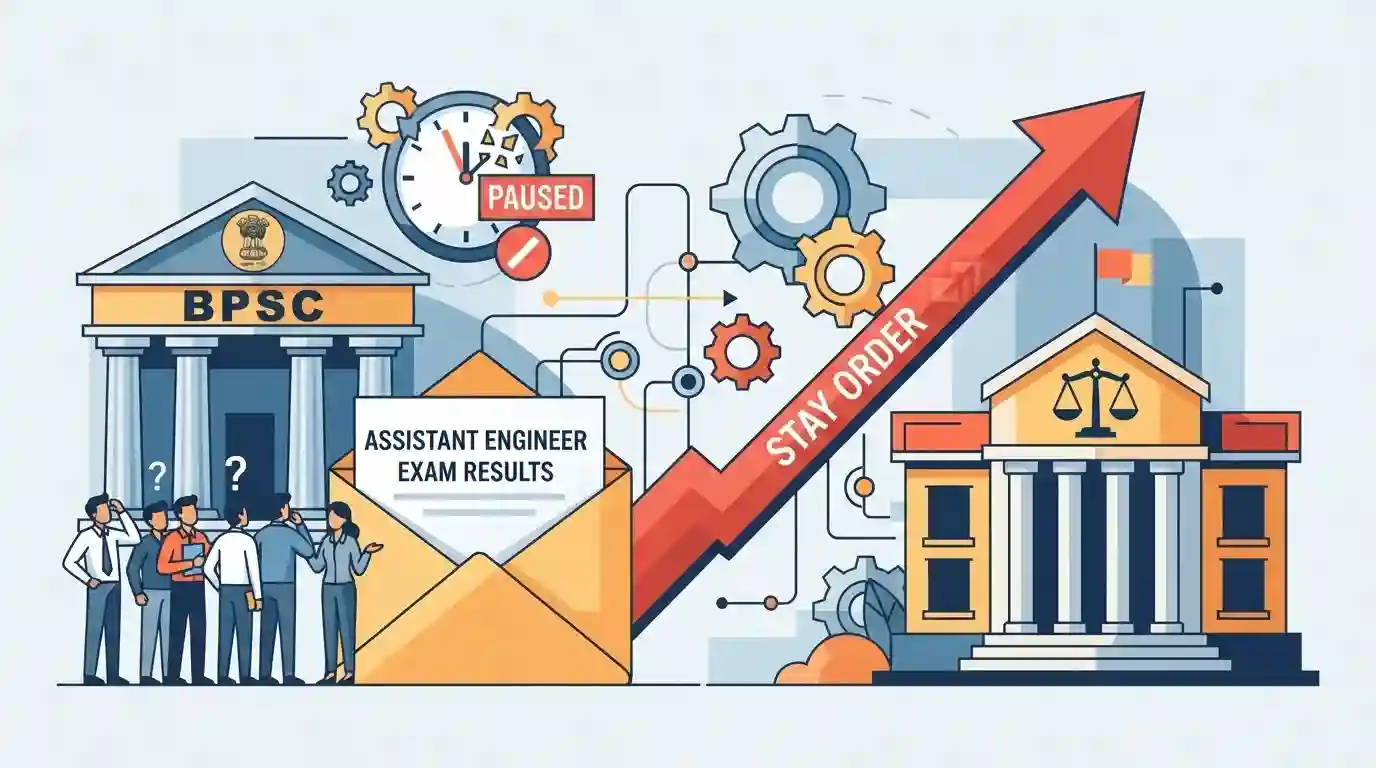
The Bihar Public Service Commission (BPSC) has officially clarified that the announcement of results for the Assistant Engineer Examination has been delayed due to a stay order issued by the Patna High Court. The commission issued the clarification to dispel rumors and stated that the results will be published once the court allows it. This highlights the intersection of judicial oversight and executive recruitment processes in the state.
Key Points
- The Bihar Public Service Commission (BPSC) has clarified that the results for the Assistant Engineer Competitive Examination (Civil, Mechanical, and Electrical) are delayed due to an ongoing court case.
- The Patna High Court has issued a stay order on the publication of these exam results via CWJC No. 3972/2026.
- The commission released a notification to address rumors regarding the delay and assured candidates that results will be declared once the court lifts the stay.
Important Terms
Bihar Public Service Commission (BPSC)

A constitutional body created under Article 315, responsible for conducting civil service examinations and advising the Bihar government on recruitment, promotions, and disciplinary procedures.
UPSC context
Important for GS-2 (Constitutional Bodies), testing the mandate, functions, and autonomy of State Public Service Commissions under Part XIV of the Constitution.
Patna High Court
The highest judicial institution in Bihar, possessing the authority to issue writs and oversee state executive actions to ensure compliance with the law.
UPSC context
Relevant to GS-2 (Judiciary), highlighting the High Court's writ jurisdiction and its role in checking state administrative actions.
Stay Order
A temporary judicial ruling that suspends or halts a specific proceeding or administrative action—like publishing exam results—until a final court decision is reached.
UPSC context
Essential for GS-2 (Judicial functioning), focusing on legal remedies, injunctions, and how court interventions impact executive processes and timelines.
Judicial Oversight
The mechanism through which the judiciary reviews executive and legislative actions to ensure they adhere to constitutional principles and statutory laws.
UPSC context
Key to GS-2 (Separation of Powers), examining the balance between ensuring executive accountability and the potential for judicial overreach in administrative functions.
Prelims Trap
The Chairman of a State Public Service Commission is appointed and removed by the Governor of the state.
While the Governor appoints the Chairman and members of the SPSC, they can only be removed by the President (following a Supreme Court inquiry).
Static Concepts Connected
How does Article 226 differ from Article 32 regarding writ jurisdiction?
- Broader scope: Article 32 is restricted to enforcing Fundamental Rights, whereas Article 226 allows High Courts to issue writs for Fundamental Rights and "any other purpose" (like administrative stays).
- Territorial limit: The Supreme Court's jurisdiction under Article 32 spans the entire territory of India. High Courts are restricted to their territorial jurisdiction or where the cause of action arises.
- Discretionary nature: Article 32 is a fundamental right itself, making SC's intervention mandatory. Article 226 is discretionary, meaning High Courts can refuse to exercise their writ jurisdiction.
What constitutional safeguards ensure the independence of a State Public Service Commission (SPSC)?
- Security of tenure: Members can only be removed by the President (not the Governor) on grounds of misbehavior after a binding Supreme Court inquiry (Article 317).
- Conditions of service: The conditions of service of the Chairman or a member cannot be varied to their disadvantage after their appointment.
- Charged expenses: The expenses of the SPSC, including salaries and pensions, are charged on the Consolidated Fund of the State, meaning they are not subject to legislative vote.
Cross-Topic Patterns
Constitutional Bodies vs. Judicial Review
The frequent stay of SPSC recruitment by High Courts under Article 226 intersects with the broader debate on judicial overreach impacting executive timelines, state capacity, and youth unemployment.
Article 226(3) & ex-parte interim stays
Article 226(3) mandates High Courts to dispose of applications vacating ex-parte stays within two weeks, showcasing a constitutional mechanism designed to prevent indefinite administrative paralysis in state functions.

Expect a multi-statement prelims question pairing SPSC removal procedures (President vs. Governor) with the broad scope of Article 226.
Linked PYQs · 2
Linked PYQs · 2
- 2025BPSC_PRELIMSGS1
Which one of the following subjects fall within the jurisdiction of both High Court and Supreme Court?
- 2022BPSC_PRELIMSGS1
Article 300 of the Indian Constitution deals with
