BPSC Postpones Seventy Second Combined Competitive Preliminary Exam
Source:indianexpress ↗
Why It Matters
While this is primarily an administrative news update regarding the BPSC examination itself, it highlights the function of the State Public Service Commission in recruiting civil servants for state administration. For aspirants, understanding the constitutional provisions surrounding the SPSC (Articles 315-323) is essential for Polity preparation.
Summary
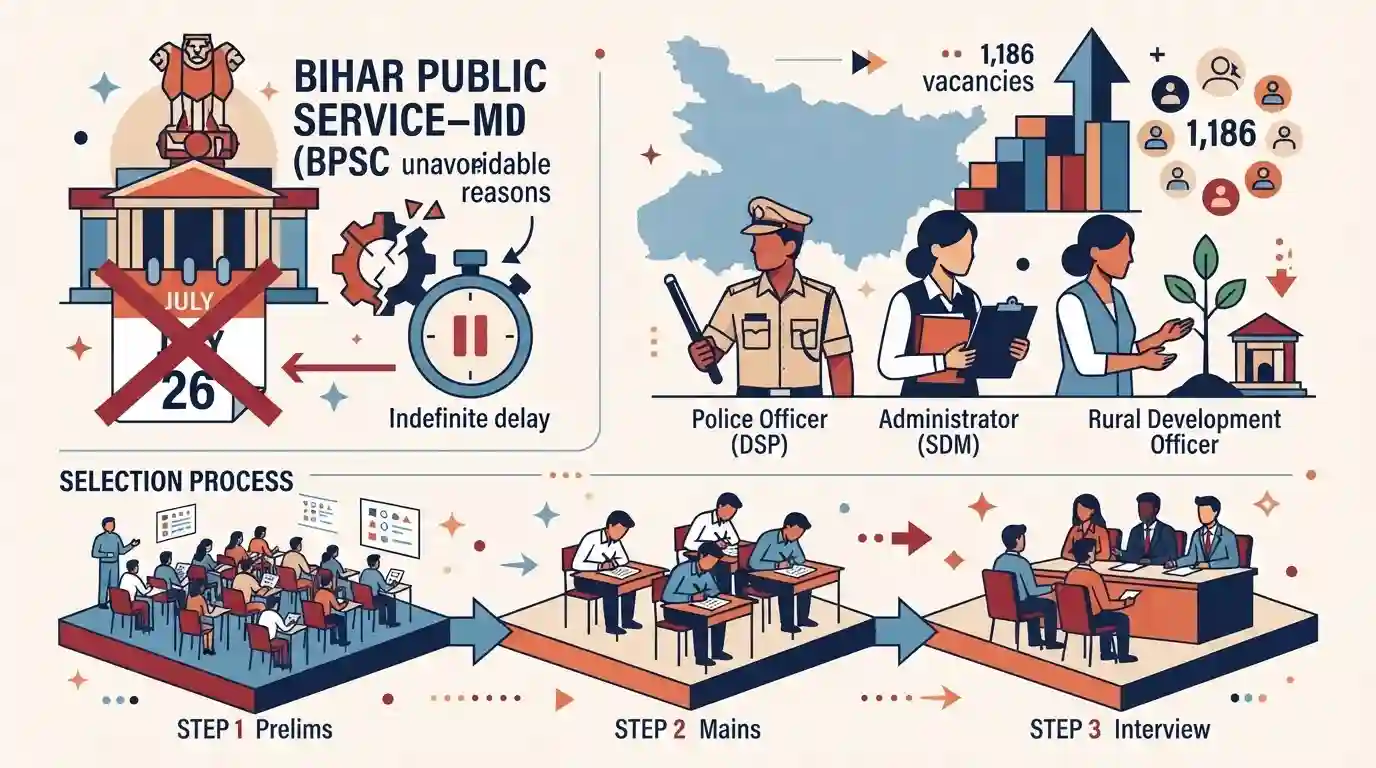
The Bihar Public Service Commission (BPSC) has postponed the 72nd Combined Competitive (Preliminary) Examination, which was originally scheduled for July 26, 2026. The delay is due to unspecified 'unavoidable reasons,' with a new exam date to be announced soon on the official website. The recruitment drive is set to fill 1,186 administrative and executive vacancies across Bihar, including posts like Deputy Superintendent of Police (DSP), Sub-Divisional Magistrate (SDM), and Rural Development Officer. The selection process comprises three phases: Prelims, Mains, and an Interview.
Key Points
- The BPSC has postponed the 72nd Combined Competitive (Preliminary) Examination (CCE), initially scheduled for July 26, 2026.
- The postponement was attributed to 'unavoidable reasons,' and a fresh date will be announced in due course.
- The exam aims to fill 1,186 vacancies in the state administration for posts including DSP, SDM, Rural Development Officer, and Revenue Officer.
- The BPSC 72nd CCE involves a three-stage selection process: Preliminary Exam, Mains Exam, and a Personality Test/Interview.
Important Terms
Bihar Public Service Commission (BPSC)

A constitutional body established under Article 315 of the Indian Constitution, responsible for conducting competitive exams and recruiting candidates for civil services and administrative roles in Bihar.
UPSC context
GS Paper 2 (Polity). Tests knowledge of constitutional bodies, their mandate, and state-level public service recruitment functions.
State Public Service Commission (SPSC)
A constitutional authority formed under Articles 315-323 to conduct state civil service exams. Its members are appointed by the Governor but hold security of tenure, removable only by the President.
UPSC context
GS Paper 2 (Polity). Frequently tests the distinction between the Governor's appointment power and the President's removal power.
State Government of Bihar
The sub-national executive and legislative authority governing an Indian state, responsible for local administration, public order, and implementing development policies through its recruited civil servants.
UPSC context
GS Paper 2 (State Executive). Relevant to topics of federalism, sub-national governance, and the functioning of state administrative machinery.
Combined Competitive Examination (CCE)
A standardized, multi-stage assessment process comprising Preliminary, Mains, and Interview phases. It is used by public service commissions to fairly recruit candidates for diverse administrative and executive vacancies.
UPSC context
GS Paper 2 (Governance). Tests understanding of merit-based bureaucratic recruitment structures and civil service reforms in India.
Prelims Trap
The Chairman and members of a State Public Service Commission are appointed and removed by the Governor of the state.
While the Governor appoints the Chairman and members of a State PSC, they can only be removed by the President of India.
Static Concepts Connected
How does the removal process for SPSC members differ from their appointment?
- Appointment: The Governor of the respective state appoints the Chairman and members of the SPSC.
- Removal: They can only be removed by the President of India (Article 317), on the same grounds as UPSC members, ensuring independence.
- Tenure: They hold office for a term of 6 years or until they attain the age of 62 years (whichever is earlier).
What is the constitutional and legal status of a Joint State Public Service Commission (JSPSC)?
- Statutory status: Unlike UPSC and SPSC, a JSPSC is not a constitutional body. It is a statutory body created by an Act of Parliament.
- Creation process: Parliament creates it only after the concerned state legislatures pass a resolution requesting its establishment.
- Presidential appointment: The Chairman and members of a JSPSC are appointed directly by the President of India, not by state Governors.
Cross-Topic Patterns
SPSC Autonomy vs State Executive
The asymmetric appointment and removal powers (Governor appoints, President removes) are constitutionally designed to shield SPSC members from arbitrary state-level political pressure and preserve meritocracy.
State Cadres and All India Services
State civil servants (like SDMs and DSPs recruited via SPSCs) often work alongside federally recruited IAS/IPS officers, reflecting the dual-administrative structure and cooperative federalism in Indian governance.

Expect statement-based questions contrasting the appointment/removal authorities of State PSCs, Joint PSCs & State Election Commissioners.
Linked PYQs · 2
Linked PYQs · 2
- 2020BPSC_PRELIMSGS1
Which Article in the Indian Constitution is related with the establishment of the Election Commission of India?
- 2020BPSC_PRELIMSGS1
Bihar Government has introduced the Comprehensive Financial Management System (CFMS) on 1st April, 2019. This system
