Geographical Borders and National Identity in Internal Security
Source:Indian Express ↗
Why It Matters
Understanding the conceptual underpinnings of borders and identity is crucial for tackling GS-3 questions on internal security threats (like migration and insurgency) and for addressing philosophical or geopolitical Essay topics on nationalism versus globalization.
Summary
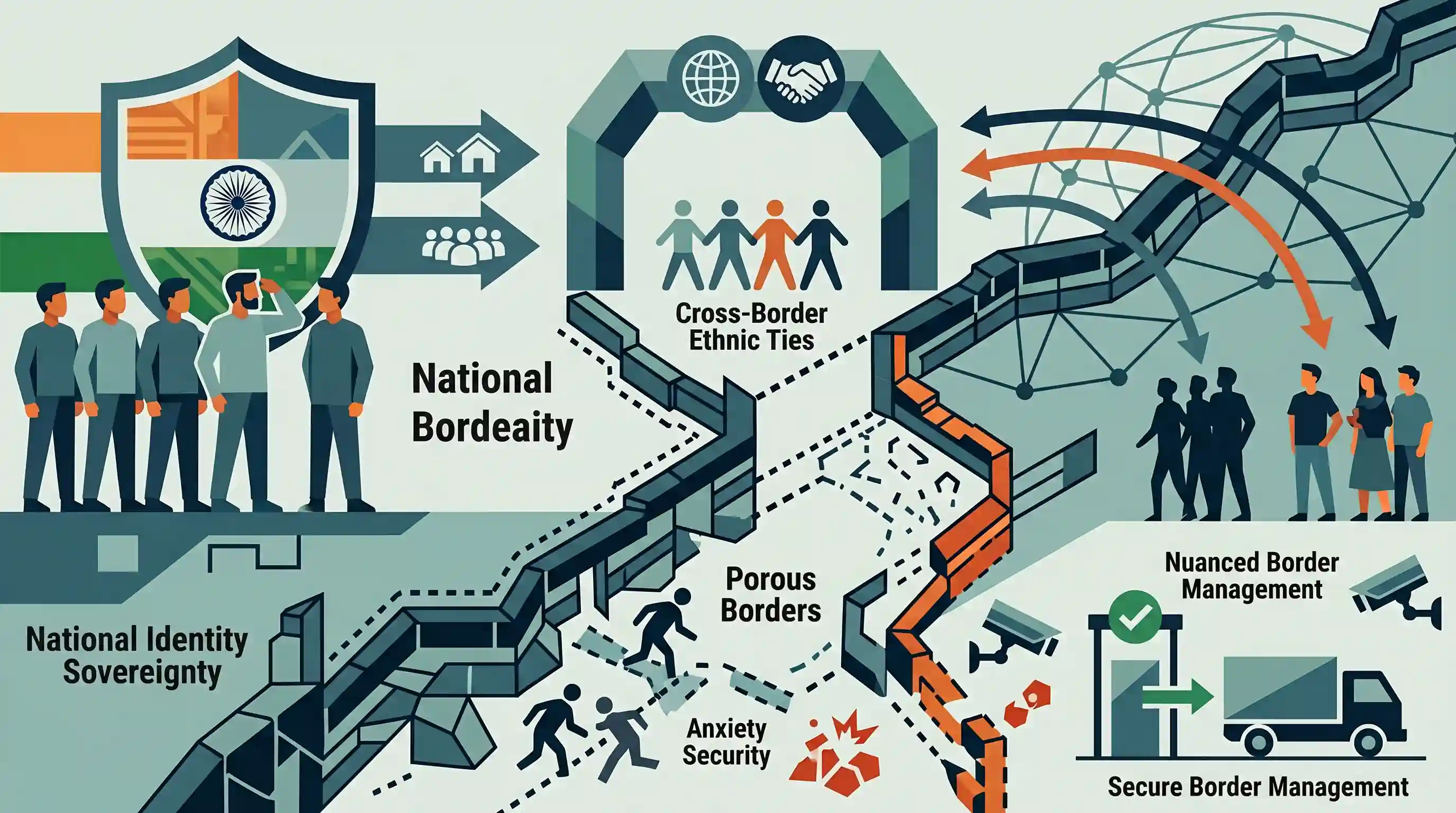
The article explores the deep interplay between geographical borders and the socio-psychological construct of national identity. It highlights that borders are not merely physical lines of demarcation; they are instrumental in defining the sovereignty, citizenship, and collective identity of a nation—often cementing the "we" versus "they" binary. While globalization attempts to blur these lines through economic integration, resurgent nationalism across the globe emphasizes the hardening of state boundaries. For India, unresolved and porous borders (like those with Bangladesh and Myanmar) present complex internal security challenges, including illegal migration, demographic anxieties, and cross-border crimes. The piece underscores the need for a nuanced border management strategy that secures the nation-state without alienating cross-border ethnic ties or disrupting legitimate trade.
Key Points
- Borders function simultaneously as geographical limits of state sovereignty and as socio-psychological constructs that define national identity.
- The nation-state model relies on these boundaries to distinguish citizens (insiders) from migrants and aliens (outsiders), cementing a collective identity.
- Despite globalization's push for a borderless world through economic and digital integration, recent geopolitical trends show a resurgence of sovereign nationalism and hardening of borders.
- For India, porous and unresolved borders pose critical internal security challenges, including illegal transborder migration, cross-border insurgency, and demographic anxieties.
- Effective border governance requires balancing hard security measures (like CIBMS and physical fencing) with a nuanced understanding of borderland populations and cross-border ethnic ties.
Important Terms
Border Management

A multifaceted strategy involving the securing of frontiers, regulation of migration, and prevention of illegal activities like smuggling, while facilitating legitimate movement and trade.
UPSC context
GS Paper 3 (Internal Security). Tests the ability to analyze threats like infiltration and demographic shifts.
One Border, One Force
A policy based on recommendations from the Kargil Review Committee, assigning a single Central Armed Police Force (CAPF) to each international border to ensure unified accountability.
UPSC context
GS Paper 3 (Security Forces). Tests knowledge of administrative structures and coordination among paramilitary forces.
Comprehensive Integrated Border Management System (CIBMS)
A high-tech surveillance framework that integrates sensors, networks, and command-and-control centers to address security gaps in traditional manual patrolling, particularly along the Pakistan and Bangladesh borders.
UPSC context
GS Paper 3 (Internal Security). Tests understanding of technology-driven solutions for modern security challenges.
Free Movement Regime (FMR)
A bilateral arrangement allowing tribes living within 16 km of the India-Myanmar border to cross without a visa to maintain cultural ties; currently being scrapped due to security concerns.
UPSC context
GS Paper 3 (Internal Security). Relevant for questions on Northeast militancy, illegal migration, and Act East Policy.
Border Security Force (BSF)
Established in 1965, it is India’s "First Line of Defence," responsible for guarding the international borders with Pakistan and Bangladesh and preventing trans-border crimes.
UPSC context
GS Paper 3 (Security Forces). Tests knowledge of specific force mandates and their legal jurisdiction.
Indo-Tibetan Border Police (ITBP)
A specialized mountain force raised in 1962, primarily tasked with guarding India’s 3,488 km high-altitude border with China (LAC) from Ladakh to Arunachal Pradesh.
UPSC context
GS Paper 3 (Internal Security). Crucial for understanding high-altitude warfare and Sino-Indian border dynamics.
Prelims Trap
CIBMS is deployed across all of India's land borders to completely replace traditional physical fencing.
CIBMS (smart fencing) doesn't replace physical fences everywhere. It is deployed specifically to plug gaps in difficult terrains (riverine, marshy, hilly) where traditional physical fencing is practically unfeasible.
Static Concepts Connected
What is the mandate of India's primary Border Guarding Forces under the One Border One Force principle?
- BSF: Guards the Indo-Pak and Indo-Bangladesh borders, preventing trans-border crimes, smuggling, and unauthorized entry.
- ITBP: Secures the Indo-China border from Karakoram Pass in Ladakh to Jachep La in Arunachal Pradesh.
- Assam Rifles: Guards the Indo-Myanmar border and conducts counter-insurgency operations in the North East.
- SSB: Secures the open and highly porous borders with Nepal and Bhutan.
How does Benedict Anderson conceptually define the "Nation"?
- Imagined Community: A nation is socially constructed, imagined by the people who perceive themselves as part of that group despite never meeting most members.
- Limited: It is imagined as having finite, elastic boundaries beyond which lie other nations. No nation encompasses all of mankind.
- Sovereign: It emerged during the Enlightenment, replacing the divinely-ordained hierarchical dynastic realm, emphasizing self-rule and independence.
Cross-Topic Patterns
Riverine borders & CIBMS technology
The shift from physical fencing to smart fencing (BOLD-QIT) in shifting riverine geographies like the Brahmaputra stretch directly links physical geography to internal security and technological interventions.
Ethnic ties vs. Westphalian state borders
The scrapping of the Free Movement Regime (FMR) highlights the tension between artificial colonial borders dividing contiguous ethnic groups (e.g., Nagas, Mizos) and modern national security imperatives.

FMR scrapping and BOLD-QIT deployment are prime targets for a mixed-statement Prelims question testing border guarding forces' mandates.
Linked PYQs · 5
Linked PYQs · 5
- 2014MainsGS3
How does illegal transborder migration pose a threat to India's security? Discuss the strategies to curb this, bringing out the factors which give impetus to such migration.
- 2019MainsGS3
Cross-border movement of insurgents is only one of the several security challenges facing the policing of the border in North-East India. Examine the various challenges currently emanating across the India-Myanmar border. Also, discuss the steps to counter the challenges.
- 2020MainsGS3
Analyze internal security threats and transborder crimes along Myanmar, Bangladesh and Pakistan borders including Line of Control (LoC). Also discuss the role played by various security forces in this regard.
- 2025MainsGS2
"With the waning of globalization, post-Cold War world is becoming a site of sovereign nationalism.” Elucidate.
- 2018MainsEssay
Management of Indian border disputes-a complex task
