Booth Level Agents Legal Immunity in Electoral Form Submissions
Source:Indian Express ↗
Why It Matters
It safeguards grassroots political agents and party workers from undue legal harassment over administrative electoral filings, impacting electoral participation and party mechanisms at the booth level.
Summary
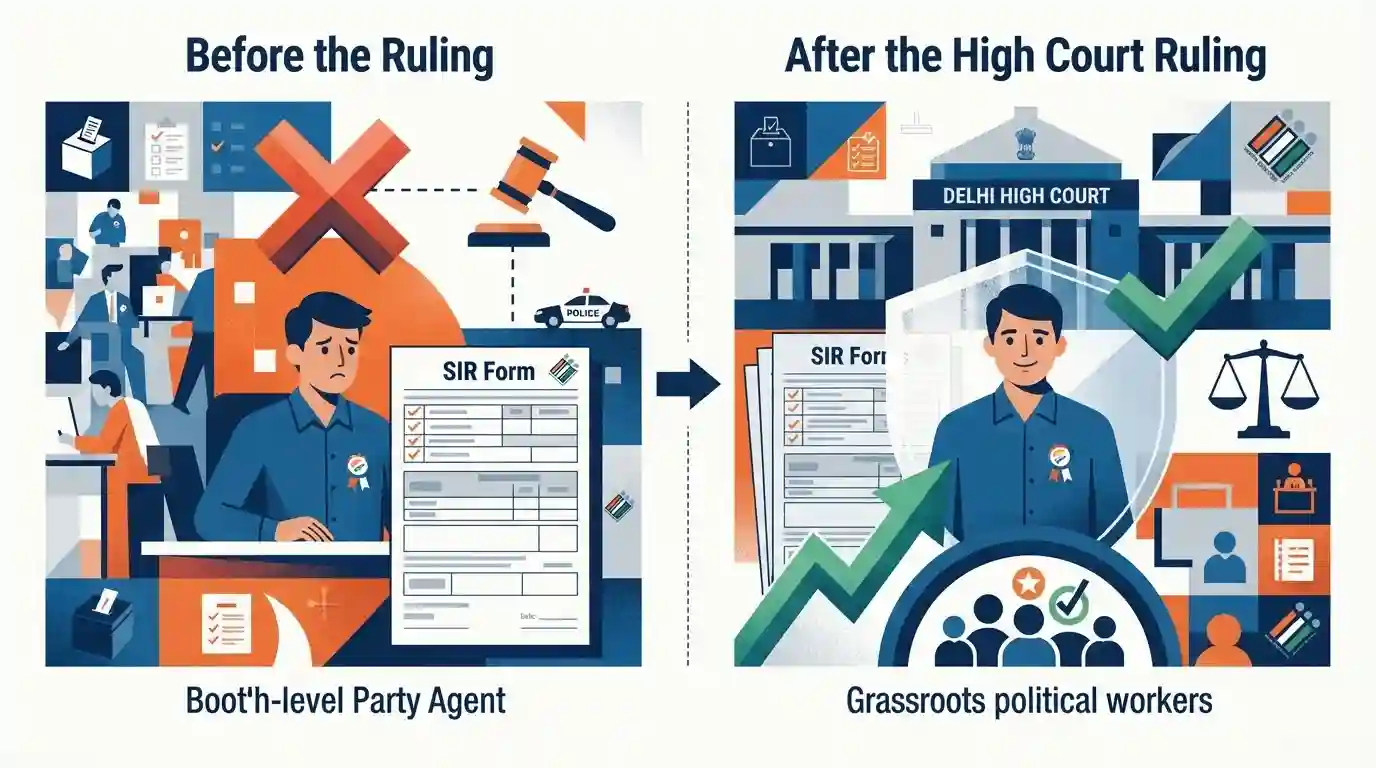
The Delhi High Court ruled that booth-level party agents are not legally liable for details provided in election-related forms like SIR forms, offering a shield to grassroots political workers against individual legal prosecution for administrative form submissions.
Key Points
- The Delhi High Court held that booth-level party agents cannot be held personally liable for details or discrepancies submitted in Special Information Return (SIR) or related election forms.
- The court clarified the legal boundaries and responsibilities of voluntary party workers and booth-level agents during electoral processes and verification drives.
- This ruling protects grassroots party functionaries from unwarranted criminal or legal liability arising from administrative data compilation or form submissions.
Important Terms
Election Commission of India

A constitutional authority established under Article 324 of the Constitution to superintend, direct, and control the conduct of elections in India, including electoral roll revisions.
UPSC context
Important for GS Paper II under Polity and Governance (Constitutional Bodies, Electoral Reforms).
Delhi High Court
The constitutional court of the National Capital Territory of Delhi, exercising writ jurisdiction under Article 226 and adjudicating administrative and electoral legal disputes.
UPSC context
Relevant for GS Paper II (Judicial pronouncements, separation of powers, and institutional oversight).
Prelims Trap
Booth-level party agents share equal legal and statutory liability with official government election functionaries for data compilation in electoral rolls.
Aspirants often confuse BLAs (party-appointed agents) with BLOs (official government functionaries). Only BLOs bear statutory field verification responsibilities under the law.
Static Concepts Connected
What is the statutory framework governing Electoral Registration Officers and Booth Level Officers in India?
- ERO Appointment: EROs are appointed by the Election Commission of India in consultation with the State Government under Section 13B of the RPA, 1950.
- BLO Status: BLOs are designated public servants (usually teachers or local govt workers) assisting EROs in door-to-door verification and roll revision.
- Penal Provisions: False declarations or breaches of official duty by electoral officers attract penal consequences under Section 32 of the Representation of the People Act, 1950.
Cross-Topic Patterns
Electoral Machinery: BLAs vs. BLOs
While BLAs assist in electoral rolls, Booth Level Officers (BLOs) are designated government/public servants whose administrative actions and omissions attract statutory penalties under the RPA.
Constitutional Limits of Electoral Administrative Oversight
Electoral verification touches Article 326 (adult suffrage) and Article 324 (ECI superintendence), making administrative accountability of grassroots workers a key constitutional touchpoint.

RPA, 1950/1951 nuances on election machinery and liabilities of party functionaries vs. public servants are high-yield for prelims statements.
Linked PYQs · 3
Linked PYQs · 3
- 2020MainsGS2
There is a need for simplification of procedure for disqualification of persons found guilty of corrupt practices under the Representation of Peoples Act". Comment.
- 2019MainsGS2
On what grounds a people's representative can be disqualified under the Representation of Peoples Act, 1951? Also mention the remedies available to such person against his disqualification.
- 2022MainsGS2
Discuss the procedures to decide the disputes arising out of the election of a Member of the Parliament or State Legislature under The Representation of the People Act, 1951. What are the grounds on which the election of any returned candidate may be declared void ? What remedy is available to the aggrieved party against the decision ? Refer to the case laws.
