Bombay High Court Seeks NIA Response on Varavara Rao Relocation Plea
Source:The Hindu ↗
Why It Matters
The article highlights the application of the UAPA, conditions surrounding medical bail, and the role of the NIA in internal security cases linked to left-wing extremism. It provides a real-world case study on the prolonged trials and legal complexities surrounding anti-terror laws, relevant to GS Paper 3 (Security) and GS Paper 2 (Polity and Governance).
Summary
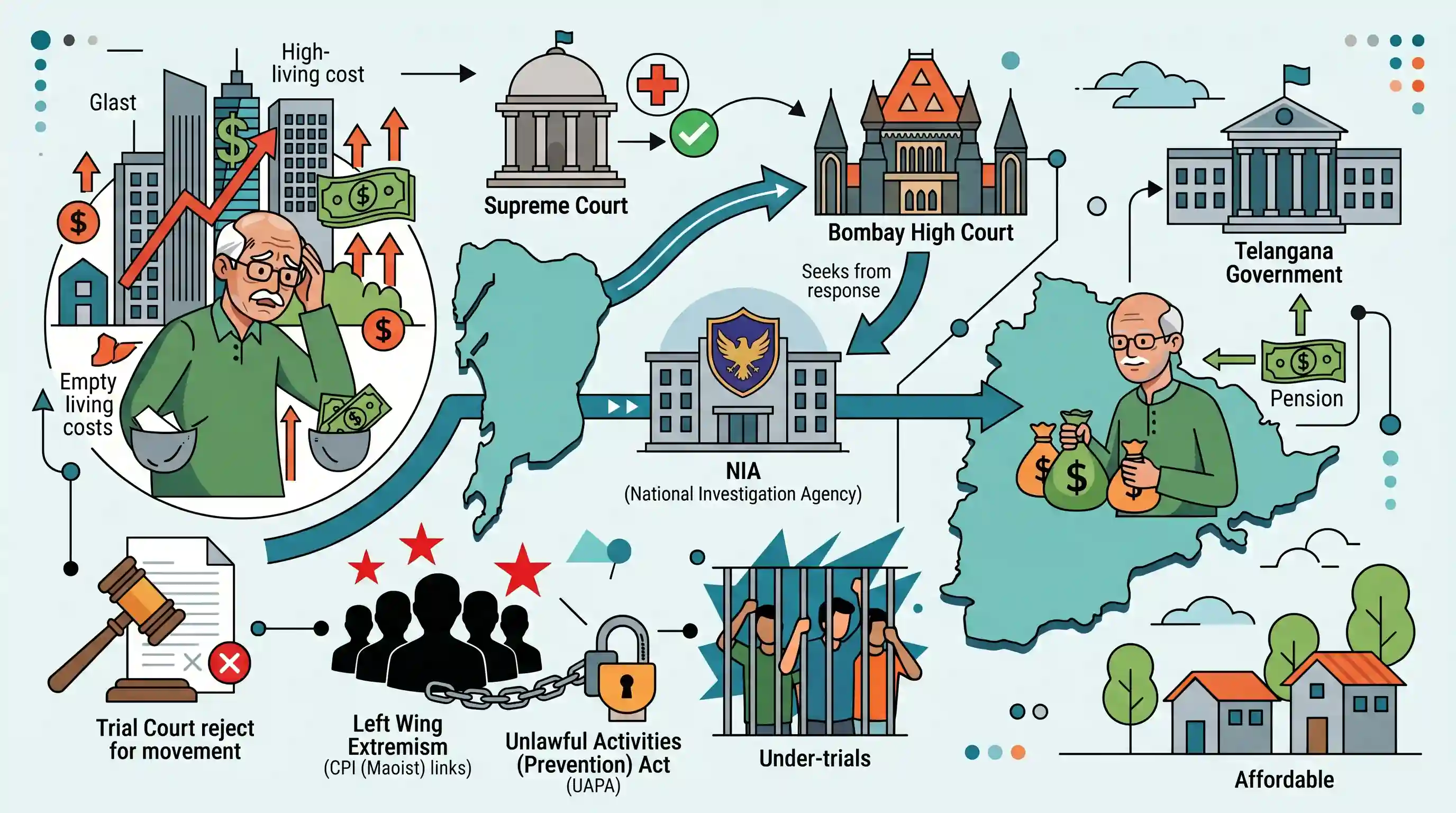
The Bombay High Court has sought a response from the National Investigation Agency (NIA) regarding Varavara Rao's plea to relocate from Mumbai to Hyderabad. Rao, an 85-year-old accused in the Elgar Parishad-Bhima Koregaon case, is out on medical bail granted by the Supreme Court but is restricted from leaving Greater Mumbai without the trial court's permission. He cited the high cost of living in Mumbai and reliance on his pension from the Telangana government as reasons for his request, noting that the special NIA court had previously rejected his application. He faces charges under the Unlawful Activities (Prevention) Act (UAPA) over alleged links to the banned CPI (Maoist) and a conspiracy to overthrow the government.
Key Points
- The Bombay High Court has directed the National Investigation Agency (NIA) to file a reply on a petition by Varavara Rao seeking to relocate to Hyderabad.
- Rao, an 85-year-old Telugu poet and accused in the Bhima Koregaon case, is currently out on medical bail but restricted from leaving Greater Mumbai.
- He filed the plea citing financial difficulties and high living costs in Mumbai as his pension from the Telangana government cannot sustain his expenses.
- He has been charged under the Unlawful Activities (Prevention) Act (UAPA) for alleged ties with the CPI (Maoist) and conspiring to overthrow the government.
Important Terms
Unlawful Activities (Prevention) Act (UAPA)

India’s primary anti-terror legislation that allows the government to designate organizations and individuals as terrorists. It features stringent bail provisions, specifically Section 43D(5), making release difficult.
UPSC context
GS Paper III: Internal Security. Tests knowledge of legal frameworks against terrorism and their impact on fundamental rights.
National Investigation Agency (NIA)
A statutory federal agency established after the 2008 Mumbai attacks. It is empowered to investigate offenses affecting national sovereignty, security, and integrity across state borders without state consent.
UPSC context
GS Paper III: Security Forces and Agencies. Relevant for understanding central-state relations and counter-terrorism institutional frameworks.
CPI (Maoist)
A banned far-left militant organization in India that follows Maoist ideology, aiming to overthrow the government through armed rebellion and a 'Protracted People’s War.'
UPSC context
GS Paper III: Internal Security. Specifically under the topic of 'Left Wing Extremism' (LWE) and its threat to national stability.
Medical Bail
A temporary release from custody granted by courts on humanitarian grounds when an undertrial or convict suffers from severe health issues requiring specialized treatment.
UPSC context
GS Paper II: Judiciary and Fundamental Rights. Relates to Article 21 (Right to Life and Health) and the rights of undertrials.
Left Wing Extremism (LWE)
An internal security challenge involving armed insurgency by Maoist groups, primarily concentrated in tribal areas (Red Corridor), stemming from socio-economic and political alienation.
UPSC context
GS Paper III: Internal Security. Tests understanding of non-state actors and challenges to internal security.
Prelims Trap
Under UAPA, courts are absolutely barred from granting bail if the accusations are prima facie true.
Constitutional Courts (HCs/SC) can bypass UAPA Sec 43D(5) and grant bail if prolonged pre-trial incarceration violates Article 21 (Najeeb case 2021).
Static Concepts Connected
What are the unique jurisdictional powers of the National Investigation Agency (NIA)?
- Federal Mandate: Investigates 'scheduled offences' (terrorism, UAPA) across India without requiring prior consent from state governments.
- Extra-territoriality: Empowered to investigate scheduled offences committed against Indian citizens or Indian interests abroad.
- Special Courts: Cases are tried in designated Special Courts to ensure speedy and exclusive adjudication.
Why is securing bail exceptionally difficult under the UAPA?
- Section 43D(5): Mandates denial of bail if the court finds accusations 'prima facie true' based on initial case records.
- Burden of Proof: Effectively overrides the usual "bail is rule, jail is exception" principle, placing a heavy burden on the accused.
- Extended Custody: Pre-charge sheet police custody can be extended up to 180 days, severely delaying the bail application process.
Cross-Topic Patterns
Urban Naxalism vs. Civil Liberties
The Elgar Parishad case highlights the friction between neutralizing "overground" Maoist support networks (Fifth Generation Warfare) and protecting undertrials' civil liberties against prolonged detention.
Central Agencies & Asymmetric Federalism
The NIA's overriding authority to investigate scheduled offences without state consent frequently triggers center-state federalism disputes, contrasting with the CBI's need for general consent.

Expect a multi-statement question on UAPA: targeting the 'prima facie true' bail test and the NIA's suo motu federal jurisdiction in 2026.
Linked PYQs · 3
Linked PYQs · 3
- 2019MainsGS3
Indian Government has recently strengthened the anti-terrorism laws by amending the Unlawful Activities (Prevention) Act (UAPA), 1967 and the NIA Act. Analyze the changes in the context of prevailing security environment while discussing the scope and reasons for opposing the UAPA by human rights organizations.
- 2022MainsGS3
Naxalism is a social, economic and developmental issue manifesting as a violent internal security threat. In this context, discuss the emerging issues and suggest a multilayered strategy to tackle the menace of Naxalism.
- 2018MainsGS3
Left Wing Extremism (LWE) is showing a downward trend, but still affects many parts of the country. Briefly explain the Government of India's approach to counter the challenges posed by LWE.
