बॉम्बे हाई कोर्ट ने राजनीतिक भाषणों से संबंधित जनहित याचिका खारिज की
स्रोत:द हिंदू ↗
क्यों मायने रखता है
The case illustrates the boundaries of judicial intervention and the frequent misuse of Public Interest Litigations (PILs) for political or non-justiciable matters. It also touches upon the historical debates surrounding V.D. Savarkar and the mechanisms (like special MP/MLA courts and defamation suits) used to hold public representatives accountable.
सारांश
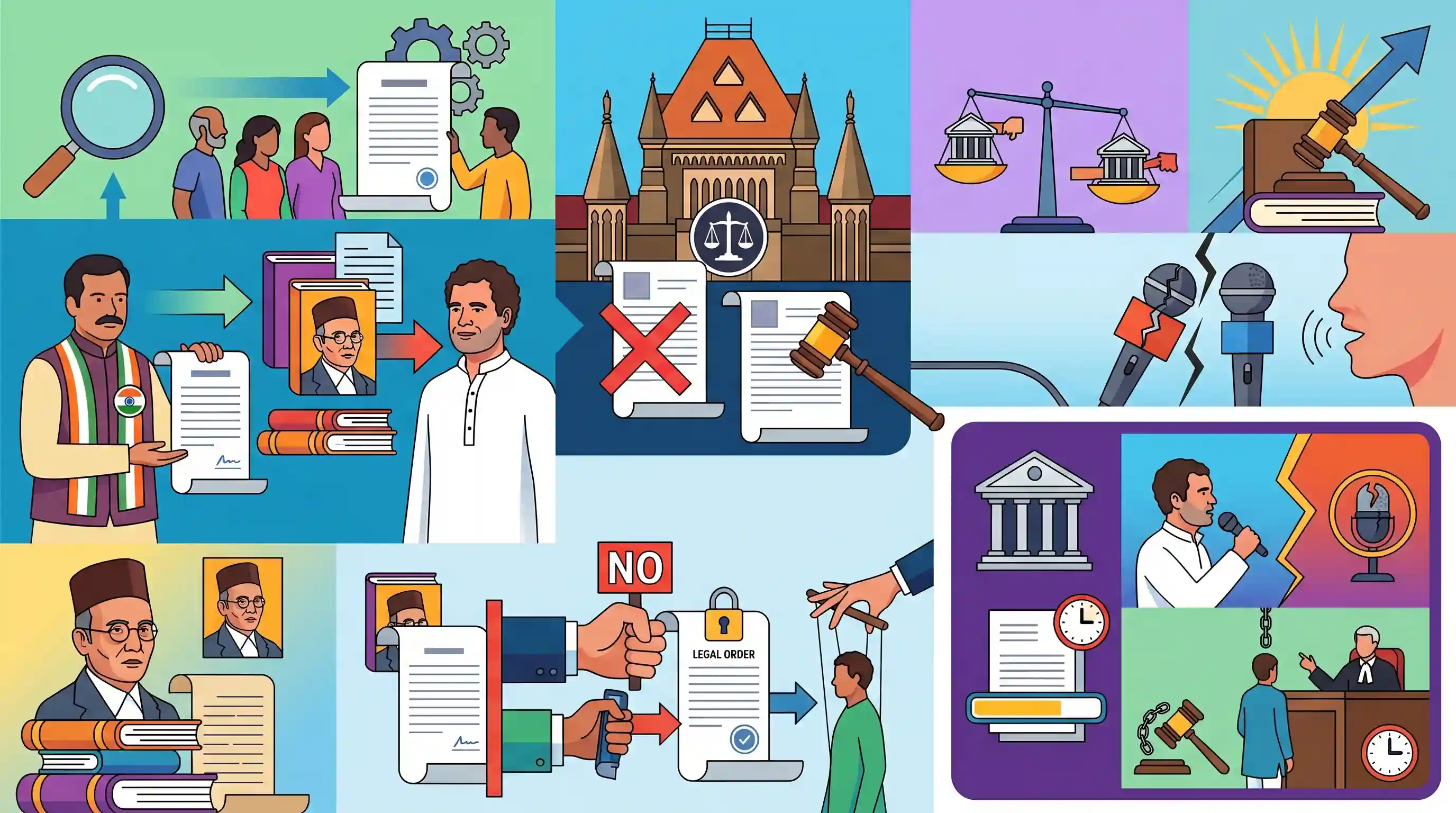
The Bombay High Court dismissed a public interest litigation (PIL) filed by the president of Abhinav Bharat Congress that sought to compel Rahul Gandhi to read research on Hindutva ideologue V.D. Savarkar. The court stated it could not issue a writ of mandamus dictating what a person should read. Furthermore, the court noted that a separate criminal defamation case regarding Gandhi's remarks about Savarkar is already pending before a special MP/MLA court in Pune.
मुख्य बिंदु
- The Bombay High Court dismissed a PIL seeking a directive to compel Congress leader Rahul Gandhi to read research on V.D. Savarkar to "remove his ignorance".
- The bench noted that it lacks the jurisdiction to mandate an individual to read specific literature.
- The court highlighted that a criminal defamation case against Rahul Gandhi over his remarks on Savarkar is already pending in a special MP/MLA court in Pune.
महत्वपूर्ण शब्द
Public Interest Litigation (PIL)

Legal action initiated in a court of law for the protection of 'public interest,' allowing any person to seek judicial redress for public wrongs or injuries.
UPSC context
GS Paper 2: Judiciary. Tests knowledge of judicial activism, locus standi, and the court's role in social justice.
Writ of Mandamus
A high court or Supreme Court order commanding a public authority or individual to perform a specific legal duty they are bound to do.
UPSC context
GS Paper 2: Constitutional Remedies (Articles 32 & 226). Tests understanding of the limits of judicial intervention.
V.D. Savarkar
A prominent revolutionary leader and Hindutva ideologue who founded the Abhinav Bharat Society and authored 'The Indian War of Independence 1857.'
UPSC context
GS Paper 1: Modern History. Essential for studying revolutionary movements and the evolution of political ideologies in India.
Abhinav Bharat Society
A secret revolutionary organization founded by the Savarkar brothers in 1904 to overthrow British rule through armed struggle; originally known as Mitra Mela.
UPSC context
GS Paper 1: Freedom Struggle. Frequently tested under revolutionary organizations and their impact on nationalist awakening.
Judicial Restraint
A theory of judicial interpretation that encourages judges to limit the exercise of their own power and avoid overstepping into legislative or personal domains.
UPSC context
GS Paper 2: Separation of Powers. Relevant for debates on judicial overreach and the functional boundaries of the courts.
Emblems and Names (Prevention of Improper Use) Act, 1950
An Indian law that prohibits the improper use of specific national emblems and names of national icons for professional or commercial purposes.
UPSC context
GS Paper 2: Governance/Statutory Bodies. Tests knowledge of laws protecting national heritage and symbols.
प्रारंभिक ट्रैप
"The High Court can issue a writ of Mandamus to direct a private citizen to read or correct their statements."
Mandamus can only compel public authorities or courts to perform statutory/public duties. It cannot be issued against private individuals.
संबंधित अवधारणाएँ
What are the explicit limitations on issuing a Writ of Mandamus?
- Private Entities: Cannot be issued against private individuals or organizations that do not possess a statutory public duty.
- Discretionary Duties: Cannot compel an authority to perform a duty that is purely discretionary rather than mandatory.
- Constitutional Executives: The President of India and State Governors are constitutionally exempt from this writ.
What were V.D. Savarkar's key contributions to the Indian freedom struggle?
- Secret Societies: Founded the secret societies Mitra Mela (1899) and Abhinav Bharat Society (1904) to organize armed rebellion against the British.
- Nationalist Literature: Authored 'The Indian War of Independence 1857' (1909), reframing the sepoy mutiny as India's first unified national struggle.
- Social Reform: Advocated against untouchability and established the Patit Pavan Mandir in Ratnagiri, open to all Hindu castes.
अंतर-विषय पैटर्न
Frivolous PILs + Judicial Restraint
Courts increasingly invoke jurisdictional limits (like Mandamus boundaries) to dismiss politically motivated PILs, reinforcing the critical boundary between judicial activism and judicial restraint.
Criminal Defamation + MP Disqualification
Political speeches leading to criminal defamation tie directly into Section 8(3) of RoPA, which disqualifies lawmakers sentenced to imprisonment of two or more years.

Expect a multi-statement Prelims question testing the exceptions to Mandamus alongside the historical timeline of Abhinav Bharat.
संबद्ध PYQ · 4
संबद्ध PYQ · 4
- 2024MainsGS2
Explain the reasons for the growth of public interest litigation in India. As a result of it, has the Indian Supreme Court emerged as the world's most powerful judiciary ?
- 2020MainsGS2
Judicial Legislation is antithetical to the doctrine of separation of powers as envisaged in the Indian Constitution. In this context justify the filing of large number of public interest petitions praying for issuing guidelines to executive authorities.
- 2020MainsGS2
There is a need for simplification of procedure for disqualification of persons found guilty of corrupt practices under the Representation of Peoples Act". Comment.
- 2019MainsGS2
On what grounds a people's representative can be disqualified under the Representation of Peoples Act, 1951? Also mention the remedies available to such person against his disqualification.
