Bombay High Court Directs RTE Reimbursement Policy Review
Source:livelaw ↗
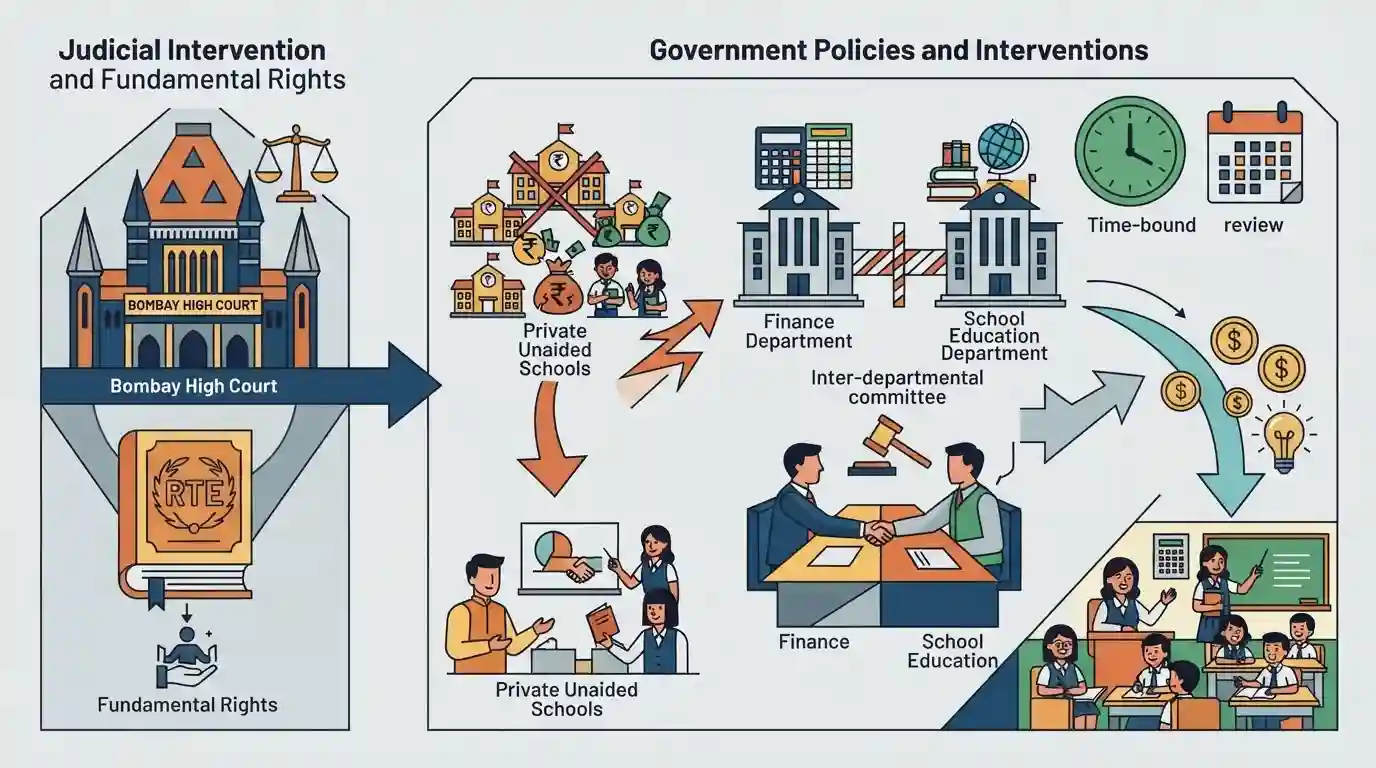
Why It Matters
The enforcement of the RTE Act is crucial for achieving universal elementary education. Delays in state reimbursements threaten the viability of private schools and the realization of Article 21A (Right to Education). This highlights issues in governance, inter-departmental coordination, and the role of the judiciary via writ jurisdiction in enforcing statutory obligations.
Summary
The Bombay High Court has intervened in the ongoing issue of delayed reimbursements to private unaided schools under the Right to Education (RTE) Act, 2009. Addressing over 133 writ petitions, the court directed the Maharashtra government to review its current reimbursement framework and establish a definitive, time-bound mechanism. Under Section 12(2) of the RTE Act, the state is obligated to reimburse schools for admitting students from economically weaker sections. Emphasizing the financial strain on educational institutions and potential impacts on the fundamental right to education, the court suggested creating an inter-departmental committee to streamline the process between the Finance and School Education departments.
Key Points
- The Bombay High Court directed the Maharashtra government to create a time-bound mechanism to reimburse private unaided schools for reserving 25% of seats under the RTE Act.
- Section 12(2) of the RTE Act legally mandates the state government to reimburse schools for the expenses incurred in providing free and compulsory elementary education to children from weaker sections.
- Due to extensive delays, over 133 writ petitions were filed in 2026 by various educational trusts, with reported pending claims amounting to over ₹2,000 crore.
- The court advised forming a committee comprising senior officials from the Finance and School Education departments to eliminate inter-departmental hurdles in processing reimbursements.
Important Terms
Right of Children to Free and Compulsory Education Act, 2009

A landmark 2009 legislation operationalizing Article 21A, ensuring free and compulsory elementary education for children aged 6-14. It enforces basic school standards and a 25% quota for disadvantaged groups in private unaided schools.
UPSC context
Crucial for GS Paper 2 (Social Justice, Education). Frequently tested regarding Article 21A, fundamental rights, and inclusive education frameworks.
Section 12(2) of the RTE Act
A provision mandating state governments to reimburse private unaided schools for expenses incurred by admitting students from Economically Weaker Sections (EWS) and disadvantaged groups under the mandated 25% quota.
UPSC context
Key for GS Paper 2 (Governance). Illustrates the financial mechanisms, center-state devolution issues, and administrative challenges of implementing educational mandates.
Bombay High Court
The apex constitutional court for Maharashtra, Goa, and certain Union Territories. It utilizes its writ jurisdiction under Article 226 to enforce fundamental rights and compel state authorities to fulfill statutory obligations.
UPSC context
Relevant for GS Paper 2 (Judiciary). Highlights the role of High Courts in judicial review, accountability, and enforcing government compliance.
Prelims Trap
"The RTE Act mandates a 25% EWS reservation in all private unaided schools across India, including minority educational institutions."
The Supreme Court in Pramati Educational Trust (2014) explicitly exempted all minority educational institutions (both aided and unaided) protected under Article 30(1) from the RTE Act.
Static Concepts Connected
How did the Right to Education evolve into a Fundamental Right?
- Mohini Jain (1992): Supreme Court held that the right to education at all levels is an integral part of the Right to Life (Article 21).
- Unni Krishnan (1993): The Court refined the previous judgment, restricting this fundamental right specifically to children up to 14 years of age.
- 86th Amendment (2002): Inserted Article 21A, formally making elementary education a fundamental right and paving the way for the RTE Act, 2009.
What are the primary administrative mandates under the RTE Act, 2009?
- 25% Quota: Private unaided, non-minority schools must reserve 25% of entry-level seats for EWS and disadvantaged groups.
- State Reimbursement: State governments are legally bound under Section 12(2) to reimburse private schools for these EWS admissions.
- School Management Committees: Government and aided schools must form SMCs where at least 75% are parents/guardians and 50% are women.
- Teacher Qualifications: The National Council for Teacher Education (NCTE) prescribes minimum qualifications, making the Teacher Eligibility Test (TET) mandatory.
Cross-Topic Patterns
Rights collision: Article 21A vs Article 30
Exam questions often test the intersection of RTE with minority rights, specifically how Article 30(1) limits the State's ability to enforce EWS quotas in minority-run institutions.
Judicial precedents shaping social legislation
The transition of education from a Directive Principle (Article 45) to an enforceable Fundamental Right highlights how judicial activism often directly precedes sweeping statutory welfare frameworks.

A 2026 Prelims question will likely test RTE applicability exceptions (minority schools), State reimbursement duties, and SMC compositions.
Linked PYQs · 3
Linked PYQs · 3
- 2015MPSC_PRELIMSGS1
What is the main purpose of Right to Education Act, 2009 ?
- 2026MPSC_PRELIMSGS1
The National Commission to review the working of the Constitution has recommended that for effectuating fundamental duties are ________. (a) Duty to vote at elections (b) To pay taxes (c) Duty of industrial organisations to provide education to children of their employees (d) To foster a spirit of family values and responsible parenthood in the matter of education, physical and moral well-being of children Answer Options :
- 2026MPSC_PRELIMSGS1
Select the correct statements from the following : (a) Prohibition is issued by a Higher Court to a Lower Court or tribunal and is intended to prohibit it from exceeding its jurisdiction. (b) Writ of prohibition can be issued against administrative agencies. (c) Writ of prohibition is issued against judicial and quasi judicial bodies. Answer Options :
