Bombay High Court ruling on BNS Section 75 and gender identity
Source:The Hindu ↗
Why It Matters
Crucial for UPSC aspirants tracking the judicial interpretation of new criminal codes (BNS) and their application to gender inclusivity and rights protection.
Summary
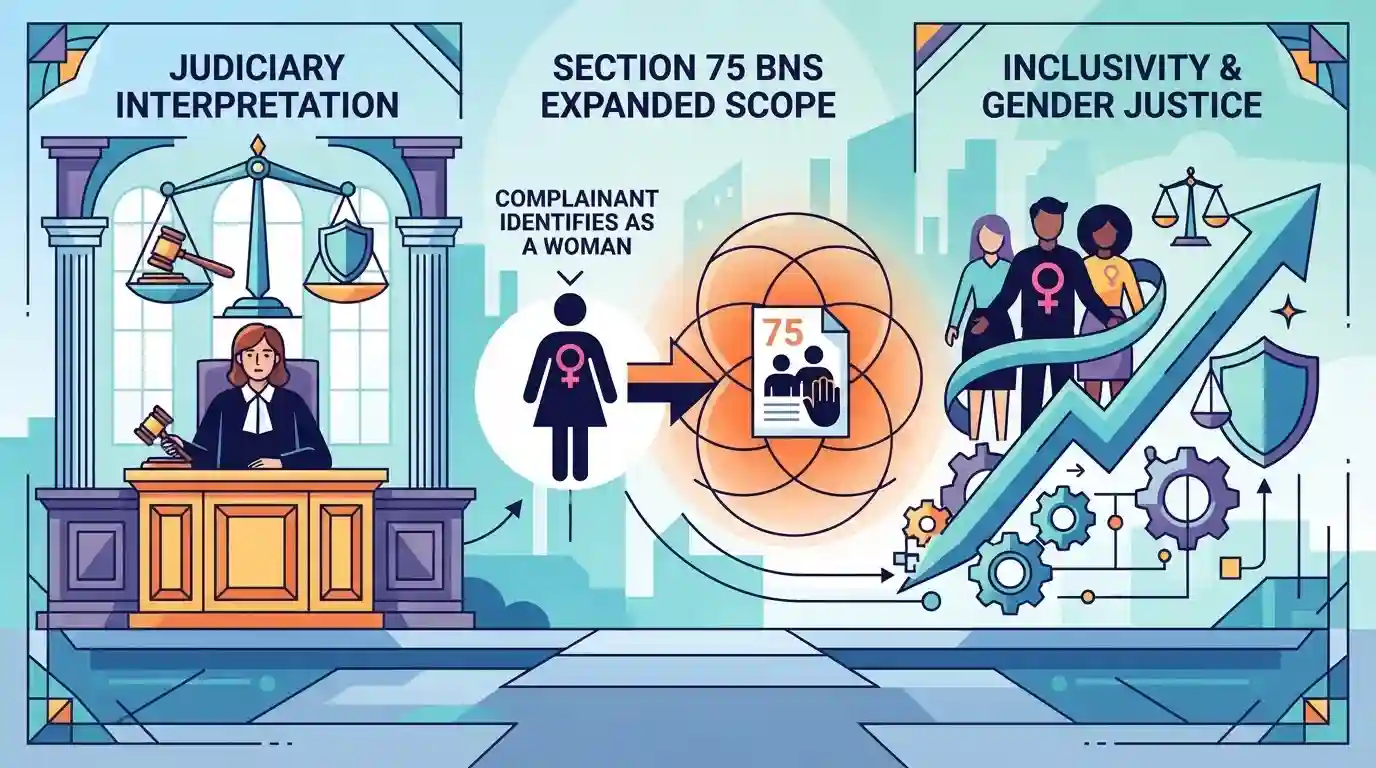
The Bombay High Court has held that Section 75 of the Bharatiya Nyaya Sanhita (BNS), relating to sexual assault, can be applied in cases where the complainant identifies as a woman. This interpretation expands the protective scope of criminal law provisions to ensure inclusivity and uphold gender justice under the new legal framework.
Key Points
- The Bombay High Court ruled that Section 75 of the Bharatiya Nyaya Sanhita (BNS), which penalises sexual assault on a woman, can be invoked in cases where the complainant identifies as a woman.
- The ruling addresses gender inclusivity in the implementation of criminal law provisions under the newly enacted penal codes in India.
- It underscores judicial interpretation of gender definitions to safeguard victims who identify as women irrespective of strict biological constraints.
Important Terms
Bharatiya Nyaya Sanhita BNS Section 75

A provision under the criminal code penalizing sexual harassment, corresponding to the erstwhile Section 354A of the IPC, now interpreted to include complainants who identify as women.
UPSC context
UPSC GS Paper II (Polity & Governance / Judiciary) and GS Paper I (Social Justice): Tests application of criminal law reforms and gender justice.
Bombay High Court
One of India's premier constitutional courts, which recently ruled that criminal provisions against sexual harassment protect any person self-identifying as a woman.
UPSC context
UPSC GS Paper II (Indian Judiciary and Constitutional Interpretation): Tests judicial review, progressive jurisprudence, and rights of marginalized or transgender persons.
Prelims Trap
absence of a formal transgender identity certificate at the time of an alleged offense bars a victim from seeking statutory protections
Aspirants might assume a formal transgender identity certificate is mandatory to invoke statutory protections, but the court ruled that lack of documentation at the time of the offense does not bar protection.
Static Concepts Connected
What are the key directives of the Supreme Court in the NALSA v. Union of India (2014) judgment?
- Gender Identity: Recognised the right to self-identification of gender as integral to Articles 14, 19, and 21 of the Constitution.
- Legal Recognition: Ruled that transgender persons have the right to be legally recognized as 'third gender' or male/female based on personal identity.
- Welfare Mandates: Directed governments to take steps for social welfare, reservation in public education, and healthcare access for transgender persons.
Cross-Topic Patterns
Gender Self-Identification & Criminal Law Jurisprudence
The NALSA framework on gender self-identification intersects directly with statutory criminal law protections, extending beyond civil rights and welfare schemes into substantive penal statutes.
Statutory Interpretation under New Criminal Codes
Judicial interpretation of the Bharatiya Nyaya Sanhita reflects the growing integration of constitutional morality with statutory gender definitions in criminal justice administration.

Expect a statement-based question linking NALSA (2014) principles, Transgender Persons Act (2019), and BNS sexual assault provisions.
Linked PYQs · 2
Linked PYQs · 2
- 2023MainsGS2
Explain the constitutional perspectives of Gender Justice with the help of relevant Constitutional Provisions and case laws.
- 2024PrelimsGS1
Under which of the following Articles of the Constitution of India, has the Supreme Court of India placed the Right to Privacy ?
