Telecom Spectrum Charges and Judicial Review of Executive Power
Source:Indian Express ↗
Why It Matters
This ruling is significant for understanding the limits of executive power and the role of judicial review in preventing arbitrary, retrospective actions by the state. It underscores the importance of regulatory consistency and honoring contractual frameworks (like license agreements) to maintain a stable business environment and encourage infrastructure investment.
Summary
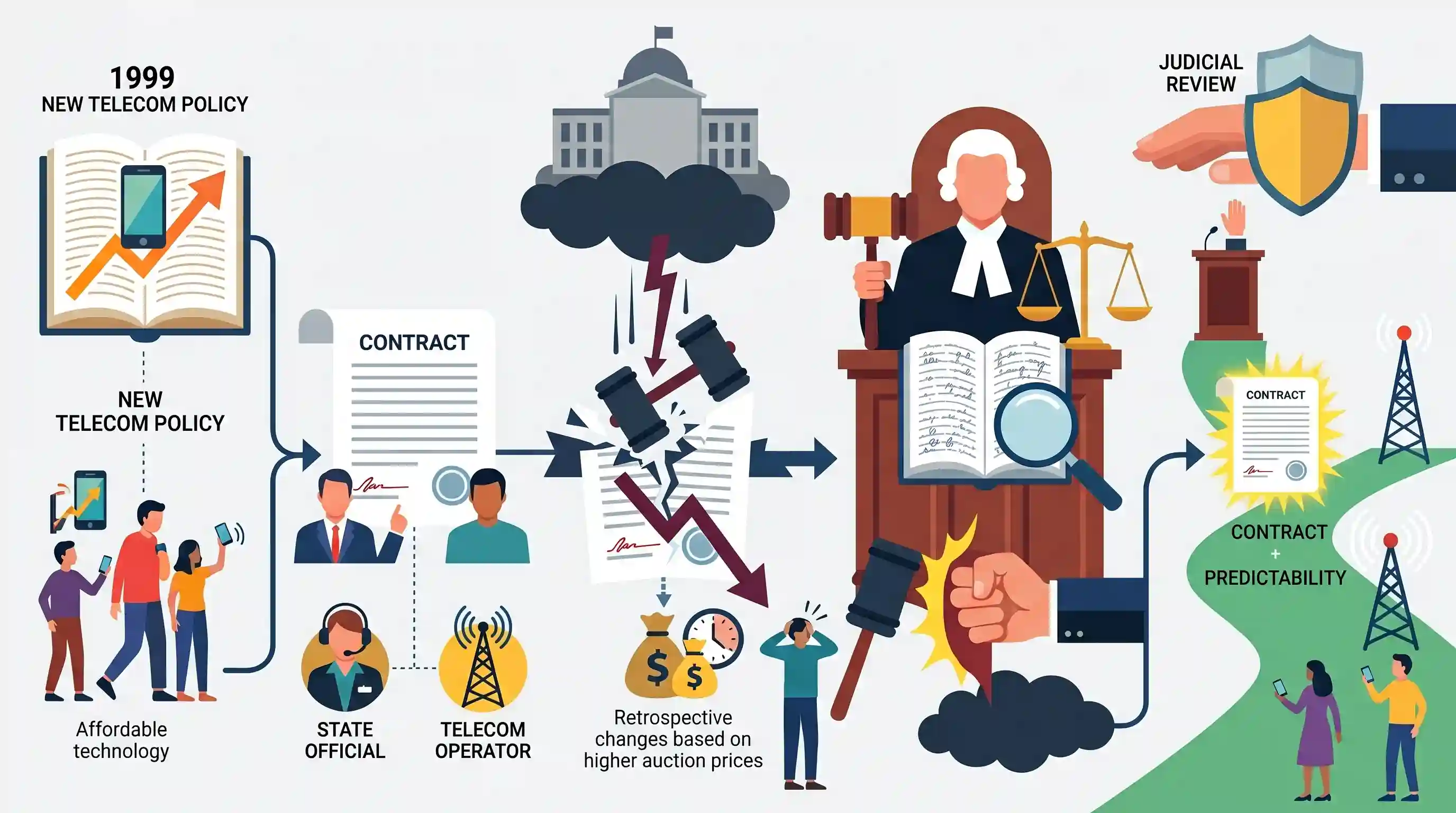
The Bombay High Court has struck down two 2012 Union Cabinet decisions that imposed a retrospective one-time spectrum charge (OTSC) on telecom operators including Bharti Airtel and Vodafone Idea. The court ruled that the Centre lacked the statutory authority under the Telegraph Act to arbitrarily alter license agreements and levy retroactive charges based on later auction prices. It emphasized that the New Telecom Policy of 1999 focused on affordable telecom access rather than revenue maximization, thereby highlighting the importance of regulatory predictability and adherence to contractual terms.
Key Points
- The Bombay High Court quashed 2012 Union Cabinet decisions that retrospectively imposed a one-time spectrum charge (OTSC) on telecom operators for spectrum held between 2008 and 2012.
- The court ruled that the government cannot act on a "whim" under Section 4 of the Telegraph Act to unilaterally alter license agreements retroactively.
- The ruling highlighted that there was no "novation" (mutual modification) of the contract between the telecom operators and the government.
- The judgment noted that the New Telecom Policy (NTP) 1999 prioritized robust and affordable access to telecommunications over revenue maximization.
- The government was directed to return the bank guarantees submitted by the telecom operators.
Important Terms
Indian Telegraph Act, 1885

An 1885 statute giving the Central Government exclusive authority to establish, maintain, and license telecom infrastructure. It remains the foundational legal framework for India's telecommunications sector.
UPSC context
GS Paper II (Statutory Bodies) & GS III (Infrastructure); essential for understanding executive powers and regulatory evolution in telecom.
New Telecom Policy, 1999 (NTP-99)
A landmark reform that transitioned India's telecom sector from a fixed license fee to a revenue-sharing model, prioritizing affordable access and private investment over state revenue maximization.
UPSC context
GS Paper III (Indian Economy & Infrastructure); a major milestone in economic liberalization and telecom growth history.
One-Time Spectrum Charge (OTSC)
A fee levied by the government on telecom operators for holding spectrum beyond a specific limit (e.g., 6.2 MHz), typically calculated based on auction-determined market prices.
UPSC context
GS Paper III (Economy); relevant for telecom sector stress, non-tax revenue, and resource allocation disputes.
Retrospective Levy
The application of a law, tax, or financial charge to transactions or events that occurred before the law was enacted, often contested for violating regulatory predictability.
UPSC context
GS Paper III (Economy/Taxation); critical concept regarding Ease of Doing Business, investor confidence, and legal stability.
Judicial Review
The constitutional power of the Judiciary to examine and quash executive or legislative actions that violate the Constitution or exceed statutory authority.
UPSC context
GS Paper II (Polity); a "Basic Structure" doctrine element testing the limits of executive discretion and administrative law.
Prelims Trap
The Centre has absolute proprietary ownership over telecom spectrum and can unilaterally alter executing licenses.
Under the Public Trust Doctrine, the State acts as a trustee, not an absolute owner. Furthermore, modifying a license agreement requires mutual consent (novation), not arbitrary unilateral action.
Static Concepts Connected
How does the Public Trust Doctrine apply to natural resources like telecom spectrum?
- State as Trustee: The State acts as a trustee for the public, holding scarce resources like spectrum, water, and air, rather than functioning as an absolute proprietary owner.
- Common Good Allocation: Resources must be allocated fairly and transparently (often via auctions) to subserve the common good, aligning with Directive Principles (Article 39(b)).
- Limits on Executive: The government cannot arbitrarily alter allocations or impose unilateral terms solely for revenue maximization at the cost of public affordability.
What are the constitutional boundaries of retrospective legislation in India?
- Criminal Law Ban: Under Article 20(1) of the Constitution, the legislature is strictly prohibited from enacting retrospective criminal laws (ex post facto laws).
- Civil & Tax Validity: Parliament and State Legislatures possess the power to enact civil and taxation laws retrospectively, provided they do not violate fundamental rights.
- Executive Limitations: Courts often strike down retrospective executive actions (like altering contracts) if they lack specific statutory backing or violate the doctrine of arbitrariness (Article 14).
Cross-Topic Patterns
Retrospective levies & Ease of Doing Business
The quashing of retrospective spectrum charges mirrors the 2021 repeal of the retrospective taxation law (Vodafone/Cairn disputes), showcasing a broader institutional push to establish regulatory predictability and secure foreign investor confidence.
Public Trust Doctrine & Article 39(b)
Connects the 2G spectrum judgment (mandatory auctions) to recent Supreme Court debates on Article 39(b), emphasizing that the State holds community resources to subserve public good, not merely to maximize revenue.

Expect a 2026 prelims question testing the 'Public Trust Doctrine' distinguishing State trusteeship of spectrum from absolute ownership.
Linked PYQs · 2
Linked PYQs · 2
- 2020MainsGS2
Judicial Legislation is antithetical to the doctrine of separation of powers as envisaged in the Indian Constitution. In this context justify the filing of large number of public interest petitions praying for issuing guidelines to executive authorities.
- 2021MainsGS3
“Investment in infrastructure is essential for more rapid and inclusive economic growth.” Discuss in the light of India's experience.
