Bombay High Court Scrutinizes Maharashtra FDA Enforcement Actions
Source:livemint ↗
Why It Matters
This case highlights the constitutional friction between regulatory enforcement (led by executive authorities like the State FDA Commissioner) and judicial review under Article 226. Understanding the balance of administrative power, statutory requirements (such as improvement notices), and the judicial enforcement of natural justice is crucial for MPSC Combined Prelims candidates in polity, governance, and state-specific administration sections.
Summary
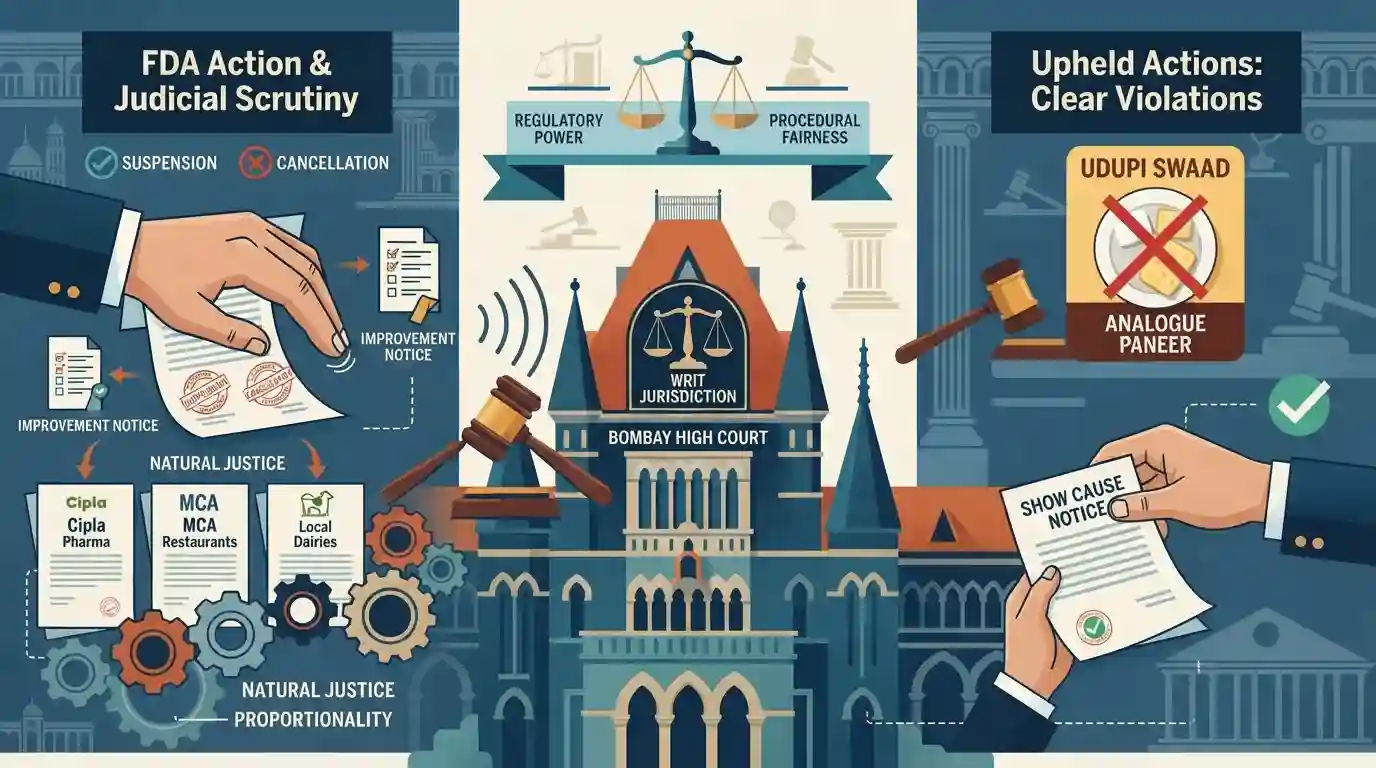
The Bombay High Court has intensively scrutinized the enforcement actions of the Maharashtra Food and Drug Administration (FDA), highlighting the necessity of due process, natural justice, and proportionality in regulatory actions. Across multiple petitions—including those from Cipla Pharma, MCA restaurants, and local dairies—the Court set aside or stayed the FDA's license suspensions and cancellations, citing arbitrary and 'high-handed' execution without following statutory methods like issuing improvement notices. However, the Court upheld actions in cases with clear food safety violations (e.g., Udupi Swaad serving analogue paneer), emphasizing that judicial review is aimed at procedural fairness and pragmatic administration rather than shielding offenders [1.1].
Key Points
- High Court Scrutiny: The Bombay High Court scrutinized the Maharashtra FDA's regulatory enforcement against multiple businesses (pharma, hotels, restaurants, sweet shops) to ensure actions follow 'due process' and 'proportionality' [1.1].
- The Cipla Case: The FDA cancelled the wholesale drug-sale licence of Cipla's Pune facility on a public holiday (August 26) after ignoring an adjournment request. The High Court labeled this 'high-handed,' prompting the FDA to withdraw the order and promise a fair hearing [1.1].
- Pragmatic vs. Pedantic: In the MCA BKC restaurants case, the High Court set aside suspension orders, criticizing the FDA's 'pedantic' approach when the establishment had demonstrated 88% hygiene compliance [1.1].
- Compensation for Arbitrary Action: The High Court quashed the suspension of Gurunanak Dairy and Sweets (Pune), which had shown 98% compliance post-inspection, and directed the FDA to pay ₹5 lakh in compensation to the business [1.1].
- Statutory Procedures Stay: The Aurangabad bench of the Bombay High Court stayed FDA actions against milk vendors due to a lack of statutory procedures, including failure to issue improvement notices and provide proper hearing opportunities [1.1].
- Administrative Leadership: These heightened enforcement actions and subsequent legal challenges followed IAS officer Tukaram Mundhe taking charge as Maharashtra's FDA Commissioner [1.1].
Important Terms
Bombay High Court

A chartered high court established in 1862, exercising judicial and writ jurisdiction over Maharashtra, Goa, and the Union Territories of Dadra and Nagar Haveli and Daman and Diu.
UPSC context
MPSC GS Paper 2 (Polity): Tests understanding of the state judiciary, its writ jurisdiction, and the application of natural justice.
Food Safety and Standards Act, 2006
A consolidated central law regulating food safety, manufacturing, and distribution, which established the Food Safety and Standards Authority of India (FSSAI).
UPSC context
MPSC GS Paper 2/3: Tests state regulatory bodies, health governance, and food safety standards.
Maharashtra Food and Drug Administration (FDA)
The primary regulatory agency in Maharashtra responsible for enforcing food, drug, and cosmetic safety standards under the state's Medical Education and Drugs Department.
UPSC context
MPSC GS Paper 2/3: Tests state administration, public health management, and executive enforcement mechanisms.
Drugs and Cosmetics Act, 1940
A landmark legislation governing the manufacture, import, distribution, and sale of drugs, cosmetics, and medical devices across India.
UPSC context
MPSC GS Paper 2/3: Tests legal frameworks for consumer protection, public health, and pharmaceutical regulation.
Prelims Trap
Writ jurisdiction of High Courts under Article 226 is narrower than that of the Supreme Court under Article 32.
Article 226 is broader as it allows High Courts to issue writs for both Fundamental Rights and ordinary legal rights ('any other purpose'), unlike Article 32.
Static Concepts Connected
How do the writ jurisdictions of the Supreme Court and High Courts compare?
- Subject Scope: Supreme Court issues writs only for Fundamental Rights; High Courts can issue them for both Fundamental Rights and ordinary legal rights.
- Discretionary Nature: Article 32 is itself a Fundamental Right (remedy is guaranteed); Article 226 is discretionary (remedy can be refused if alternative routes exist).
- Territorial Range: Supreme Court's jurisdiction runs throughout India; High Court's is limited to its state boundaries or where cause of action arises.
What is the administrative law principle of Audi Alteram Partem?
- Right to Heard: No person should be condemned unheard; a reasonable opportunity to present one's case must be granted before punitive action.
- Notice Requirement: The affected party must receive adequate notice of the charges or proposed actions before a decision is finalized.
- Constitutional Link: Any arbitrary order passed in violation of this principle is deemed void and violates Article 14 of the Constitution.
Cross-Topic Patterns
Executive Activism vs Procedural Fairness
Highlights the tension between proactive administrative actions by state commissioners and the constitutional mandate of proportionality and natural justice.
FSS Act 2006 & EoDB
Examines how arbitrary state-level enforcement of food safety laws affects local food businesses, stressing the statutory need for mandatory compliance notices.

Multi-statement questions comparing Article 32 vs 226 writ powers and natural justice rules in administrative law are highly likely.
Linked PYQs · 3
Linked PYQs · 3
- 2024MPSC_PRELIMSGS1
Which article empowers the High Courts to issue directions for the enforcement of Fundamental Rights ?
- 2026MPSC_PRELIMSGS1
Which of the following statement/s is/are correct regarding National Food Security Act - 2013 ? (a) Women empowerment is a feature of the National Food Security Act - 2013. (b) State Food Commission is monitoring, reviewing and implementing authority of this Act - 2013. Answer options :
- 2024MPSC_PRELIMSGS1
Food security includes following stages : (a) Adequate availability of food grains to all. (b) Adequate availability of food grains and pulses to all. (c) Adequate availability of food grains, pulses, milk and vegetables to all. (d) Adequate availability of food grains, pulses, milk products, vegetables, fruits, meat and fish etc. Answer options :
