Bombay High Court rules on maternity benefits for contractual staff
Source:Indian Express ↗
Why It Matters
This judicial precedent is crucial for UPSC aspirants as it highlights the intersection of labor rights, women's empowerment, and constitutional law. It exemplifies how courts interpret the Maternity Benefit Act and Directive Principles of State Policy (Article 42) to protect vulnerable contractual workers, an increasingly common employment category in India's labor market.
Summary
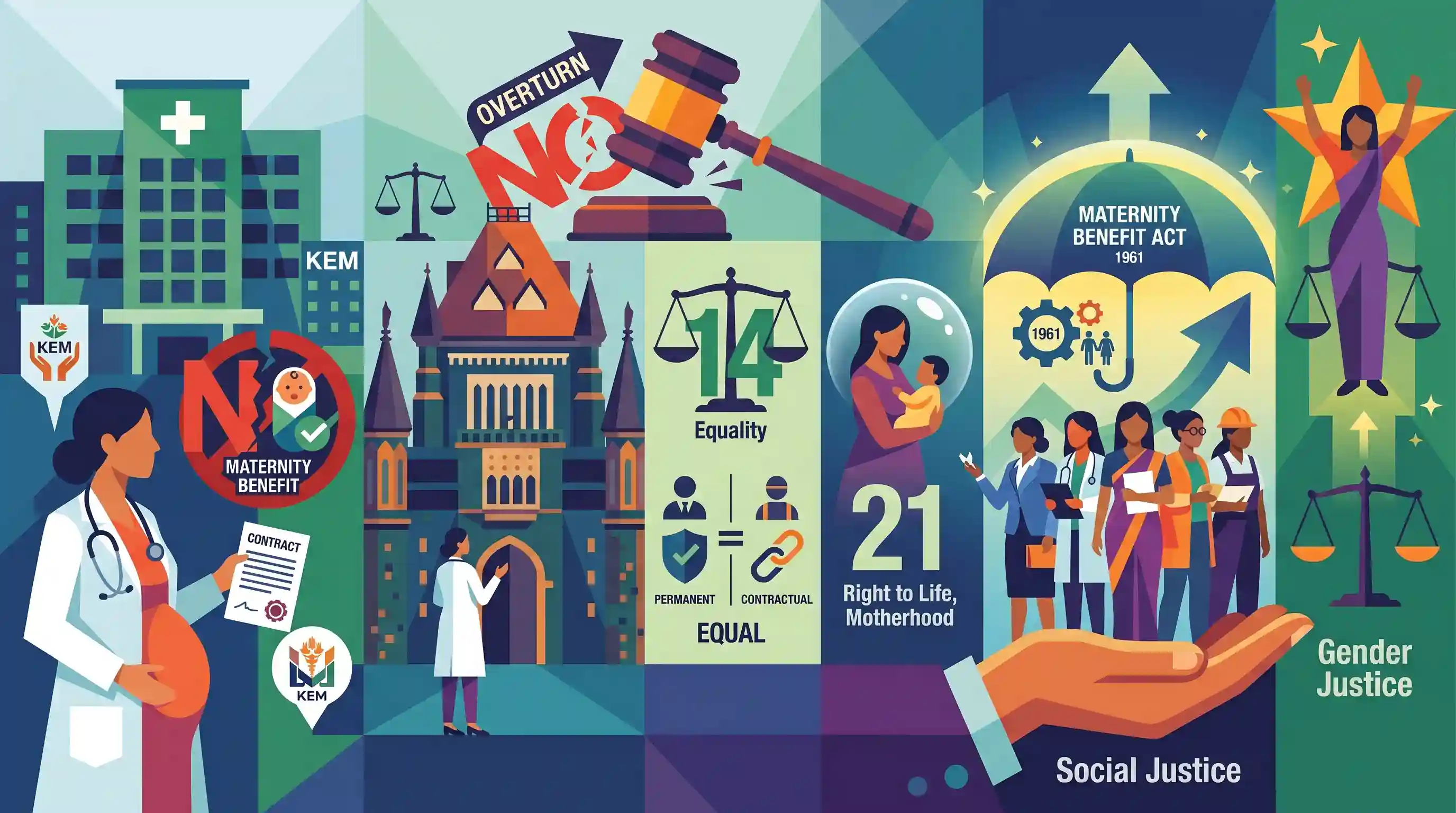
The Bombay High Court has delivered a significant ruling by setting aside KEM Hospital's denial of maternity benefits to a contractual female doctor. The court held that distinguishing between permanent and contractual employees for the purpose of maternity benefits is discriminatory and violates fundamental constitutional rights, including Article 14 and Article 21. This judgment reinforces the universal applicability of the Maternity Benefit Act, 1961, emphasizing that maternity relief is a fundamental statutory right aimed at achieving gender justice and social welfare in the workplace, regardless of the nature of employment.
Key Points
- The Bombay High Court set aside KEM Hospital's decision to deny maternity benefits to a female doctor employed on a contractual basis.
- The court established that denying maternity benefits solely on the grounds of contractual employment is discriminatory and arbitrary.
- This ruling reinforces that the Maternity Benefit Act, 1961, applies equally to contractual and ad-hoc employees, not just regular or permanent staff.
- The judgment upholds constitutional guarantees of gender justice, the right to equality (Article 14), and the right to life with dignity (Article 21).
Important Terms
Maternity Benefit Act, 1961

A central legislation providing 26 weeks of paid leave and benefits to women employees. It applies to establishments with 10+ workers and, judicially, covers contractual staff regardless of employment nature.
UPSC context
GS2 (Social Justice) and GS3 (Labour Laws); tests statutory protections and judicial expansion of welfare rights for women.
Article 21
A fundamental right guaranteeing life and personal liberty, interpreted by courts to include the right to reproductive dignity, health, and financial security during motherhood as essential to life.
UPSC context
GS2 (Fundamental Rights); tests the evolution of constitutional rights through judicial activism and the concept of "living dignity."
Article 42
A Directive Principle of State Policy (DPSP) mandating the State to secure just and humane conditions of work and provide maternity relief, forming the constitutional basis for maternity legislation.
UPSC context
GS2 (Polity and Social Welfare); tests understanding of DPSPs as the bedrock for socio-economic and labor welfare policies.
Article 14
A constitutional guarantee of equality before the law, used by courts to prohibit arbitrary discrimination between permanent and contractual employees regarding statutory welfare benefits like maternity leave.
UPSC context
GS2 (Fundamental Rights); tests the application of the 'reasonable classification' doctrine in administrative and labor disputes.
Gender Justice
The principle of ensuring fair and equal treatment for all genders, specifically removing systemic barriers (like pregnancy) that hinder women's equal participation and economic independence in the workforce.
UPSC context
GS1 (Social Issues) and GS2 (Social Justice); tests awareness of intersectional challenges facing women in the formal and informal economy.
Social Security Code, 2020
A comprehensive 2020 law intended to subsume and universalize various social security statutes, including the Maternity Benefit Act, though its full implementation and informal sector coverage remain debated.
UPSC context
GS3 (Economy and Labour Reforms); tests knowledge of the legislative transition from fragmented labor laws to unified, simplified codes.
Prelims Trap
"Maternity benefits under the 1961 Act apply only to permanent employees and cease upon the expiration of a temporary contract."
The law applies to contractual/ad-hoc workers if they worked 80 days in the preceding 12 months. The Supreme Court established that benefits continue even if the contract expires during the leave period.
Static Concepts Connected
What are the key provisions of the Maternity Benefit (Amendment) Act, 2017?
- Duration: Increased paid leave from 12 to 26 weeks for the first two surviving children (remains 12 weeks for third/subsequent).
- Adoptive & Surrogate: Introduced 12 weeks of leave for commissioning (surrogate) and adoptive mothers (for a child below 3 months).
- Crèche Facility: Made crèche facilities mandatory for establishments with 50 or more employees, allowing 4 daily visits.
Which Constitutional provisions mandate maternity relief and workplace equality?
- Article 42 (DPSP): Directs the State to make provisions for securing just and humane conditions of work and for maternity relief.
- Articles 14 & 21: Guarantee equality before the law and the right to life with dignity, respectively, forming the basis to strike down discriminatory employment rules.
Cross-Topic Patterns
Contractualization and the Social Security Code
The ruling highlights the vulnerability of contract workers, directly mirroring debates around the Code on Social Security, 2020, which seeks to formalize benefits for unorganized and gig workers.
Article 21 expanding into workplace dignity
Extending statutory benefits to temporary staff demonstrates how Constitutional courts continually use Article 21 (Right to Dignity) to bridge labor law gaps and enforce workplace gender equality.

Expect a multi-statement Prelims question on the Maternity Benefit Act targeting the 80-day rule and applicability to contract workers.
Linked PYQs · 2
Linked PYQs · 2
- 2019PrelimsGS1
Which of the following statements is/are correct regarding the Maternity Benefit (Amendment) Act, 2017? 1. Pregnant women are entitled for three months pre-delivery and three months post-delivery paid leave. 2. Enterprises with crèches must allow the mother minimum six crèche visits daily. 3. Women with two children get reduced entitlements. Select the correct answer using the code given below.
- 2023MainsGS2
Explain the constitutional perspectives of Gender Justice with the help of relevant Constitutional Provisions and case laws.
