Bombay High Court Directs Strict Monitoring of Landfill Emissions
Source:Indian Express ↗
Why It Matters
The article serves as a prime case study for the persistent challenges of urban solid waste management in Indian megacities. It illustrates the environmental and health hazards posed by unscientific landfills (methane emissions) and underscores the critical role of judicial intervention in holding municipal bodies accountable for environmental governance.
Summary
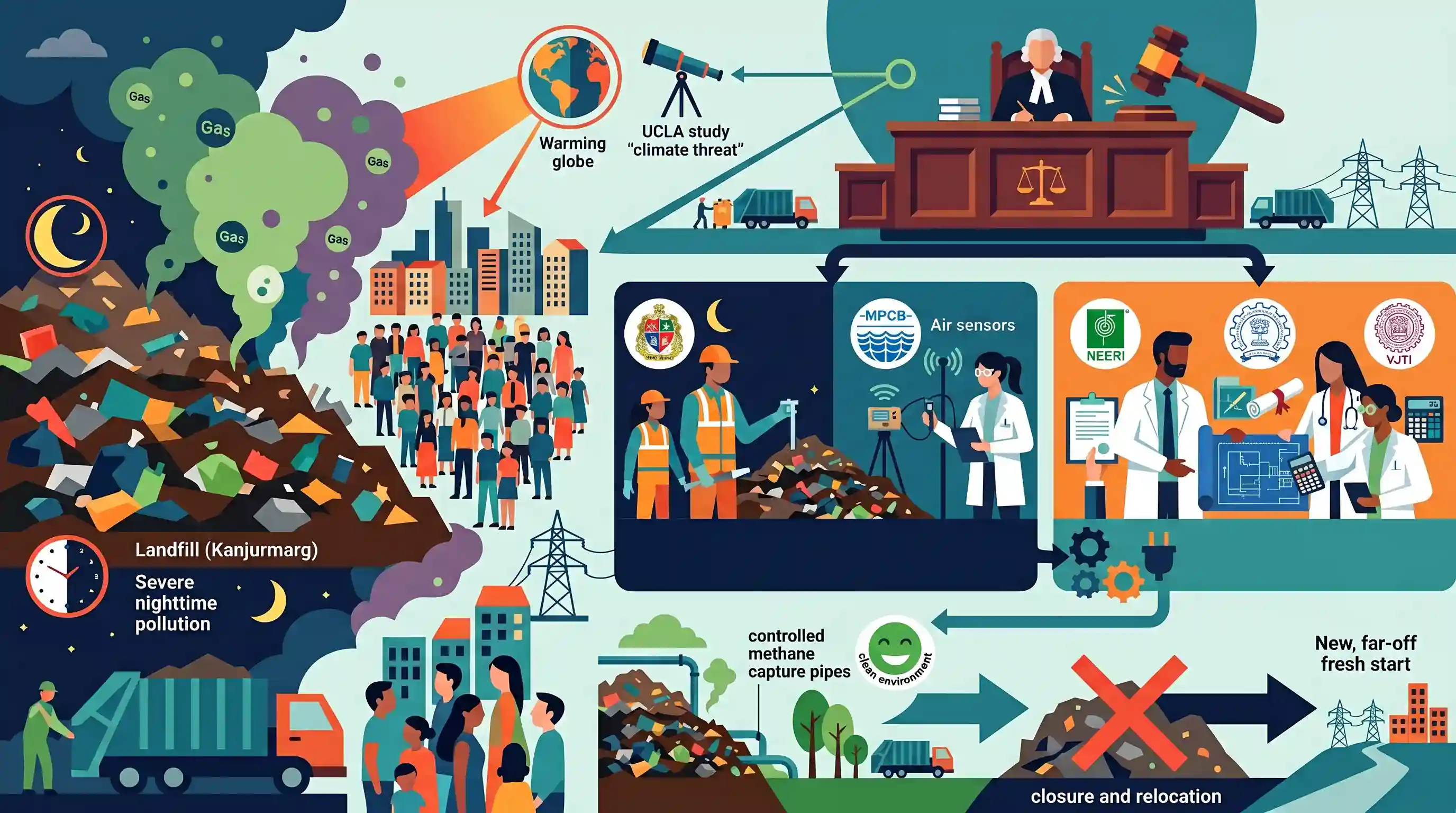
The Bombay High Court has strongly intervened against the severe pollution and dangerous methane emissions emanating from the Kanjurmarg dumping ground in Mumbai, stating that such hazards affecting lakhs of residents cannot be tolerated. Citing a UCLA study that identified the methane emissions as a significant "climate threat", the court ordered the Brihanmumbai Municipal Corporation (BMC) and Maharashtra Pollution Control Board (MPCB) to implement day-to-day monitoring of nighttime pollution levels. A panel of experts from premier institutions including NEERI, IIT-Bombay, and VJTI has been tasked with analyzing the emissions and devising mitigation strategies. The court warned that it may order the closure and relocation of the landfill if immediate improvements are not achieved, highlighting the judiciary's proactive role in enforcing citizens' right to a clean environment.
Key Points
- The Bombay High Court strongly criticized the continuous pollution and dangerous methane emissions from Mumbai's Kanjurmarg landfill, which affects over 15 lakh residents.
- Methane emissions from the dumping ground were recognized as a significant climate threat and health hazard, corroborated by a UCLA study.
- The court ordered the BMC and MPCB to conduct strict day-to-day monitoring of pollution and odour levels between 1 am and 6 am.
- Experts from NEERI, IIT-Bombay, and VJTI have been enlisted to analyze the hazardous emissions and recommend scientific containment strategies.
- The judiciary warned of entirely shutting down the landfill operations if authorities fail to mitigate the environmental and health crisis.
Important Terms
National Environmental Engineering Research Institute (NEERI)

A constituent laboratory of the CSIR (Ministry of Science and Technology) headquartered in Nagpur. It conducts research and develops technical solutions for pollution control, waste management, and environmental sustainability.
UPSC context
GS3 (Environment and Science & Technology). Relevant for pollution mitigation strategies and expert-led environmental governance.
Maharashtra Pollution Control Board (MPCB)
A state-level statutory body responsible for implementing environmental laws in Maharashtra, including the Water Act (1974) and Air Act (1981). It monitors industrial compliance and executes pollution abatement programs.
UPSC context
GS3 (Statutory Bodies and Environment). Tests knowledge of regulatory frameworks for waste management and industrial pollution.
Brihanmumbai Municipal Corporation (BMC)
The governing civic body for Mumbai, established under the BMC Act 1888. As India’s wealthiest municipal corporation, it handles urban infrastructure, public health, and solid waste management.
UPSC context
GS2 (Urban Local Bodies and Governance). Relevant for challenges in municipal solid waste management and urban decentralization.
Bombay High Court
One of India's oldest High Courts, exercising writ jurisdiction under Article 226. In environmental law, it frequently intervenes to protect citizens' fundamental right to a clean environment under Article 21.
UPSC context
GS2 (Judiciary and Judicial Activism). Demonstrates the judiciary's role in enforcing environmental accountability when executive agencies fail.
NGO Vanashakti
A Mumbai-based environmental non-profit trust that uses Public Interest Litigation (PIL) to advocate for forest conservation, wetland protection, and stricter compliance with environmental clearance norms.
UPSC context
GS2 (Civil Society and NGOs). Highlights the role of non-state actors in environmental advocacy and judicial oversight.
IIT-Bombay
A premier public technical and research university in Mumbai, designated as an Institute of National Importance. It provides advanced scientific consultation and technical analysis for critical urban and environmental challenges.
UPSC context
GS3 (S&T and Urban Planning). Relevant for the role of premier academic institutions in evidence-based policy making.
Prelims Trap
"NEERI is an apex research institute operating under the Ministry of Environment, Forest and Climate Change (MoEFCC)."
NEERI is a constituent laboratory of CSIR, which operates under the Union Ministry of Science and Technology, not the MoEFCC.
Static Concepts Connected
What are the key mandates of the Solid Waste Management Rules, 2016?
- Source Segregation: Mandates segregating waste at source into three distinct streams: biodegradable, dry, and domestic hazardous waste.
- Expanded Scope: Jurisdiction expanded beyond municipal areas to include census towns, special economic zones (SEZs), and industrial townships.
- EPR Mandate: Manufacturers of packaging are financially responsible for collecting the waste generated from their products.
How do legacy landfills generate methane and what is its climate impact?
- Anaerobic Decomposition: Deeply buried organic waste breaks down without oxygen, generating landfill gas which is roughly 50% methane.
- High GWP: Methane is a highly potent greenhouse gas with a Global Warming Potential (GWP) roughly 84 times higher than CO2 over a 20-year timeframe.
- Fire Catalyst: Trapped methane gas in legacy dumpsites is highly combustible and acts as the primary catalyst for frequent, deep-seated urban landfill fires.
Cross-Topic Patterns
Landfill methane and the Global Methane Pledge
India abstained from the Global Methane Pledge largely due to agricultural concerns, yet urban landfill emissions (15% of India's methane) remain a major, politically less-sensitive domestic climate target.
Judicial Activism via Article 21
High Courts and the NGT frequently invoke Article 21 (Right to Life) to force executive action on municipal failures, establishing a strong pattern of 'constitutionalizing' urban environmental crises.

Expect a multi-statement Prelims question linking urban solid waste rules, anaerobic methane generation in landfills, and NEERI's mandate.
Linked PYQs · 3
Linked PYQs · 3
- 2018MainsGS3
What are the impediments in disposing the huge quantities of discarded solid wastes which are continuously being generated? How do we remove safely the toxic wastes that have been accumulating in our habitable environment?
- 2022MainsGS2
“The most significant achievement of modern law in India is the constitutionalization of environmental problems by the Supreme Court.” Discuss this statement with the help of relevant case laws.
- 2015MainsGS2
Does the right to clean environment entail legal regulations on burning crackers during Diwali? Discuss in the light of Article 21 of the Indian Constitution and Judgement(s) of the Apex Court in this regard.
