Bombay High Court Judge Recuses From Public Security Act Petitions
Source:The Hindu ↗
Why It Matters
This development is significant for MPSC aspirants as it touches upon core constitutional principles regarding the balance between state security measures and individual civil liberties. It directly involves fundamental rights, judicial recusal, and executive overreach in state laws.
Summary
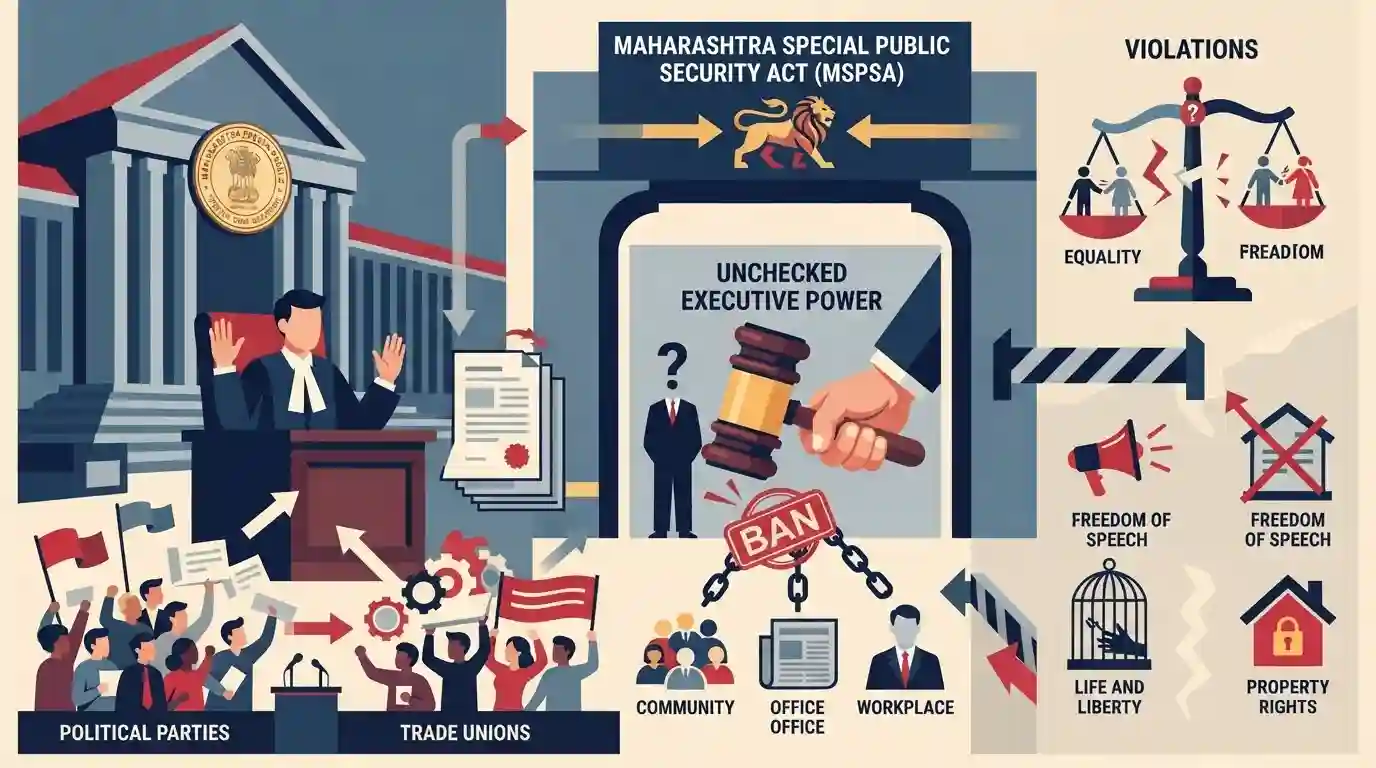
A Bombay High Court judge recently recused himself from hearing a batch of petitions challenging the Maharashtra Special Public Security Act (MSPSA), 2025. The petitioners, including political parties and trade unions, argue that the Act violates Fundamental Rights (Articles 14, 19, 21) and the Right to Property (Article 300A). They contend that the legislation provides unchecked executive power to declare organizations unlawful, ban them, and attach properties without judicial scrutiny, a prior hearing, or disclosure of evidence, posing severe threats to civil liberties.
Key Points
- Bombay High Court Justice Gautam Ankhad recused himself from hearing petitions challenging the constitutional validity of the Maharashtra Special Public Security Act, 2025, due to his prior representation of the State in the Bhima Koregaon case.
- The MSPSA is challenged by political and trade union bodies for granting excessive executive powers, allowing the government to ban organizations and attach properties without a prior hearing or judicial oversight.
- Petitioners argue the definition of 'unlawful activity' under the MSPSA is vague and broad, potentially criminalizing non-members merely for association without proving criminal intent (mens rea).
- The legislation is contested for allegedly violating multiple Fundamental Rights, including Articles 14, 19(1)(a), 19(1)(b), 19(1)(c), and 21, as well as the constitutional right to property under Article 300A.
Important Terms
Maharashtra Special Public Security Act (MSPSA)

A state legislation empowering the Maharashtra government to declare organizations as "unlawful," criminalize membership or funding, and attach properties without prior judicial oversight, ostensibly to combat Left-Wing Extremism.
UPSC context
GS Papers 2 & 3 (Internal Security). Highlights the friction between counter-insurgency state powers and constitutional civil liberties.
Unlawful Activities (Prevention) Act (UAPA)
India's principal central anti-terrorism legislation enacted in 1967. It allows the government to designate individuals and organizations as terrorists, featuring stringent bail conditions and broad legal definitions for unlawful activities.
UPSC context
GS Papers 2 & 3 (Internal Security, Fundamental Rights). Central to debates on national security frameworks versus human rights safeguards.
All India Trade Union Congress (AITUC)
India's oldest central trade union federation, established in 1920 by leaders including Lala Lajpat Rai. It was originally formed to represent the Indian working class at the International Labour Organization.
UPSC context
GS Paper 1 (Modern Indian History). Highly relevant for questions on the pre-independence labor movement and nationalist leaders.
Bombay High Court
One of India's oldest High Courts, established in 1862. It exercises broad territorial jurisdiction covering the states of Maharashtra and Goa, as well as the Union Territory of Dadra and Nagar Haveli and Daman and Diu.
UPSC context
GS Paper 2 (Judiciary). Relevant for understanding the architecture of higher judiciary and fundamental rights enforcement via writ jurisdiction.
Prelims Trap
Judicial recusal in India is governed by specific statutory rules under the Advocates Act.
Recusal is entirely uncodified in India. It is a voluntary convention guided by principles of natural justice and the judge's conscience, without statutory backing.
Static Concepts Connected
What is the legal framework and standard for judicial recusal in India?
- Uncodified Convention: There is no statute governing recusal. It relies on natural justice principles (nemo judex in sua causa) and the judge's own conscience.
- Apprehension of Bias: The SC established that 'reasonable apprehension of bias' by a fair-minded observer is sufficient for recusal; proving actual bias is not required.
- Master of Roster: Once a judge recuses, the Chief Justice of the respective court exercises administrative power to reassign the case to an alternate bench.
How do Public Security Acts intersect with Constitutional safeguards?
- Article 19(1)(c): The right to form associations is heavily tested by state powers that broadly ban organizations for 'unlawful activity' on vague grounds.
- Mens Rea: Criminalizing mere association without proving explicit criminal intent is frequently challenged for violating the due process under Article 21.
- Article 300A: Property attachment without prior hearing or judicial oversight risks violating the constitutional protection against arbitrary deprivation of property.
Cross-Topic Patterns
State Security Laws vs. UAPA
Maharashtra joining Chhattisgarh and Telangana in enacting local LWE-focused security laws highlights the federal overlap between State police powers and the central UAPA framework.
LWE Frontal Organizations
The focus on banning 'fronts' connects Paper 3 (Internal Security: Left Wing Extremism) with Paper 2 issues of civil liberties, free speech, and trade union rights.

Expect a 2026 Prelims question testing whether judicial recusal is statutorily codified or purely based on constitutional conventions.
Linked PYQs · 3
Linked PYQs · 3
- 2024MPSC_PRELIMSGS1
Which article empowers the High Courts to issue directions for the enforcement of Fundamental Rights ?
- 2023MPSC_PRELIMSGS1
Match the pairs correctly. | Column A | Column B | |---|---| | A. Part - I | i. Fundamental Rights | | B. Part - III | ii. Panchayat Raj | | C. Part - IX | iii. Citizenship | | D. Part - II | iv. The Union and its territory | Code: A B C D
- 2020MPSC_PRELIMSGS1
Which one of the :following has been wrongly listed as criteria for appointment as a judge of the High Court ?
