Bombay High Court Warns Anarchy from Illegal Constructions
Source:Indian Express ↗
Why It Matters
The article highlights the critical gap between urban planning policies and their implementation due to executive apathy. It is highly relevant for GS Paper 1 (Urbanization), GS Paper 2 (Governance and Judiciary's role in enforcing executive accountability), and GS Paper 3 (Urban disasters caused by illegal constructions).
Summary
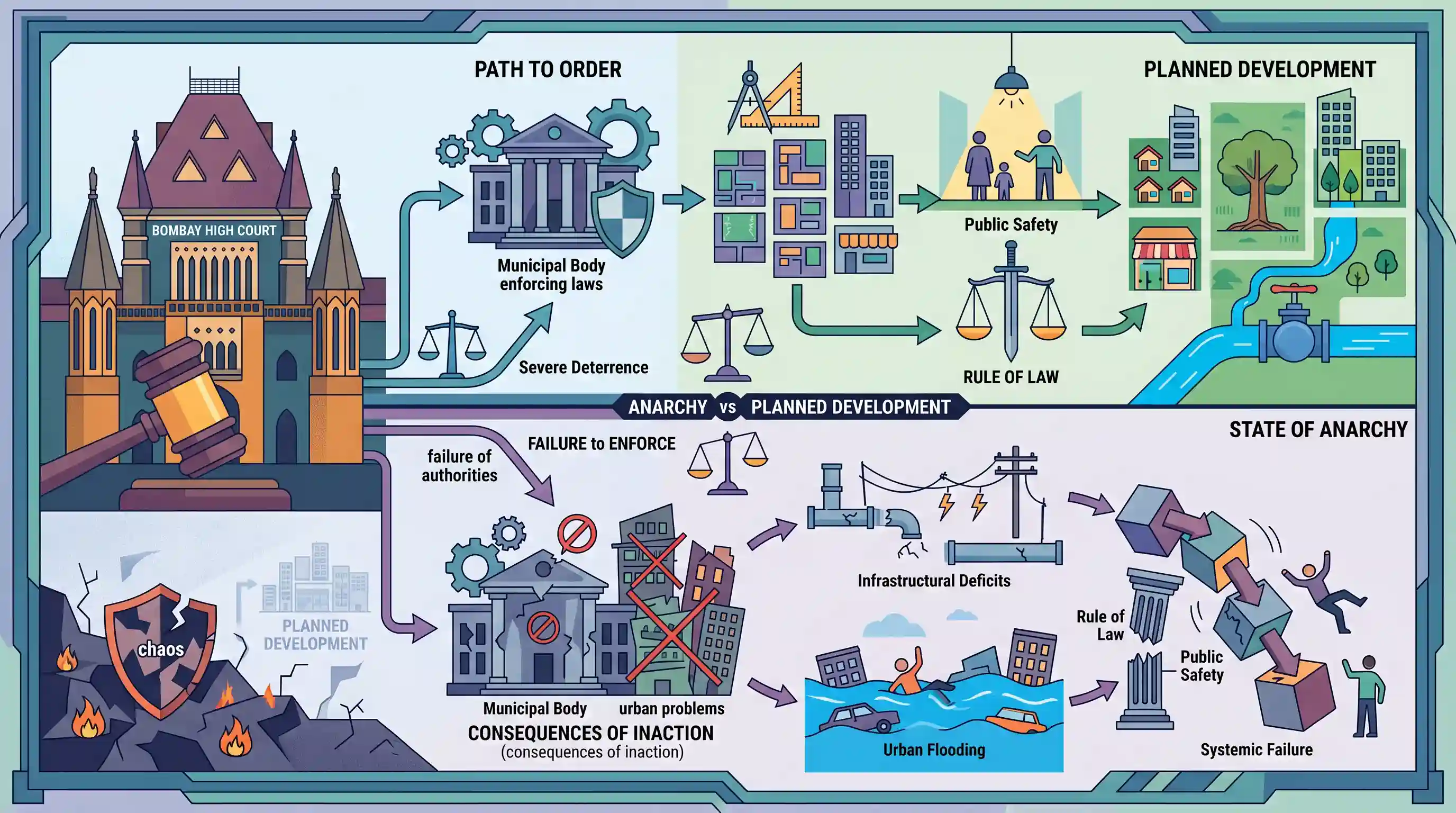
The Bombay High Court has strongly criticized the failure of authorities to curb illegal constructions, warning that the lack of severe deterrence will lead to a "state of anarchy" in urban areas. The Court emphasized that unchecked unauthorized building activities render the goal of "planned development" a distant dream. These observations underscore systemic governance failures by municipal bodies in enforcing civic laws, which not only compromise public safety and the rule of law but also exacerbate urban challenges such as infrastructural deficits and urban flooding.
Key Points
- The Bombay High Court warned that the absence of severe deterrence against illegal constructions will lead to a "state of anarchy".
- Unchecked proliferation of unauthorized structures renders "planned development" a "distant dream", undermining urban planning efforts.
- The observations highlight systemic negligence and failure of civic and executive authorities to enforce municipal laws and building regulations.
- Such illegal constructions exacerbate infrastructural strain, compromise public safety, and contribute to urban disasters like flooding.
Important Terms
Rule of Law

A fundamental principle where all individuals, institutions, and the state are accountable to supreme, fairly applied laws. In India, it is anchored in Article 14 of the Constitution.
UPSC context
GS Paper II: Indian Constitution and Polity. Tested on its role in preventing arbitrary governance and ensuring equality before law.
Urban Governance
The systems, institutions, and processes used by local governments and stakeholders to manage urban areas, services, and infrastructure, largely governed by the 74th Constitutional Amendment Act.
UPSC context
GS Paper II: Governance. Tests the effectiveness of Urban Local Bodies (ULBs) and administrative decentralization in India.
Municipal Corporations
The highest tier of urban local self-government in India, established under the 74th Amendment (Part IX-A) for cities with populations typically exceeding one million.
UPSC context
GS Paper II: Polity/Local Government. Important for understanding the functional and financial challenges of urban grassroots democracy.
Planned Development
An integrated approach to designing land use, built environments, and infrastructure (water, transport, etc.) to promote social, economic, and environmental sustainability in urban centers.
UPSC context
GS Paper III: Infrastructure/Urban Planning. Relevant to discussions on 'Smart Cities' and mitigating urban sprawl.
Urban Flooding
A 'man-made disaster' in built environments where rainfall exceeds the capacity of drainage systems, often exacerbated by unplanned construction, encroachment on wetlands, and concretization.
UPSC context
GS Paper III: Disaster Management. Frequently tested as a consequence of rapid, unplanned urbanization and climate change.
Urbanization
The process of population shift from rural to urban areas, leading to the physical expansion of cities and towns, creating both economic opportunities and systemic civic challenges.
UPSC context
GS Paper I: Social Issues/Geography. Focuses on the socio-economic impacts and environmental pressures of rapid city growth.
Prelims Trap
The 74th Amendment Act makes it mandatory for State governments to devolve urban planning and land-use regulation to Municipalities.
Article 243W enables, but does not mandate, states to devolve 12th Schedule matters. Parastatal bodies often retain urban planning control, undermining ULB authority.
Static Concepts Connected
Which urban planning functions fall under the 12th Schedule?
- Urban planning: Encompasses town planning, regulation of land use, and the construction of buildings.
- Discretionary devolution: Article 243W leaves the actual devolution of these 18 functional items to the discretion of state legislatures, rather than making it automatic.
What is the judicial stance on unauthorized construction regularisation?
- Article 14 violation: The Supreme Court holds that blanket post-facto regularisation of deliberate illegal structures violates the right to equality and encourages impunity.
- Due process requirement: While illegal structures must be removed, punitive demolitions ("bulldozer justice") executed without statutory municipal notices violate constitutional due process.
Cross-Topic Patterns
Blue infrastructure and urban flooding
Illegal constructions on natural drainage networks and wetlands act as primary anthropogenic drivers of urban flooding, linking GS2 governance failures directly to GS3 disaster management.
Parastatal bodies vs. elected ULBs
Overlapping jurisdictions between State-appointed development authorities (like MMRDA) and elected municipal corporations dilute accountability, making enforcement of building codes incredibly weak.

Expect a multi-statement Prelims question on the 12th Schedule's discretionary devolution vs. mandatory provisions under the 74th CAA.
Linked PYQs · 4
Linked PYQs · 4
- 2013MainsGS1
Discuss the various social problems which originated out of the speedy process of urbanization in India.
- 2020MainsGS2
Judicial Legislation is antithetical to the doctrine of separation of powers as envisaged in the Indian Constitution. In this context justify the filing of large number of public interest petitions praying for issuing guidelines to executive authorities.
- 2024MainsGS3
Flooding in urban areas is an emerging climate-induced disaster. Discuss the causes of this disaster. Mention the features of two such major floods in the last two decades in India. Describe the policies and frameworks in India that aim at tackling such floods.
- 2025MainsGS1
How does smart city in India, address the issues of urban poverty and distributive justice?
