UAPA Detention Parity and Judicial Bail Rulings
Source:The Hindu ↗
Why It Matters
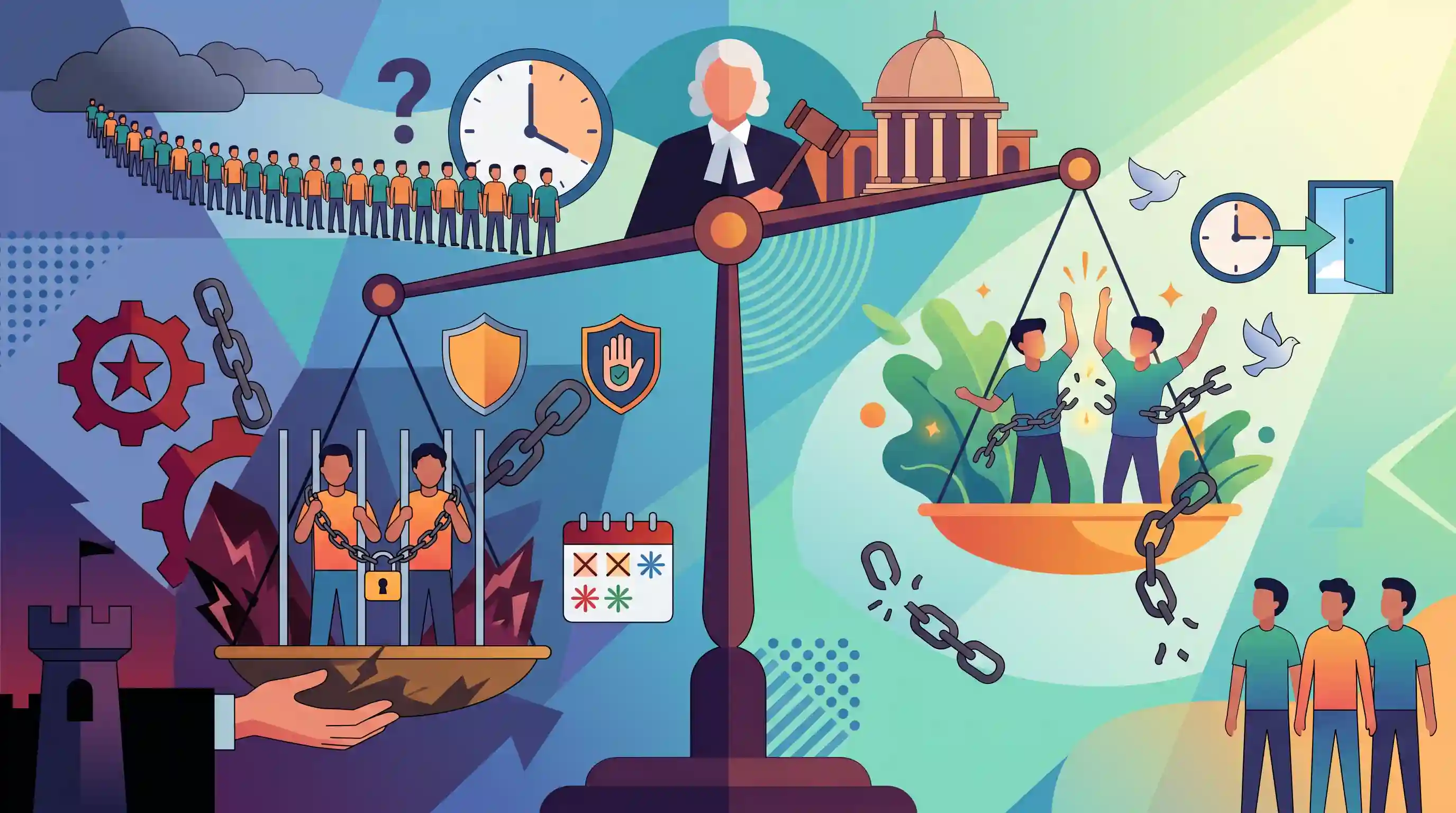
Highlights the tension between stringent internal security and anti-terror laws (like UAPA) and constitutional fundamental rights (like the right to a speedy trial and personal liberty). It illustrates the judicial application of 'parity' and the challenge of prolonged pre-trial detention in complex terrorism cases.
Summary
The Bombay High Court has granted bail to two activists, Sagar Gorkhe and Ramesh Gaichor, who were arrested in 2020 by the National Investigation Agency (NIA) under the Unlawful Activities (Prevention) Act (UAPA) in connection with the Elgar Parishad-Maoist links case. The activists were accused of promoting the banned CPI (Maoist) agenda through their cultural group, Kabir Kala Manch, and allegedly inciting the Koregaon-Bhima violence. The court justified the bail based on parity with co-accused, their prolonged four-year pre-trial incarceration, and the unlikely prospect of a speedy trial given the extensive witness list. This highlights judicial reasoning balancing stringent internal security laws with fundamental rights to personal liberty and a timely trial.
Key Points
- The Bombay High Court granted bail to activists Sagar Gorkhe and Ramesh Gaichor in the Elgar Parishad-Maoist links case.
- Bail was granted on the principles of parity with co-accused, prolonged pre-trial incarceration of over four years, and the unlikelihood of a speedy trial.
- The NIA had charged the accused under the UAPA, alleging they were members of the banned CPI (Maoist) and used their cultural group to spread Maoist ideology.
- The case stems from allegations that provocative speeches at the Elgar Parishad conclave in Pune incited the Koregaon-Bhima violence in 2018.
- The court emphasized the balance between the stringency of anti-terror laws and the fundamental right to liberty and a speedy trial.
Important Terms
Unlawful Activities (Prevention) Act (UAPA)

India's primary anti-terror law enacted in 1967. It empowers the government to designate individuals and organizations as terrorists and provides for stringent bail conditions and extended pre-trial detention.
UPSC context
GS Paper 3: Internal Security. Tests knowledge of legal frameworks for counter-terrorism and their impact on fundamental rights.
National Investigation Agency (NIA)
India's federal counter-terrorism agency established under the NIA Act 2008 following the 26/11 attacks. It investigates scheduled offenses like terrorism and insurgency without requiring state government consent.
UPSC context
GS Paper 3: Internal Security. Tests understanding of specialized central agencies and federalism in law enforcement.
CPI (Maoist)
A banned far-left militant organization formed in 2004. It aims to overthrow the Indian state through armed struggle (Protracted People's War) and is designated a terrorist organization under UAPA.
UPSC context
GS Paper 3: Internal Security (Left Wing Extremism). Key for understanding the biggest internal security challenge in India.
Kabir Kala Manch (KKM)
A Pune-based cultural troupe accused by agencies of being a 'frontal organization' for Maoists. It uses street plays and poetry to highlight Dalit and marginalized issues.
UPSC context
GS Paper 3: Internal Security. Relevant for discussing the role of front organizations in extremist movements.
Right to Speedy Trial
A fundamental right interpreted by the Supreme Court under Article 21. It ensures the legal process is fair and reasonable, preventing indefinite detention of undertrials.
UPSC context
GS Paper 2: Judiciary/Fundamental Rights. Vital for debates on judicial delays and criminal justice reform.
Left Wing Extremism (LWE)
An umbrella term for militant movements inspired by Maoist ideology that seek to overthrow the government. It is primarily concentrated in the 'Red Corridor' of central India.
UPSC context
GS Paper 3: Internal Security. A core syllabus topic regarding development vs. security challenges.
Prelims Trap
Bail is strictly prohibited under UAPA if the chargesheet establishes a prima facie case.
The SC ruled (K.A. Najeeb) that Constitutional Courts can grant bail, despite the statutory bar in Section 43D(5), if a trial is unreasonably delayed, upholding Article 21.
Static Concepts Connected
How does the UAPA restrict bail and what is the judicial exception?
- Section 43D(5): Imposes a strict statutory bar on bail if the accusations are deemed "prima facie true" based on the police chargesheet.
- K.A. Najeeb Exception: The Supreme Court ruled that statutory restrictions cannot override the fundamental right to a speedy trial (Article 21) in cases of prolonged incarceration.
What is the historical context of the Battle of Bhima Koregaon?
- Anglo-Maratha War: Fought in 1818 during the Third Anglo-Maratha War, resulting in the British East India Company defeating Peshwa Baji Rao II.
- Dalit Assertion: The British forces heavily featured Mahar soldiers. Today, the victory pillar (Jay Stambh) is a modern symbol of Dalit resistance against the Peshwa caste hierarchy.
Cross-Topic Patterns
UAPA + Article 21 jurisprudence
The tension between stringent anti-terror laws and fundamental rights frequently repeats in UPSC Mains GS2 (Constitutional mechanisms) and GS3 (Internal Security).
LWE + Front Organizations
Cultural and intellectual groups operating in urban centers are increasingly scrutinized as 'overground workers' providing logistics, legal aid, and recruitment for banned Maoist factions.

Expect a multi-statement Prelims question testing the interplay of UAPA Section 43D(5), Article 21 (speedy trial), and NIA jurisdiction.
Linked PYQs · 3
Linked PYQs · 3
- 2022MainsGS3
Naxalism is a social, economic and developmental issue manifesting as a violent internal security threat. In this context, discuss the emerging issues and suggest a multilayered strategy to tackle the menace of Naxalism.
- 2018MainsGS3
Left Wing Extremism (LWE) is showing a downward trend, but still affects many parts of the country. Briefly explain the Government of India's approach to counter the challenges posed by LWE.
- 2019MainsGS3
Indian Government has recently strengthened the anti-terrorism laws by amending the Unlawful Activities (Prevention) Act (UAPA), 1967 and the NIA Act. Analyze the changes in the context of prevailing security environment while discussing the scope and reasons for opposing the UAPA by human rights organizations.
