Bombay High Court Ruling on Dharavi Redevelopment
Source:Indian Express ↗
Why It Matters
Dharavi is Asia's largest slum, and its redevelopment is a crucial case study for urban planning, slum rehabilitation, and balancing state-led modernization with the livelihood concerns of traditional inhabitants. The ruling demonstrates the judiciary's approach to preventing delays in essential infrastructure projects.
Summary
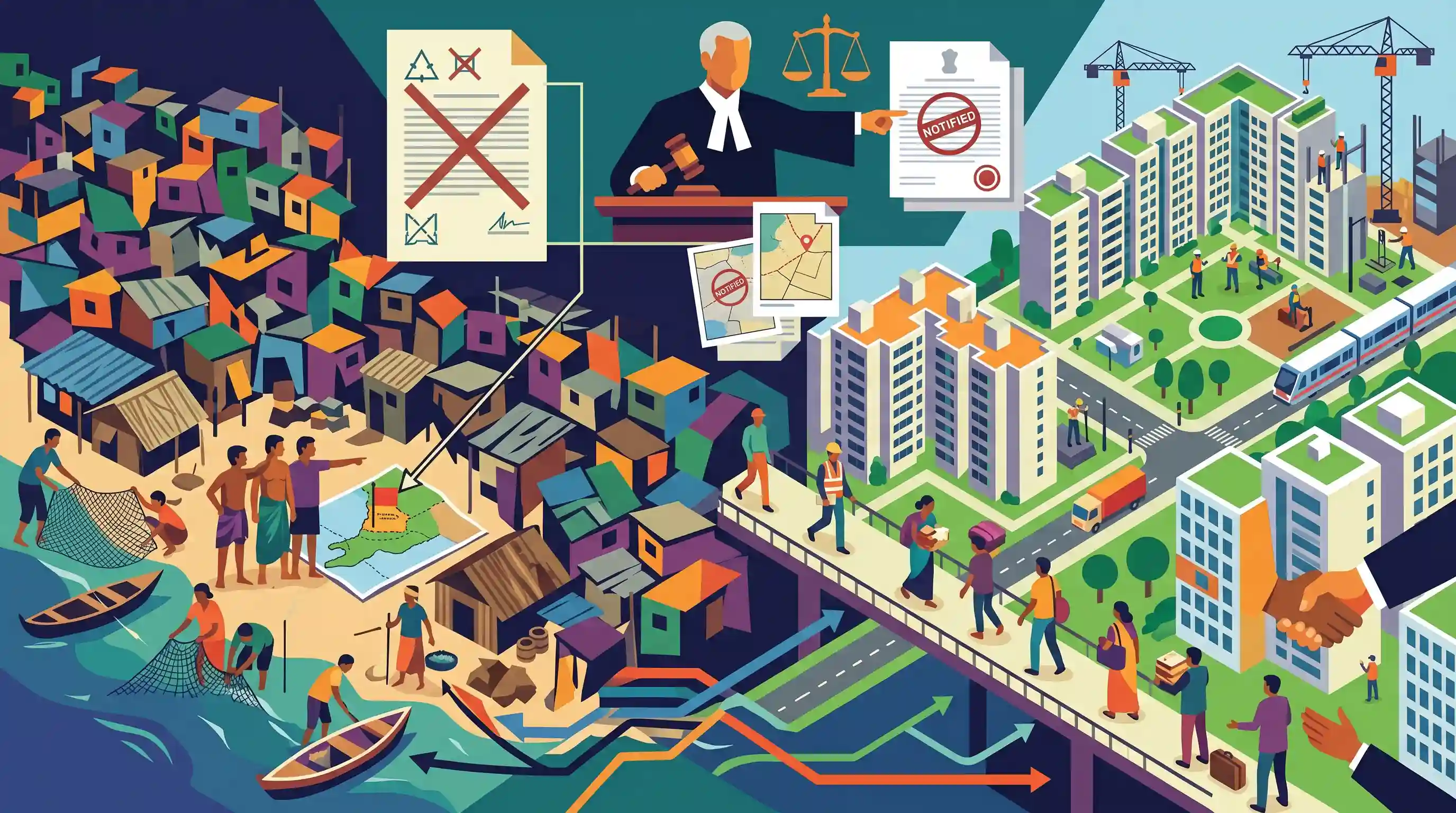
The Bombay High Court has rejected a petition by the Dharavi Koli Jamat Trust that sought to halt the Dharavi Redevelopment Project (DRP) pending boundary demarcation of traditional fishing areas (Koliwadas). The court stated that the plea was 'misconceived' and 'belated,' noting that the region had already been surveyed and notified under the Maharashtra Slum Areas Act. The bench observed that the area had lost its traditional fishing characteristics to encroachments and slums, rendering the demand for demarcation under the Maharashtra Land Revenue Code invalid at this stage. The State Government assured that Koliwada residents would not be evicted but accommodated in the redevelopment, highlighting the ongoing tension between large-scale urban infrastructure projects and traditional community rights.
Key Points
- The Bombay High Court dismissed a plea by the Dharavi Koli Jamat Trust seeking to stall the Dharavi Redevelopment Project (DRP) until the boundaries of Dharavi Koliwada were demarcated.
- The court ruled that applying the Maharashtra Land Revenue Code (MLRC) for demarcation was 'misconceived' since the area had already been legally notified under the Maharashtra Slum Areas Act.
- The bench observed that the land had largely lost its traditional fishing character due to extensive encroachments and the proliferation of slums.
- The Maharashtra government assured the court that legitimate Koliwada areas and their residents would not be evicted but would be integrated into the redevelopment plan.
- The judgment underscores the judiciary's stance against delaying critical urban redevelopment projects through belated litigation when statutory procedures have already been followed.
Important Terms
Dharavi Redevelopment Project (DRP)

A mega urban renewal project aiming to transform Dharavi, one of Asia's largest slums, into a planned township with modern housing, infrastructure, and commercial hubs.
UPSC context
GS-1 (Urbanization issues) and GS-3 (Infrastructure). Essential for questions on large-scale urban rehabilitation and rehabilitation policy.
Maharashtra Slum Areas (Improvement, Clearance and Redevelopment) Act, 1971
A state law governing the identification, declaration, and redevelopment of slum areas in Maharashtra, providing the legal basis for rehabilitating dwellers and clearing unsafe structures.
UPSC context
GS-2 (Government policies) and GS-3 (Land laws). Tests understanding of legislative frameworks for urban slum management.
Slum Rehabilitation Authority (SRA)
A statutory body established by the Maharashtra government to oversee slum redevelopment schemes, survey slums, and provide single-window clearances for housing rehabilitation projects.
UPSC context
GS-2 (Statutory bodies). Crucial for understanding the institutional mechanisms behind urban development and social welfare projects.
Maharashtra Land Revenue Code (MLRC), 1966
The primary legal framework for land ownership, classification, and boundary demarcation in Maharashtra, consolidating laws related to land records and revenue administration.
UPSC context
GS-3 (Land reforms/laws). Relevant for cases involving land rights disputes between traditional communities and the state.
Koliwada
Traditional coastal villages in Mumbai inhabited by the Koli (fisherfolk) community, which maintain distinct cultural identities and specific land rights often disputed during urbanization.
UPSC context
GS-1 (Indian society and traditional communities). Highlights the impact of modern development on indigenous community settlements.
Special Purpose Vehicle (SPV)
A legal entity created to fulfill narrow, specific, or temporary objectives; for Dharavi, it is a partnership between the state and private developers (Adani Group).
UPSC context
GS-3 (Economics/Infrastructure). Important for understanding the financial and legal structures of Public-Private Partnerships (PPP).
Prelims Trap
Traditional urban settlements like Koliwadas are protected from slum redevelopment under central indigenous rights laws.
Protections like PESA or FRA apply strictly to scheduled or forest areas. Urban traditional settlements fall under state slum and town planning legislative frameworks.
Static Concepts Connected
How does the Census of India classify urban slums?
- Notified Slums: Areas formally notified as slums by state governments, municipalities, or local bodies under any relevant Slum Act.
- Recognized Slums: Areas that are recognized as slums by state or local authorities, but have not been formally notified under a Slum Act.
- Identified Slums: A compact area of at least 300 population (approx. 60-70 households) with poorly built congested tenements, inadequate infrastructure, and unhygienic conditions.
What is the constitutional and judicial stance on the eviction of slum dwellers?
- Article 21 Protection: In the landmark Olga Tellis vs. Bombay Municipal Corporation (1985) case, the Supreme Court ruled that the Right to Livelihood and Shelter falls under Article 21.
- No Absolute Veto: While slum dwellers have a right to rehabilitation and due process before eviction, they cannot permanently stall lawful public infrastructure projects once statutory redevelopment procedures are followed.
Cross-Topic Patterns
CRZ norms vs Urban Renewal
Slum redevelopment in coastal cities frequently intersects with Coastal Regulation Zone (CRZ) clearances, creating regulatory bottlenecks and livelihood conflicts for traditional fishing communities.
Judicial restraint in mega-projects
Courts increasingly reject belated PILs targeting large infrastructure (e.g., Central Vista, Dharavi) to prevent economic bottlenecks and cost overruns once statutory processes are complete.

Expect a GS1 Mains question assessing how rapid urbanization and mega-infrastructure projects extinguish traditional urban livelihoods.
Linked PYQs · 3
Linked PYQs · 3
- 2023MainsGS1
Does urbanization lead to more segregation and/or marginalization of the poor in Indian metropolises?
- 2013MainsGS1
Discuss the various social problems which originated out of the speedy process of urbanization in India.
- 2024MainsGS2
Explain the reasons for the growth of public interest litigation in India. As a result of it, has the Indian Supreme Court emerged as the world's most powerful judiciary ?
