Gadchiroli Mining Project Referred to Tiger Conservation Body
Source:The Hindu ↗
Why It Matters
It highlights the ongoing conflict between economic development (mining) and wildlife conservation in Maharashtra, specifically focusing on the statutory role of the NTCA and the protection of crucial tiger corridors under the Wildlife (Protection) Act.
Summary
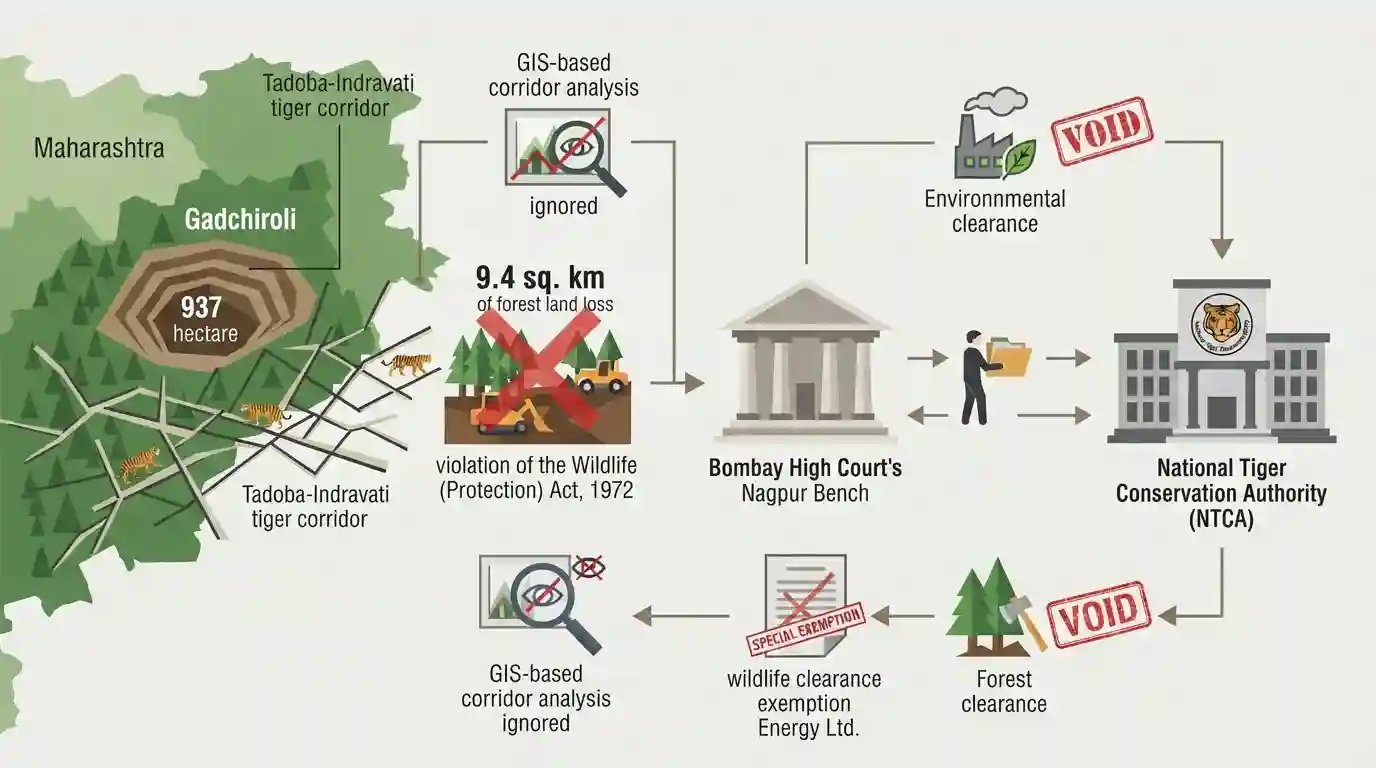
The Bombay High Court's Nagpur Bench has instructed a petitioner to approach the National Tiger Conservation Authority (NTCA) concerning a 937-hectare iron ore mining project in Gadchiroli, Maharashtra. The petition challenges the environmental and forest clearances, and specifically the wildlife clearance exemption granted to Lloyds Metals and Energy Ltd., arguing the project threatens the Tadoba-Indravati tiger corridor. The petitioner contends that the diversion of 9.4 sq. km of forest land violates the Wildlife (Protection) Act, 1972, and ignores essential GIS-based corridor analysis.
Key Points
- The Bombay High Court directed a petitioner challenging a 937-hectare iron ore mining project in Gadchiroli to approach the National Tiger Conservation Authority (NTCA).
- The project by Lloyds Metals and Energy Ltd. received environmental clearance, Stage-II forest clearance, and a controversial wildlife clearance exemption.
- Petitioners argue the area falls in the Tadoba-Indravati tiger corridor and the exemption violates Sections 38-O and 38-V of the Wildlife (Protection) Act, 1972.
- Environmentalists are questioning the State government's diversion of 9.4 sq. km of forest land and the Least Cost Path (LCP) model used to map the wildlife corridors.
Important Terms
National Tiger Conservation Authority (NTCA)

A statutory body under the MoEFCC established in 2005. It oversees Project Tiger, regulates tiger reserves, approves state-drafted Tiger Conservation Plans, and ensures environmentally destructive projects avoid critical wildlife corridors.
UPSC context
MPSC GS-1 & GS-4 (Environment). Crucial for questions on statutory biodiversity bodies, wildlife corridor protection, and Project Tiger governance.
Wildlife (Protection) Act, 1972
India's primary legislation safeguarding plant and animal species. Amended in 2006 to constitute the NTCA, it provides the statutory framework for declaring protected areas, managing tiger reserves, and regulating wildlife clearances.
UPSC context
MPSC GS-2 (Polity) & GS-4 (Environment). Essential for environmental governance, legal protection of flora/fauna, and institutional frameworks.
Tiger Conservation Plan
A statutory management plan prepared by state governments for tiger reserves and connecting corridors under the Wildlife (Protection) Act. It requires NTCA approval to regulate land use and prevent ecologically unsustainable activities.
UPSC context
MPSC GS-4 (Environment). Important for questions on regional ecological planning, habitat management, and centre-state coordination in wildlife conservation.
Ministry of Environment, Forest and Climate Change
The central government's nodal agency overseeing environmental policy. It administers the Wildlife (Protection) Act, manages statutory bodies like the NTCA, and handles environmental and forest clearance processes for industrial projects.
UPSC context
MPSC GS-2 (Governance) & GS-4 (Environment). Tests knowledge of central regulatory frameworks, environmental impact assessments, and clearance protocols.
Wildlife Institute of India
An autonomous research institution under the MoEFCC. It conducts scientific studies, biodiversity surveys, and GIS-based wildlife corridor analyses that guide statutory bodies during environmental and forest clearance appraisals.
UPSC context
MPSC GS-4 (Science/Environment). Relevant to questions on scientific institutions, biodiversity mapping tools, and evidence-based environmental policy.
Prelims Trap
NTCA was originally established under the Wildlife (Protection) Act in 1972.
NTCA was not part of the original 1972 legislation. It was established later in 2005 through a major amendment to the WPA.
Static Concepts Connected
What is the geographic distribution of iron ore in Maharashtra?
- Gadchiroli District: Major deposits are found in Surjagarh, Damkodwadi, and Bhamragad areas, forming the state's largest iron ore reserves.
- Sindhudurg District: Significant lateritic and haematite deposits are mined near Redi port for export.
- Other regions: Minor deposits are distributed across Gondia and Chandrapur districts in the eastern Vidarbha region.
What is the statutory framework of the National Tiger Conservation Authority (NTCA)?
- Statutory Origin: Established in December 2005 following the Tiger Task Force recommendations via an amendment to the WPA 1972.
- Leadership: Chaired by the Union Minister for Environment, Forest and Climate Change.
- Key Mandate: Approves Tiger Conservation Plans prepared by state governments and ensures standards for tiger reserves are met.
Cross-Topic Patterns
LWE, Mining, and Conservation overlap
Gadchiroli's Surjagarh iron ore mining is a recurring flashpoint linking Left Wing Extremism (LWE) mitigation, tribal rights under PESA, and friction over environmental clearances.
Interstate contiguous tiger corridors
Tadoba (Maharashtra) to Indravati (Chhattisgarh) highlights trans-boundary wildlife corridors. MPSC frequently tests contiguous interstate protected areas, similar to the Pench (MH/MP) landscape.

Expect a multi-statement question on Gadchiroli's Surjagarh iron ore deposits paired with the statutory powers of NTCA under WPA 1972.
Linked PYQs · 3
Linked PYQs · 3
- 2026MPSC_PRELIMSGS1
Match the following forest circles with their share in percentage to total forest area of Maharashtra. | (Forest circles of Maharashtra) | (Percentage to total forest area Economic survey of Maharashtra (2024)) | |---|---| | (a) Gadchiroli | (1) 12.5 | | (b) Nagpur | (2) 20.8 | | (c) Dhule | (3) 9.5 | | (d) Thane | (4) 10.4 | Code: (a) (b) (c) (d)
- 2026MPSC_PRELIMSGS1
Observe the following statements. (a) As per the State Mineral Policy 1999, iron, sulphur, gold, copper and lead mineral production was opened to the private sector. (b) Konkan region has the highest mineral availability after Nagpur region. (c) Maharashtra State Mining Corporation was established in 1973.
- 2016MPSC_PRELIMSGS1
Arrange the following projects in the order in which they were launched : a. Lion Project b. Tiger Project c. Crocodile Breeding Project d. Rhino Conservation Project
