Nagpur Police Arresting Suspect Behind Minister Residence Hoax Call
Source:Indian Express ↗
Why It Matters
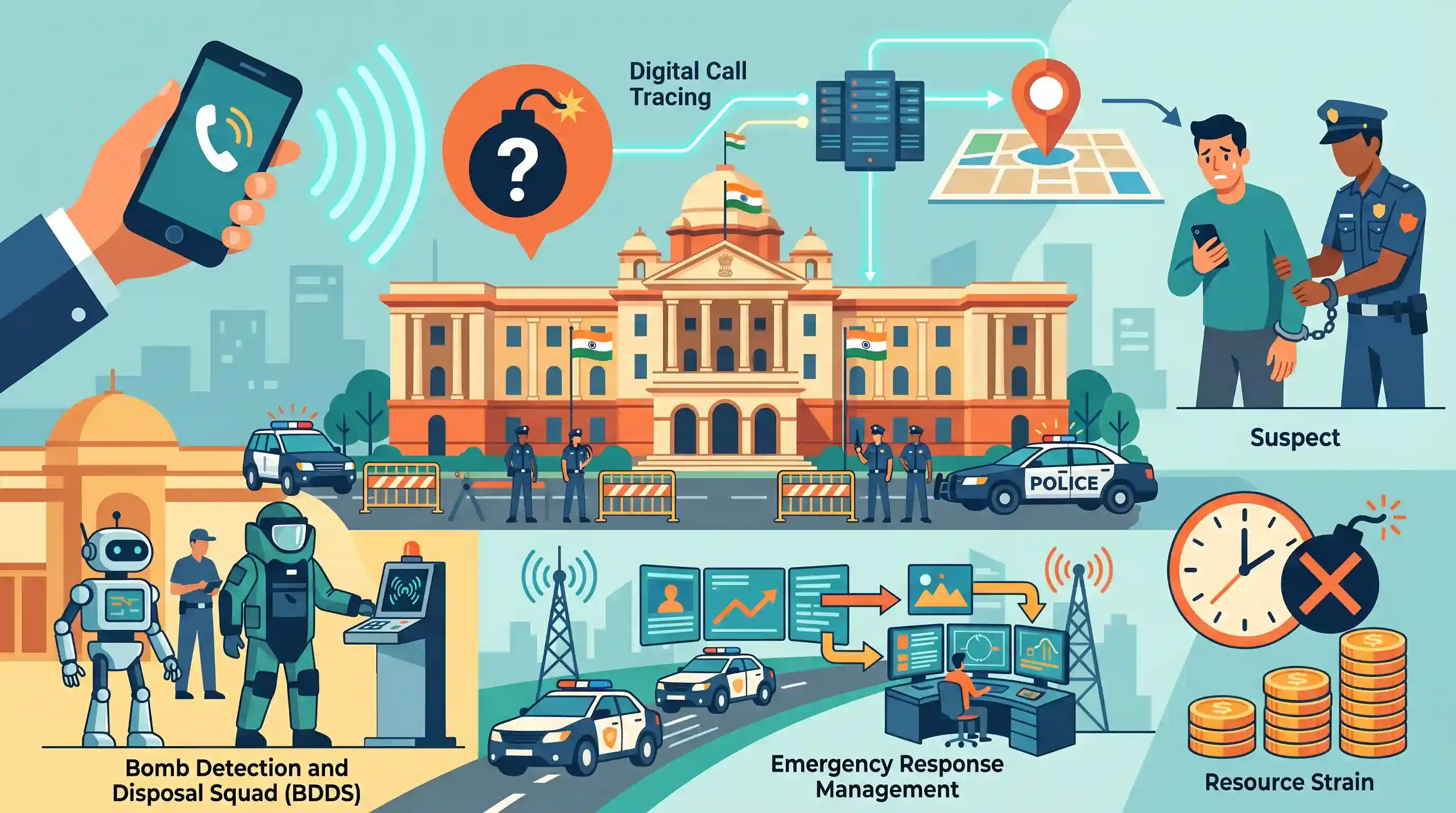
The incident underscores the challenges posed by hoax threats to law enforcement, which can drain critical resources and cause public panic. It highlights the importance of swift emergency response systems, cyber-tracing capabilities, and robust security protocols for public figures in the broader context of internal security management.
Summary
A hoax bomb threat was made against Union Minister Nitin Gadkari's residence in Nagpur, prompting an immediate security response. The Nagpur Police deployed a Bomb Detection and Disposal Squad (BDDS) and tightened security around the premises. Utilizing call tracing, authorities quickly apprehended the suspect, who had no known criminal background. The incident highlights the operational readiness of local law enforcement in addressing sudden security threats and the resource strain caused by hoax calls.
Key Points
- A hoax bomb threat was reported at Union Minister Nitin Gadkari's residence in Nagpur.
- Local police immediately deployed a Bomb Detection and Disposal Squad (BDDS) and intensified security around the premises.
- The suspect was swiftly traced and arrested using telecom tracking tools.
- Preliminary investigations revealed the caller had no prior criminal history, classifying the incident as a hoax.
Important Terms
Bomb Detection and Disposal Squad (BDDS)

Specialized units within state police forces trained to detect, identify, and neutralize explosive devices like IEDs and conduct anti-sabotage checks for high-profile locations.
UPSC context
GS Paper III (Internal Security); tests knowledge of specialized agencies tasked with countering domestic security threats and disaster response.
VIP Security Categories
A hierarchical protection system (X, Y, Y+, Z, Z+) assigned to high-risk individuals based on threat perception reports from intelligence agencies and the Ministry of Home Affairs.
UPSC context
GS Paper III (Internal Security); relevant for topics on institutional frameworks for security and the management of protective resources.
Bharatiya Nyaya Sanhita (BNS)
The criminal code replacing the Indian Penal Code (IPC) in 2024; contains updated provisions for penalizing hoax threats, criminal intimidation, and acts disrupting public order.
UPSC context
GS Paper II (Governance & Polity); critical for understanding legislative reforms and the legal tools available for internal security management.
Police Modernization
A central scheme to upgrade police infrastructure, equipment (like bomb disposal kits), and technology to better address modern security challenges, including terrorism and cyber-forensics.
UPSC context
GS Paper III (Internal Security); essential for analyzing police reforms and the capacity-building of law enforcement agencies.
Public Mischief
A legal offense involving the spread of false alarms or reports intended to cause panic, fear, or public disorder, now prosecuted under specific sections of the BNS.
UPSC context
GS Paper III (Internal Security); focuses on the legal challenges posed by hoax threats and their impact on emergency response resources.
Prelims Trap
"The Special Protection Group (SPG) provides Z+ security to all Union Cabinet Ministers based on MHA assessments."
The SPG's mandate is restricted exclusively to the Prime Minister. Security for other Union Ministers (even Z+) is provided by CAPFs like the CRPF or CISF.
Static Concepts Connected
How is VIP security categorized and governed in India?
- Threat Assessment: The Ministry of Home Affairs (MHA) decides security levels (X, Y, Y+, Z, Z+) based on intelligence inputs and threat perception reports from the Intelligence Bureau (IB).
- Implementing Agencies: Physical protection is primarily executed by Central Armed Police Forces (CAPFs) such as the CRPF, CISF, and NSG, alongside state police forces.
- SPG Mandate: The SPG is governed by the SPG Act (amended in 2019) and now exclusively provides armed security to the serving Prime Minister.
What is the Modernisation of Police Forces (MPF) scheme?
- Scheme Type: It is an umbrella Centrally Sponsored Scheme aimed at assisting state governments in upgrading their police infrastructure, acknowledging that 'Police' is a State subject.
- Key Upgrades: Funds are deployed for procuring modern weapons, upgrading Bomb Detection and Disposal Squads (BDDS), enhancing forensic science laboratories, and implementing the CCTNS network.
Cross-Topic Patterns
Aviation Hoaxes & Security Rules
Rising hoax threats recently prompted amendments to the Aircraft (Security) Rules, making fake threats a Level 6 offense with no-fly list consequences, linking digital mischief to severe economic disruption.
BNS and Digital Mischief
Without a standalone anti-hoax law for general public spaces, enforcement relies on the Bharatiya Nyaya Sanhita (BNS) for public mischief alongside IT Act provisions to prosecute digital threat actors.

Expect a Prelims question contrasting the SPG's statutory mandate with CAPF duties for standard VIP security tiers (Z+, Z, Y, X).
Linked PYQs · 2
Linked PYQs · 2
- 2023MainsGS3
What are the internal security challenges being faced by India? Give out the role of Central Intelligence and Investigative Agencies tasked to counter such threats.
- 2020MainsGS3
Discuss different types of cyber crimes and measures required to be taken to fight the menace.
