India Free Trade Agreements and Strategic Energy Balancing
Source:Indian Express ↗
Why It Matters
Highlights India's pivotal transition from a protectionist trade stance to an open economy, integrating RCEP/FTA dynamics, manufacturing exports, and the geopolitical maneuvering required to ensure energy security amidst great power rivalries.
Summary
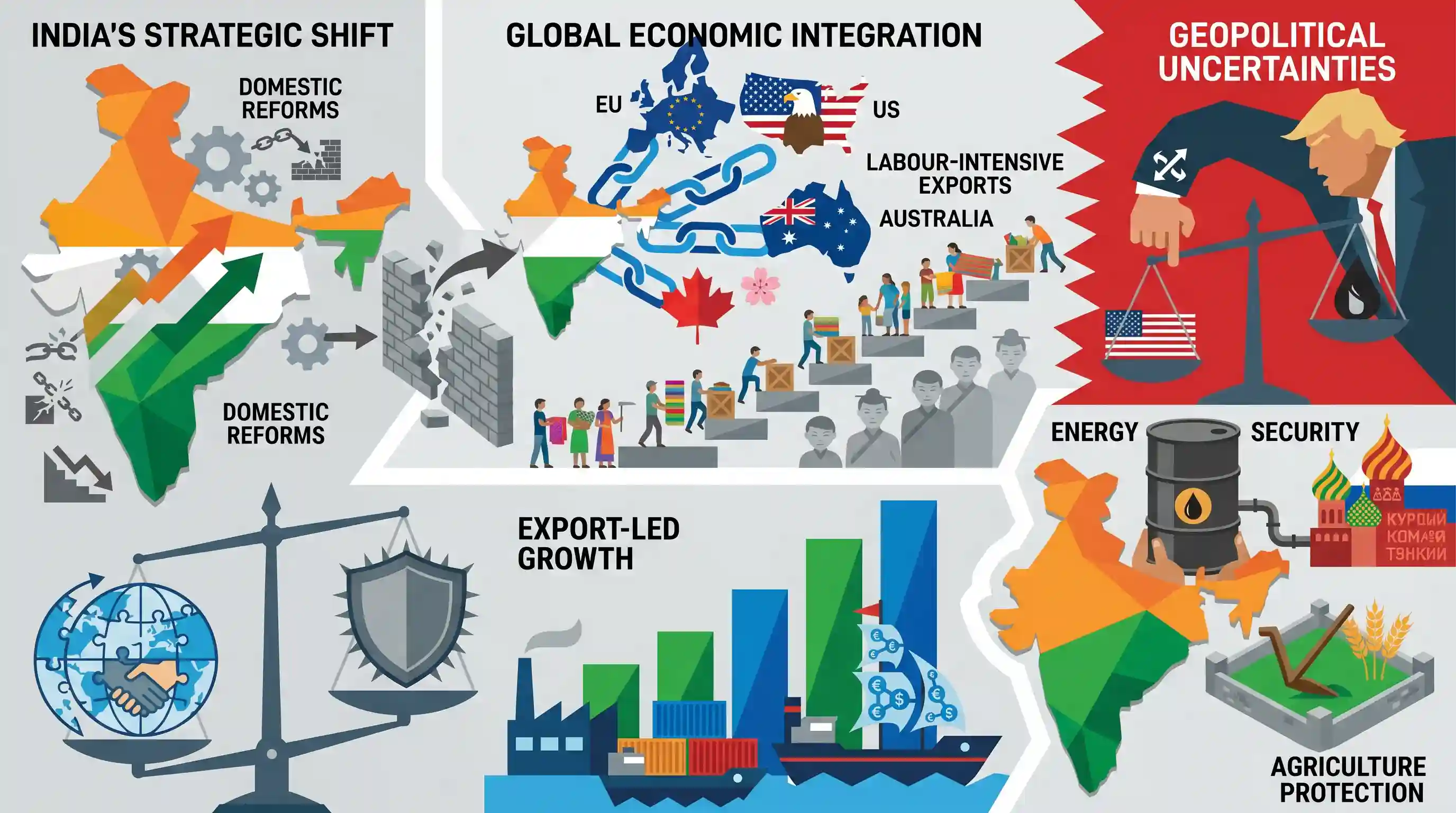
The editorial highlights India's strategic shift towards global economic integration through a series of recent free trade agreements and trade frameworks with the EU, US, Australia, and others. By dismantling trade barriers and tariffs, India is positioning itself to boost its labour-intensive exports, aiming to outperform East Asian competitors. While this requires a strong focus on domestic reforms and export-led growth, the government remains cautious about protecting sensitive sectors like agriculture. Concurrently, India must navigate geopolitical uncertainties, particularly managing US pressure under Donald Trump regarding its ongoing purchases of Russian oil.
Key Points
- India is pivoting from protectionism to a more open economy by concluding trade deals and dismantling non-tariff barriers.
- The removal of tariff walls is expected to boost India's labour-intensive export segments, giving it a competitive edge over rivals like Vietnam and Indonesia.
- Delhi must focus on domestic reforms to pursue an export-led growth model while protecting sensitive sectors like agriculture.
- Geopolitically, India faces the challenge of navigating US pressure under Donald Trump regarding its purchase of Russian oil, requiring a careful balance of diplomacy and strategic autonomy.
Important Terms
Free Trade Agreements (FTAs)

Formal treaties between two or more countries to reduce or eliminate trade barriers like tariffs and quotas on goods and services.
UPSC context
GS Paper 2 (International Relations) and GS Paper 3 (Economy); tests India’s global trade strategy and economic integration.
India–US Interim Trade Framework
A specific 2026 trade arrangement where the US lowered tariffs on Indian exports in exchange for India increasing purchases of US energy and technology.
UPSC context
GS Paper 2 (Bilateral Relations); specifically addresses the "tightrope walk" between US trade demands and Russian energy ties.
Export-Led Growth
An economic strategy that seeks to speed up industrialization by exporting goods for which a nation has a comparative advantage.
UPSC context
GS Paper 3 (Indian Economy); tests understanding of growth models, manufacturing competitiveness, and the "Make in India" initiative.
Sensitive List (Negative List)
A list of specific products (like dairy or wheat) excluded from tariff cuts in a trade deal to protect domestic producers.
UPSC context
GS Paper 3 (Agriculture/Economy); crucial for discussing how India balances global trade with protecting small-scale farmers and MSMEs.
Strategic Autonomy
A nation's ability to pursue its own national interests and foreign policy without being constrained by the influence of other global powers.
UPSC context
GS Paper 2 (International Relations); relevant to India's balancing act between the US and Russia regarding energy security.
Rules of Origin (RoO)
Technical criteria used to determine the national source of a product to ensure only signatory countries benefit from FTA tariff cuts.
UPSC context
GS Paper 3 (Economy); tests knowledge of non-tariff measures used to prevent the transshipment of goods from third parties like China.
Prelims Trap
"Tariff-Rate Quotas (TRQs) place an absolute quantitative limit on imports, beyond which no goods can enter."
TRQs do not ban imports beyond the quota. They create a two-tiered system: imports within the quota get a low/zero tariff, while anything above it faces a steeply higher tariff.
Static Concepts Connected
What is a Tariff-Rate Quota (TRQ) mechanism in international trade?
- Two-tier system: It combines a quota and a tariff, applying a lower tariff rate to a specified quantity of imports and a higher rate for quantities exceeding that limit.
- Domestic protection: Used heavily in FTAs to grant limited market access to partner countries while shielding domestic farmers and sensitive sectors from sudden import surges.
How do Non-Tariff Barriers (NTBs) restrict global trade?
- Sanitary measures (SPS): Regulations focusing on food safety, animal, and plant health, which are often used by developed nations to block agricultural imports.
- Technical barriers (TBT): Mandatory product standards, rigorous testing, and complex certification procedures that significantly increase compliance costs for foreign exporters.
Cross-Topic Patterns
Rules of Origin & FTA misuse
As India signs more FTAs, strict customs enforcement of CAROTAR (Rules of Origin) becomes crucial to prevent third-country routing of goods, such as Chinese products entering via ASEAN nations.
Energy Security vs Geopolitics
India's purchase of discounted Russian crude highlights the complex tension between domestic inflation targeting, energy security, and foreign policy balancing against potential US sanctions.

Expect a multi-statement Prelims question testing the difference between TRQs and absolute quotas, alongside India's EFTA/CECA pacts.
Linked PYQs · 4
Linked PYQs · 4
- 2025MainsGS3
What are the challenges before the Indian economy when the world is moving away from free trade and multilateralism to protectionism and bilateralism? How can these challenges be met?
- 2025MainsGS2
"Energy security constitutes the dominant kingpin of India's foreign policy, and is linked with India's overarching influence in Middle Eastern countries.” How would you integrate energy security with India's foreign policy trajectories in the coming years?
- 2017MainsGS3
Account for the failure of manufacturing sector in achieving the goal of labour-intensive exports. Suggest measures for more labour-intensive rather than capital-intensive exports.
- 2022MainsGS3
Economic growth in the recent past has been led by increase in labour productivity." Explain this statement. Suggest the growth pattern that will lead to creation of more jobs without compromising labour productivity.
