Board of Peace Pledges 5 Billion Dollars for Gaza Reconstruction
Source:The Hindu ↗
Why It Matters
The establishment of the 'Board of Peace' and the ISF represents a major shift in international efforts to stabilize Gaza and resolve the Israel-Palestine conflict. For UPSC aspirants, understanding India's potential involvement and its careful navigation of West Asian geopolitics, alongside new multilateral conflict-resolution mechanisms, is crucial for IR.
Summary
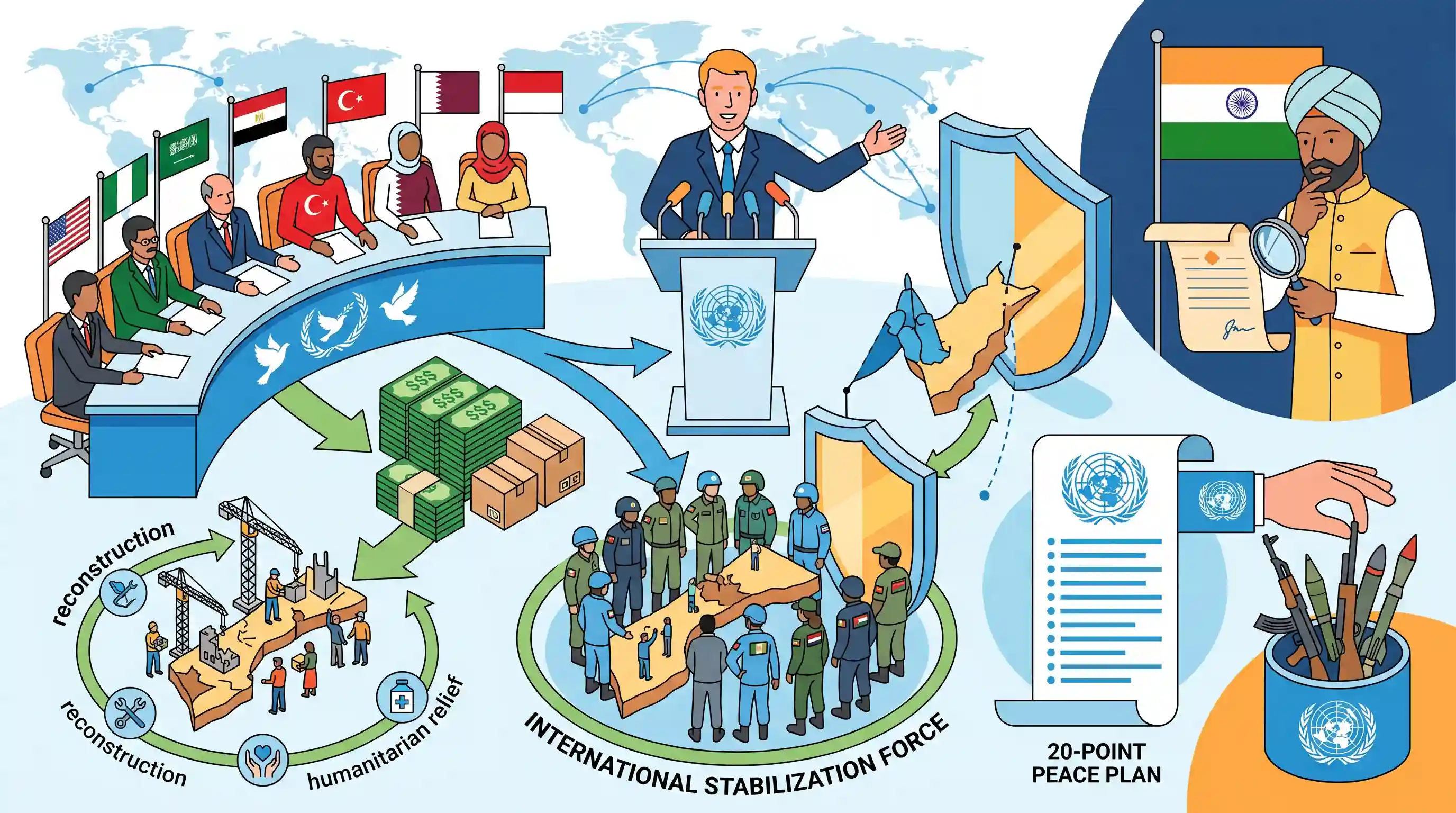
US President Donald Trump has announced that the newly formed 26-member 'Board of Peace' has pledged over $5 billion toward humanitarian relief and reconstruction in Gaza. The Board, which includes key nations like Saudi Arabia, Egypt, Turkey, Qatar, and Indonesia, will also supply thousands of personnel to an International Stabilization Force (ISF) to secure the territory. A 20-point peace plan, backed by the UN Security Council, calls for this ISF deployment and the demilitarization of Hamas. India, having received an invitation to join the Board, is currently reviewing its potential participation.
Key Points
- US President Donald Trump announced that member states of the newly established 'Board of Peace' pledged over $5 billion for Gaza's humanitarian relief and reconstruction.
- The Board has committed thousands of personnel to an International Stabilization Force (ISF) which will assume security responsibilities in Gaza.
- The 26-member Board includes major Middle Eastern and Islamic countries such as Egypt, Saudi Arabia, Turkey, Qatar, Pakistan, and Indonesia.
- India has been invited to join the Board of Peace and is currently reviewing the invitation.
- A 20-point peace plan for Gaza has been backed by the UN Security Council, involving the demilitarization of Hamas.
Important Terms
Board of Peace

A US-led multilateral body established in 2026 to oversee Gaza's reconstruction and governance, functioning as a transitional administration mandated by UNSC Resolution 2803.
UPSC context
GS Paper II (Multilateral groupings); tests understanding of new international architectures and India's role in West Asian stabilization.
International Stabilization Force (ISF)
A UN-mandated multinational peacekeeping force authorized to secure the Gaza Strip, oversee demilitarization, and facilitate the transition to local Palestinian police and governance.
UPSC context
GS Paper II (International security); examines UN-backed peacekeeping models and their effectiveness in complex regional conflict zones.
UNSC Resolution 2803
A 2025 UN Security Council resolution providing international legal authorization for the Gaza peace framework, the Board of Peace, and the deployment of stabilization forces.
UPSC context
GS Paper II (Important International Institutions); tests knowledge of UNSC mechanisms and their impact on regional geopolitics.
Hamas
The Palestinian militant organization in Gaza; under the 2026 peace framework, its complete demilitarization is a primary security objective for the International Stabilization Force.
UPSC context
GS Paper II (West Asia Geopolitics); essential for discussing terrorism, regional security, and postwar political transitions.
Observer Status
A diplomatic standing (held by India in the BoP) allowing participation in deliberations and monitoring without full membership, financial pledges, or military commitments.
UPSC context
GS Paper II (India’s Foreign Policy); highlights India's "Strategic Autonomy" and cautious engagement with US-led regional initiatives.
Prelims Trap
"The International Stabilization Force (ISF) is a traditional UN Peacekeeping Operation funded by assessed UN contributions."
While the 20-point plan is backed by the UNSC, the ISF is a coalition-led force funded by the 'Board of Peace' pledges, not a traditional UN 'Blue Helmet' operation.
Static Concepts Connected
How do UN Peacekeeping Operations differ from UN-backed Stabilization Forces?
- Command Structure: UNPKOs are under direct UN operational command (Blue Helmets), while stabilization forces often operate under a lead nation or coalition command with UNSC authorization.
- Funding Mechanism: UNPKOs use the UN's assessed peacekeeping budget. Ad-hoc stabilization forces rely on voluntary contributions from coalition members (like the $5B Board of Peace pledge).
- UN Charter Mandate: Stabilization/Multinational forces often operate under robust Chapter VII mandates (peace enforcement), whereas traditional peacekeeping heavily relies on Chapter VI (pacific settlement of disputes).
What is India's 'De-hyphenation' policy regarding West Asia?
- Independent Ties: Treating relations with Israel and Palestine as mutually independent and exclusive, rather than linking diplomatic engagement with one to the actions of the other.
- Strategic Autonomy: Engaging with competing regional poles (Arab states, Israel, Iran) simultaneously, moving from purely ideological non-alignment to pragmatic, issue-based partnerships.
Cross-Topic Patterns
India's expanding institutional footprint in West Asia
India's potential entry into the 'Board of Peace' complements its recent strategic and geoeconomic engagements in West Asia, such as the I2U2 grouping and the India-Middle East-Europe Economic Corridor (IMEC).
Rise of Middle Powers in regional security
The coalition relies heavily on Turkey, Saudi Arabia, Egypt, and Indonesia, reflecting a geopolitical shift away from sole US policing toward regional burden-sharing and middle-power diplomacy.

Expect a Prelims question distinguishing traditional UN Peacekeeping from UNSC-authorized multilateral coalitions like the Gaza ISF.
Linked PYQs · 3
Linked PYQs · 3
- 2018MainsGS2
“India’s relations with Israel have, of late, acquired a depth and diversity, which cannot be rolled back.” Discuss.
- 2025MainsGS2
"The reform process in the United Nations remains unresolved, because of the delicate imbalance of East and West and entanglement of the USA vs. Russo-Chinese alliance.” Examine and critically evaluate the East-West policy confrontations in this regard.
- 2024MainsGS2
‘Terrorism has become a significant threat to global peace and security.’ Evaluate the effectiveness of the United Nations Security Council's Counter Terrorism Committee (CTC) and its associated bodies in addressing and mitigating this threat at the international level.
