Bengaluru Ward Delimitation and Urban Local Government Governance
Source:The Hindu ↗
Why It Matters
Effective decentralization and local governance are pivotal for the administration of rapidly growing megacities. Flawed delimitation exercises can skew political representation, undermine the 74th Constitutional Amendment's goal of empowering Urban Local Bodies (ULBs), and lead to significant administrative and resource allocation challenges.
Summary
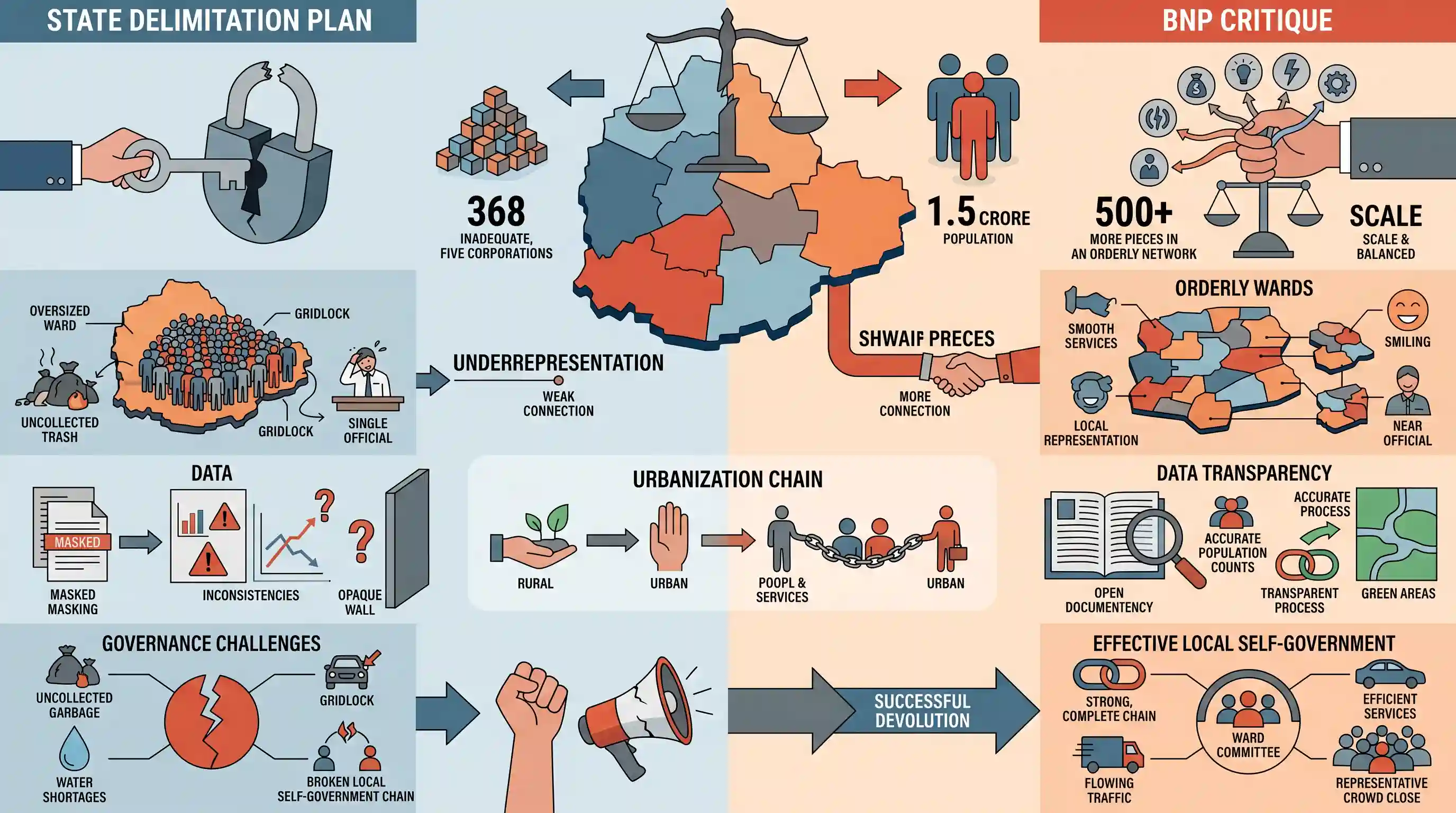
The Bengaluru Nava Nirmana Party (BNP) has heavily criticized the Karnataka State government's ward delimitation process following the division of the Bruhat Bengaluru Mahanagara Palike (BBMP) into five corporations under the Greater Bengaluru Authority (GBA). The BNP argues that capping the city at 368 wards results in excessively large and unmanageable administrative units for a population of 1.5 crore. Calling for at least 500 wards, the party also highlighted severe inconsistencies in population projection data and a lack of transparency in releasing voter counts. Ultimately, they warned that these inaccuracies could lead to the underrepresentation of rapidly growing regions and further exacerbate governance challenges in the metropolis.
Key Points
- The State government split the Bruhat Bengaluru Mahanagara Palike (BBMP) into five corporations under the newly-formed Greater Bengaluru Authority (GBA) to improve urban governance.
- The Bengaluru Nava Nirmana Party (BNP) criticized the ward delimitation process, claiming that capping the number of wards at 368 makes them unmanageably large for a city of 1.5 crore residents.
- The BNP advocates for at least 500 wards (approximately 30,000 residents and 20,000 voters per ward), a recommendation also made by the Brand Bengaluru Committee.
- The BNP alleged inconsistencies in the population projection data used for delimitation, pointing out that rapidly growing East Bengaluru was projected at lower growth rates than Central Bengaluru.
- The Greater Bengaluru Authority released boundaries for the 368 wards, distributed across the West (111), South (72), North (72), Central (63), and East (50) corporations.
Important Terms
74th Constitutional Amendment Act

Enacted in 1992, it granted constitutional status to Urban Local Bodies (ULBs), mandating three-tier structures, regular elections, and the devolution of eighteen functional powers to strengthen urban local self-government.
UPSC context
GS-II: Governance/Polity; tests decentralization framework and constitutional mandates for municipal administration.
Greater Bengaluru Authority (GBA)
An apex body established under the Greater Bengaluru Governance Act, 2024, to coordinate planning, infrastructure, and finances across multiple newly-formed municipal corporations in the Bengaluru metropolitan region.
UPSC context
GS-II: Local Self-Government; relevant for metropolitan governance reforms and integrated urban planning.
Bruhat Bengaluru Mahanagara Palike (BBMP)
The long-standing municipal corporation for Bengaluru city, currently being restructured into multiple smaller administrative units under the supervision of the Greater Bengaluru Authority.
UPSC context
GS-II: Urban Local Bodies; example of administrative restructuring and challenges in large-scale urban governance.
Delimitation
The process of redrawing boundaries for territorial constituencies, such as municipal wards, based on population data to ensure equitable representation and efficient administrative management.
UPSC context
GS-II: Polity/Elections; tests knowledge of electoral reforms, administrative boundaries, and demographic data importance.
Brand Bengaluru Committee
An expert panel tasked with suggesting reforms for Bengaluru’s governance, mobility, and infrastructure; it provided the framework for the Greater Bengaluru Governance Bill.
UPSC context
GS-II: Urban Governance; highlights the role of expert committees in shaping municipal policy and planning.
Ward Committee
The grassroots unit of urban local governance mandated for large cities, composed of elected councillors and citizens to ensure participatory planning and local accountability.
UPSC context
GS-II: Governance; tests understanding of the lowest tier of urban decentralization and community-led administration.
Prelims Trap
The Delimitation Commission of India oversees the delimitation of municipal wards in metropolitan cities.
Municipal ward delimitation is governed by State laws and conducted by State authorities or State Election Commissions (Article 243ZA), not the national Delimitation Commission.
Static Concepts Connected
What is the constitutional mandate for Metropolitan Planning Committees (MPCs)?
- Article 243ZE: Mandates the creation of an MPC in every metropolitan area with a population of 10 lakhs or more to draft a consolidated regional development plan.
- Democratic composition: At least two-thirds of members must be elected by and from amongst the elected members of municipalities and panchayat chairpersons in that metropolitan area.
- Functional overlap: The creation of overarching, State-controlled statutory authorities often creates jurisdictional overlaps and functionally undermines the constitutionally mandated MPCs.
Who is responsible for the delimitation of municipal wards?
- State jurisdiction: The delimitation of local body wards is governed by respective State municipal laws, not by Parliamentary acts.
- Authority responsible: It is typically overseen by State-appointed bodies or the State Election Commission under Article 243ZA, strictly excluding the Delimitation Commission of India (Article 82).
Cross-Topic Patterns
Parastatals vs. 74th Amendment
State-created statutory authorities (like the GBA) often bypass constitutionally mandated Metropolitan Planning Committees, centralizing urban governance and undermining the devolution envisaged by the 74th Amendment.
Peri-urban electoral malapportionment
Flawed demographic projections during delimitation cause rapidly expanding peri-urban areas to be politically underrepresented, directly worsening service delivery deficits for rural-urban migrants.

Prelims 2026 may test the jurisdictional difference between the Delimitation Commission (Art 82) and State Election Commissions (Art 243ZA).
Linked PYQs · 3
Linked PYQs · 3
- 2024MainsGS2
Analyse the role of local bodies in providing good governance at local level and bring out the pros and cons merging the rural local bodies with the urban local bodies.
- 2023MainsGS2
“The states in India seem reluctant to empower urban local bodies both functionally as well as financially.” Comment.
- 2022MainsGS2
To what extent, in your opinion, has the decentralisation of power in India changed the governance landscape at the grassroots?
