Urban infrastructure development and land use conflict in Mumbai
Source:Indian Express ↗
Why It Matters
The article demonstrates the real-world complexities of urban governance, specifically the conflict between providing essential environmental infrastructure (sewage treatment, stormwater management, and water security) and addressing the housing needs of the urban poor (slum rehabilitation). It provides a concrete case study for GS-1 (Urbanization issues), GS-2 (Governance), and GS-3 (Infrastructure and Disaster Management).
Summary
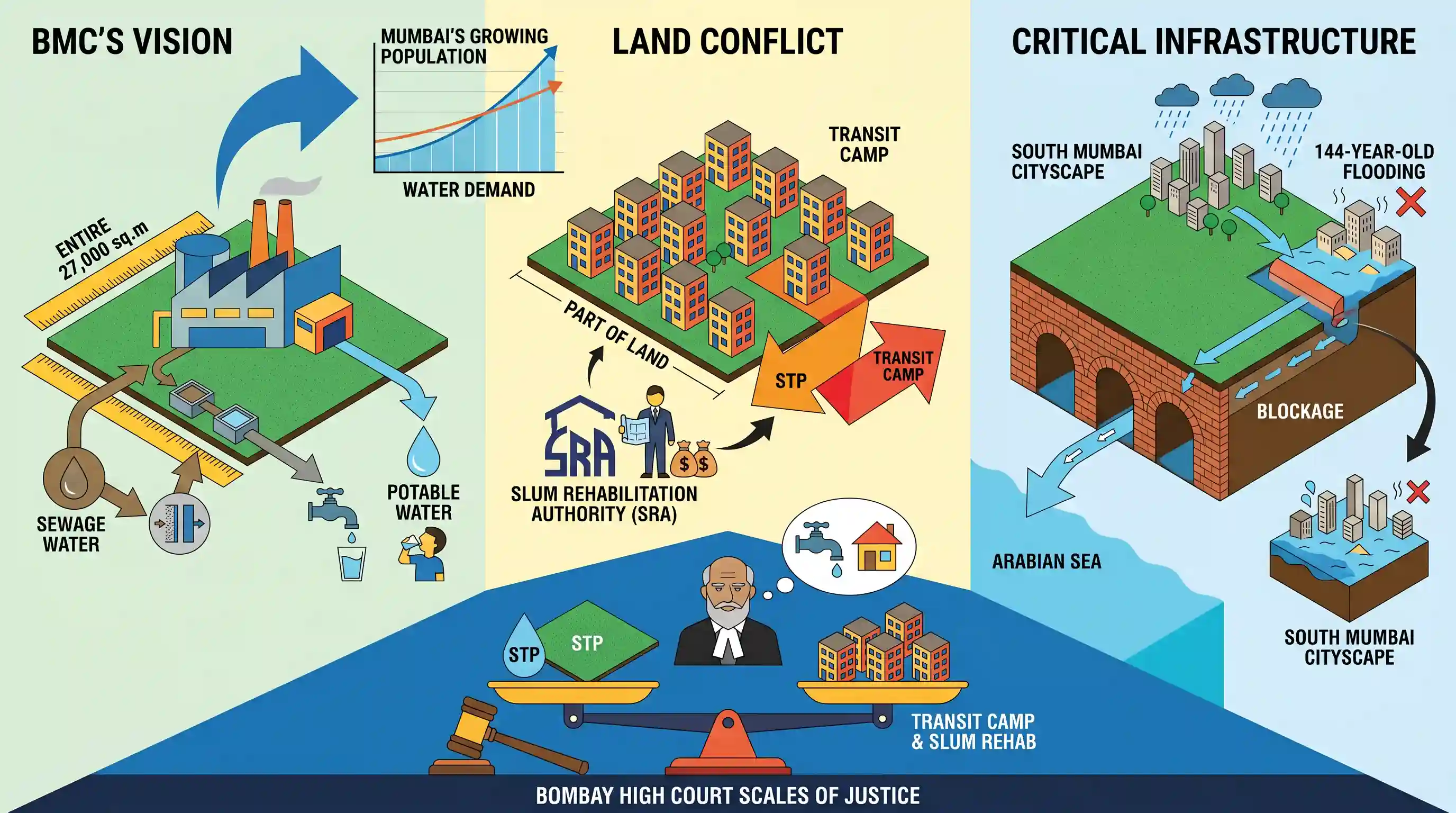
The Brihanmumbai Municipal Corporation (BMC) has asserted before the Bombay High Court that it requires an entire 27,000 sq.m plot in Worli to construct a crucial Sewage Treatment Plant (STP). The BMC envisions upgrading the facility to treat sewage to potable water standards to accommodate Mumbai's growing population. However, the land is embroiled in a conflict because the Slum Rehabilitation Authority (SRA) and a developer planned a transit camp on part of it. The plot also houses a 144-year-old British-era stormwater and sewage drain system essential for averting urban flooding in south Mumbai. The court is now tasked with balancing critical urban environmental infrastructure against housing and slum rehabilitation.
Key Points
- The Brihanmumbai Municipal Corporation (BMC) informed the Bombay High Court that it needs the entire 27,000 sq.m of land in Worli for a modern Sewage Treatment Plant (STP) to meet the needs of Mumbai's growing population.
- The BMC aims to treat sewage to potable water standards in the future to address freshwater shortages.
- The site is home to 144-year-old British-era sewage and stormwater trunk lines, which are crucial for preventing urban flooding in south Mumbai.
- A land-use conflict has emerged as the Slum Rehabilitation Authority (SRA) and a private developer were previously allowed to build a transit camp on a portion of the same land.
- The Bombay High Court is examining the issue, weighing the critical public infrastructure requirement for water and sewage management against slum rehabilitation demands.
Important Terms
Brihanmumbai Municipal Corporation (BMC)

One of India's richest local self-government bodies, responsible for Mumbai's civic infrastructure and administration under the Maharashtra Municipal Corporation Act.
UPSC context
Relevant for GS-II (Local Governance) and GS-III (Urban Infrastructure). It tests knowledge of urban local bodies (ULBs) and their service delivery roles.
Slum Rehabilitation Authority (SRA)
A statutory body in Maharashtra created to implement slum redevelopment schemes by using land as a resource and providing free housing to eligible slum dwellers.
UPSC context
Important for GS-I (Urbanization) and GS-II (Welfare Schemes). It represents the 'Land as a Resource' model for urban poverty alleviation.
National Green Tribunal (NGT)
A specialized statutory body established under the NGT Act (2010) for the effective and expeditious disposal of cases relating to environmental protection and conservation.
UPSC context
A core GS-II (Statutory Bodies) and GS-III (Environment) topic. It tests the judiciary’s role in balancing development and ecological protection.
Sewage Treatment Plant (STP)
Infrastructure designed to remove contaminants from wastewater, involving physical, chemical, and biological processes to meet environmental discharge standards or potable reuse requirements.
UPSC context
Crucial for GS-III (Environment & Infrastructure). It links to the Jal Jeevan Mission, AMRUT, and urban water management challenges.
Urban Flooding
Inundation of property in a built-up environment, often caused by heavy rainfall overwhelming aging or inadequate drainage systems (like Mumbai's British-era network).
UPSC context
A recurring GS-III (Disaster Management) theme. It tests understanding of climate change adaptation and the failure of urban planning.
Bombay High Court
One of India's oldest High Courts with jurisdiction over Maharashtra and Goa; it often adjudicates disputes between public interest infrastructure and private development rights.
UPSC context
Relevant for GS-II (Judiciary). It highlights the court's role in Public Interest Litigation (PIL) and administrative law regarding land use.
Prelims Trap
Treated municipal wastewater from STPs in India is legally restricted to non-potable agricultural or industrial uses.
Megacities are actively upgrading STPs to treat sewage to potable water standards to combat acute freshwater shortages, extending beyond mere industrial reuse.
Static Concepts Connected
What is the role of Floor Space Index (FSI) in slum rehabilitation?
- Definition: The ratio of a building's total constructed floor area to the size of the land plot it is built upon.
- Regulatory Tool: Used by municipal bodies to control urban population density, skyline, and pressure on civic amenities.
- Incentive FSI: Additional built-up area granted to private developers to cross-subsidize and recover the costs of building free in-situ housing for slum dwellers.
What are the core structural causes of urban flooding in Indian megacities?
- Outdated Infrastructure: Heavy reliance on 19th-century colonial-era stormwater and sewage networks designed for drastically smaller populations and lower surface runoff volumes.
- Concretization: Loss of natural wetlands, mangroves, and permeable soil surfaces significantly reduces natural drainage and groundwater infiltration capacity.
- Drain Clogging: Poor municipal solid waste management and illegal dumping of construction debris frequently choke the existing drainage networks during monsoons.
Cross-Topic Patterns
Carrying Capacity vs. Densification
The BMC-SRA land clash illustrates the trade-off between increasing population density through vertical slum rehabilitation and the hard limits of urban environmental infrastructure like STPs.
Circular Economy in Urban Water
Upgrading municipal STPs to achieve potable water standards aligns perfectly with circular economy principles and the AMRUT mission's thrust on wastewater recycling in megacities.

Expect a GS3 Mains question examining governance paralysis caused by overlapping jurisdictions of parastatals and ULBs in megacities.
Linked PYQs · 3
Linked PYQs · 3
- 2024MainsGS3
Flooding in urban areas is an emerging climate-induced disaster. Discuss the causes of this disaster. Mention the features of two such major floods in the last two decades in India. Describe the policies and frameworks in India that aim at tackling such floods.
- 2024MainsGS3
The world is facing an acute shortage of clean and safe freshwater. What are the alternative technologies which can solve this crisis? Briefly discuss any three such technologies citing their key merits and demerits.
- 2021MainsGS1
What are the environmental implications of the reclamation of water bodies into urban land use ? Explain with examples.
