Mumbai Municipal Corporation Waste Rules And Event User Fee Policy
Source:Indian Express ↗
Why It Matters
Understanding municipal initiatives like BMC's waste rules for large events is crucial for understanding urban local governance, sanitation policies, and implementation of environmental rules in Maharashtra.
Summary
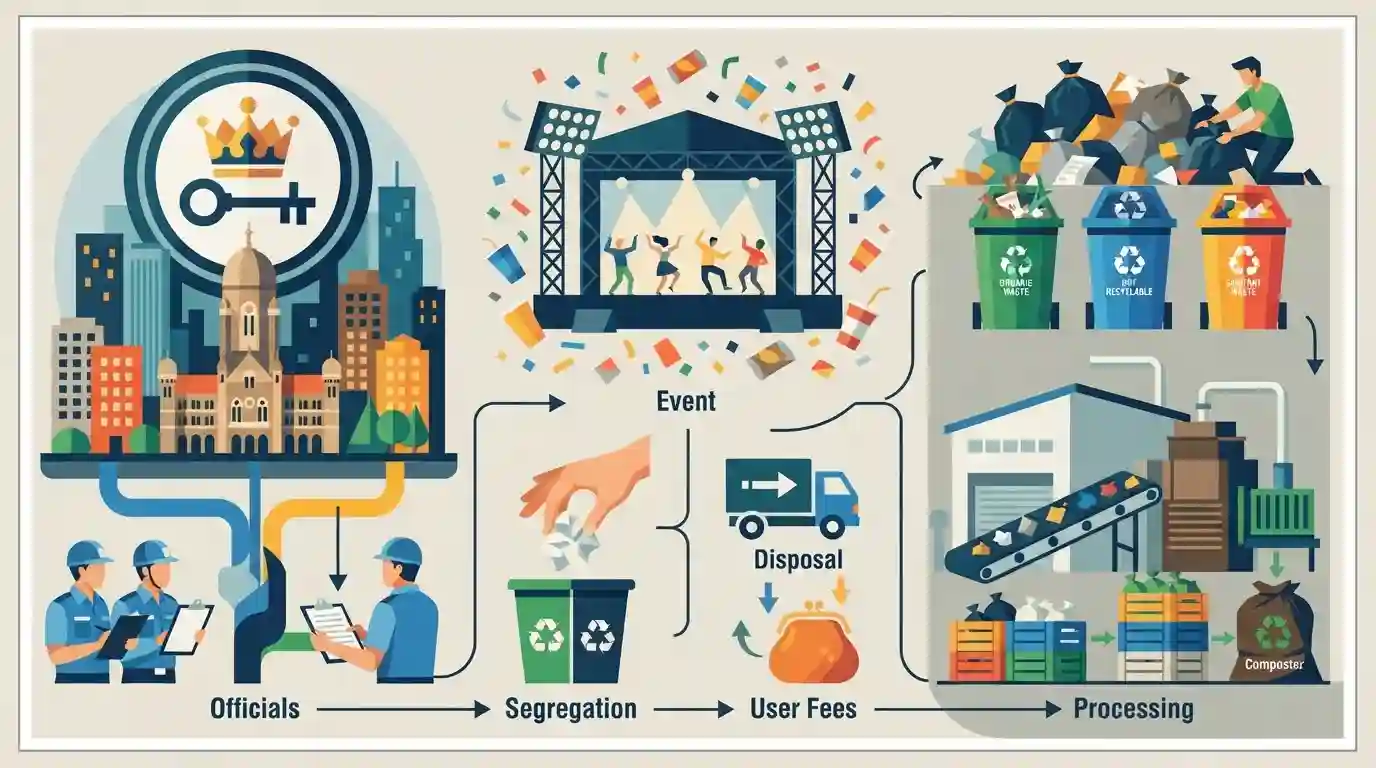
The Brihanmumbai Municipal Corporation (BMC) has proposed stricter waste management regulations and user fees for large-scale events in Mumbai to combat mounting garbage and enforce proper segregation and disposal by event organizers.
Key Points
- The Brihanmumbai Municipal Corporation (BMC) is planning stricter waste management rules and user fees for large events and gatherings in Mumbai.
- The initiative aims to curb mounting municipal solid waste, enforce source segregation, and hold event organizers accountable for waste processing and disposal.
- This highlights the role of urban local bodies (ULBs) in implementing localized environmental bylaws and sustainable civic governance.
Important Terms
Solid Waste Management Rules

National guidelines governing waste collection, source segregation, processing, and disposal across urban and rural local bodies in India.
UPSC context
MPSC Paper II / Environment & Urban Governance: Evaluates policies on municipal solid waste disposal, segregation mandates, and pollution control.
Brihanmumbai Municipal Corporation (BMC)
The apex civic governing body responsible for the civic administration, public health, sanitation, and municipal infrastructure of Mumbai.
UPSC context
MPSC Paper I / Maharashtra Administration: Crucial for testing local self-government structures, municipal finances, and urban service delivery in the state.
Prelims Trap
Central Ministry of Environment formulates direct bylaws and user fees for municipal events in Mumbai.
Aspirants often assume central government ministries directly formulate and fine local event bylaws, ignoring that ULBs hold autonomous rulemaking powers under state municipal acts.
Static Concepts Connected
What are the constitutional provisions and functional items under the 74th Constitutional Amendment Act relating to urban governance?
- Constitutional Basis: Article 243W empowers State Legislatures to endow Municipalities with powers and responsibilities regarding matters listed in the Twelfth Schedule.
- Twelfth Schedule: Twelfth Schedule contains 18 functional items, explicitly including public health, sanitation, conservancy, and solid waste management.
- Financial Powers: Municipal corporations possess powers to levy taxes, duties, tolls, and user fees as authorized by respective state municipal legislation.
Cross-Topic Patterns
ULBs and Decentralised Environmental Governance
Municipal solid waste rules intersect with Article 243W and Twelfth Schedule functions of urban local bodies in Indian federal governance.
Polluter-Pays Principle in Local Taxation
Imposing user fees for large events connects municipal revenue generation with the polluter-pays principle in environmental law.

Expect a multi-statement question on BMC waste rules, municipal taxation powers under 74th Amendment, and Solid Waste Management Rules.
Linked PYQs · 2
Linked PYQs · 2
- 2021MPSC_PRELIMSGS1
The Mumbai Metropolitan Region spread over 6,328 sq.km. consists of ________ Municipal Corporations.
- 2025MPSC_PRELIMSGS1
As per the Hazardous Waste (Management, Handling and Transboundary Movement) Rules, 2008, the ________ shall be the nodal Ministry to deal with the transboundary movement of the hazardous wastes and to grant permission for transit of the hazardous wastes through any part of India.
